Future of driving takes an unexpected turn, as gas cars get a new boost
The E.U. is retreating from its landmark pledge to impose a ban on new gas-powered cars in 2035, and Ford is pulling back from EV production.
BRUSSELS — The gasoline-powered car is outlasting the policies that had aimed to banish it.
The latest example of the combustion engine’s staying power came Tuesday, when the European Union said it would back away from a landmark pledge to ban emissions from new vehicles in 2035. That announcement came one day after Ford said it would scale back electric vehicle production plans, joining a long list of American and European automakers to rethink climate strategies.
Those retreats, taken together, show that the full-on electric transition is far less certain than it might have looked several years ago — and that polluting cars and trucks could remain on roads across Europe and America for decades to come. The moves also sharpen the contrast between the West and China, which has developed a massive and lucrative EV market supplied by state-backed automakers.
In the United States, where President Donald Trump has portrayed electric cars as an expensive “scam,” the White House has cut EV incentives and this month announced plans to weaken fuel efficiency standards for new cars and trucks.
European officials say they favor a future that is mostly electric, and many countries still have EV incentives in place. But Brussels faced intense pressure from the continent’s automakers to dilute the 2035 ban. Those legacy carmakers, with huge workforces and factories built around combustion engines, have struggled to compete with China’s low-cost, high-quality EVs.
The revised proposal will force carmakers to meet 90% fleetwide emissions reductions compared with 2021 levels. That means most vehicles will be fully electric. But it also leaves room for hybrids — including those with a plug-in option — and gas-powered vehicles.
Ferdinand Dudenhöffer, the director of the Center Automotive Research in Bochum, Germany, said he sees the world’s auto industry splitting into three parts — one in the United States, fully supportive of gas cars; one in China, all in on EVs; and another in Europe, where policies are now muddled. He said Chinese automakers are likely to benefit most from that dynamic because the Chinese market dwarfs those in the U.S. and Europe and looks to keep growing — and electrifying.
American and European markets have had a hard time splitting from the gas-powered vehicles because combustion engines have higher profit margins. But that strategy leaves them in a long-term bind.
“In the future, China will define the rules of the car industry,” Dudenhöffer said.
With a license to keep producing gas vehicles, he said, Western manufacturers “earn some kind of short-term windfall. But in the long term, they lose a lot. The advantages of the Chinese carmakers will be larger and larger.”
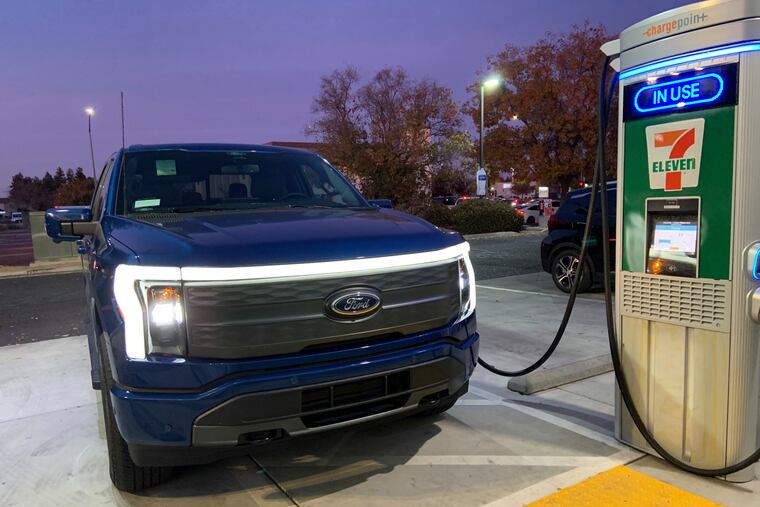
Ford, in its announcement, said it was seeking out “higher-return opportunities” by expanding gas and hybrid options. It said it would produce a gas-powered pickup truck at a Tennessee plant while putting a hold on production of its flagship EV, the F-150 Lightning.
Carmakers such as Volvo and Porsche have also pulled back from more ambitious EV plans. Earlier this year, Stellantis, which includes the Jeep and Fiat brands, shifted away from plans to be fully electric in Europe by 2030.
The gas vehicle ban had been a core component of Europe’s much-heralded climate plan, introduced four years ago as officials cited the “generational task” of saving the planet. At the time, E.U. leaders said they had put the continent’s car industry — which accounts for 7% of Europe’s gross domestic product — at the forefront of innovation by creating a clear future target.
But large automakers — including Mercedes-Benz, Volkswagen, and BMW — have seen their market values nosedive. In a strategic error, the EVs they produced tended to be high-end, not for the mass market. In the meantime, leaders in Germany and Italy described the 2035 target as a danger to European jobs.
“Such a hard cutoff in 2035 will not take place, if I have anything to do with it,” German Chancellor Friedrich Merz had said.