Fed chair Warsh, concerned about inflation, says bank ‘has more work to do’
In a much-anticipated speech, Kevin Warsh also doubled down on his controversial strategy of providing investors less explicit “forward guidance” about when the Fed would raise interest rates.
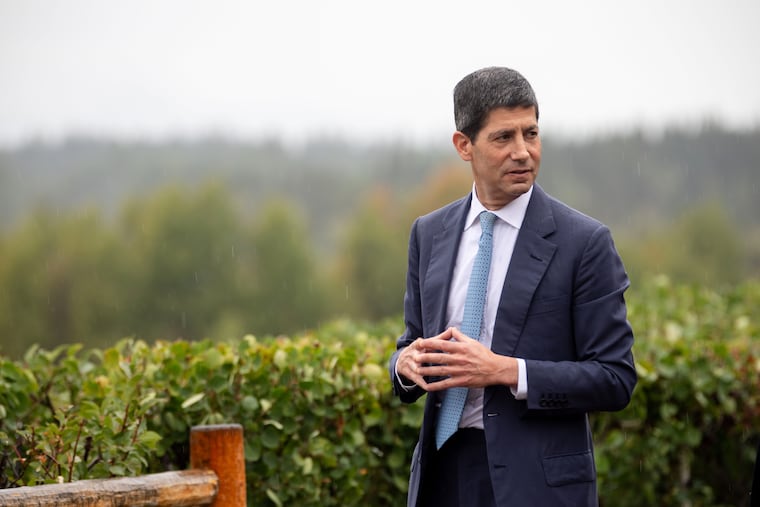
JACKSON HOLE, Wyo. — Federal Reserve Chair Kevin Warsh said he was “impressed” with the economy’s overall strength but is concerned by signs that “underlying trends” in inflation have not improved.
Warsh, 56, making his first appearance here as Fed chair, described his approach to helming the economy in a bid to answer critics who complain that his limited public comments have left the markets confused about the central bank’s intentions.
Speaking in a rustic lodge beneath elk antler chandeliers, Warsh hailed developments in artificial intelligence as a “hinge point in history” that offered the “potential for substantially higher growth.” But that long-term promise is eclipsed for now by the need to vanquish inflation, he said.
“The Fed’s predominant focus right now should be on prices,” Warsh said. “We must be confident that underlying inflation is moving to our objective, clearly and at sufficient speed. Otherwise, we have work to do.”
Warsh endorsed the Fed’s traditional inflation goal of an annual 2% rise in prices, according to the personal consumption expenditures index (PCE), calling it “a firm fixed target.”
Over the past six months, almost half of the individual product prices that the Fed tracks have increased at an annual rate of more than 3%. That share is down from the pandemic high point but “is still quite elevated,” Warsh said.
The central bank chief also responded to critics who questioned his inflation-fighting plan by saying the Fed’s control over short-term interest rates remained “the predominant tool” to achieve its goals.
But Warsh doubled down on his controversial strategy of providing investors less explicit “forward guidance” about future Fed moves. “A quieter Fed,” he said, will be better able to steer the economy to stable prices and full employment.
“Transparency in communications about future policy decisions is not a virtue unto itself. Communications must be in service to the Fed’s paramount responsibility: getting monetary policy right,” Warsh said.
In a nod perhaps to the populist president who appointed him to his job, Warsh said “hardworking Americans,” not “financial highfliers,” are suffering the most from the Fed’s failure in recent years to bring inflation under control.
Since taking over from his predecessor, Jerome H. Powell, Warsh has been unsparing in his criticism of the Fed for failing to control inflation, which has been elevated for more than five years, since the COVID pandemic.
On Friday, U.S. markets were mostly flat as all eyes turned to the Jackson Hole event, which is hosted by the Federal Reserve Bank of Kansas City and draws global central bankers, economists, and journalists to Wyoming’s spectacular Grand Tetons.
Warsh’s remarks were among the most highly anticipated by any Fed chair at the central bank’s annual late-summer conference. Investors were eager for any hint of his thinking on the need for the Fed to raise short-term interest rates to tame persistent inflation, and it was not immediately clear whether Warsh’s defense of a “quieter Fed” satisfied that desire.
The chair faces a daunting landscape. He leads a divided Fed with at least three members of its rate-setting committee on record supporting an increase in interest rates to slow rising prices. Long-term bond yields have ticked higher this month amid concerns over the nation’s $40 trillion gross public debt. And Treasury Secretary Scott Bessent has intervened in financial markets in a way that some analysts say could conflict with Warsh’s goals.
While managing those immediate concerns, Warsh seeks to pilot the economy through an era of epic change. The rules-based global order constructed at the end of World War II is breaking down as the United States and other nations seek greater self-sufficiency. And a disruptive new technology, artificial intelligence, is reshaping markets and economies at a rapid clip.
Since taking command of the Fed in late May, Warsh has disappointed some investors by refusing to provide the routine guidance that his predecessors offered for nearly two decades about the Fed’s next moves.
After his tight-lipped news conference late last month, analysts at investment banks including JPMorgan said Warsh’s refusal to elaborate on how he planned to fight inflation raised doubts about whether he was willing to raise short-term borrowing costs to do so. Those concerns were amplified by President Donald Trump’s vocal insistence that rates should move down, not up, under the new Fed chair.
But Warsh has signaled his determination to force investors to make their own decisions independent of expectations about moves by the nation’s central bank.
While numerous market watchers have complained about Warsh’s public reticence, there is little sign in financial markets of concern. Inflation expectations are little changed since the day he was sworn in as Fed chair. Volatility in stock and bond trading also has remained within normal ranges, according to standard market measures.
Recent economic data suggesting an improved outlook for the economy may explain part of the recent uptick in bond yields. While the economy grew at an unremarkable annual rate of 1.5% in the second quarter, underlying measures of activity were far stronger, according to a Commerce Department update this week.
Final sales to private domestic purchasers, which some economists consider a better gauge of the economy’s condition, rose by an updated 4.2% compared with an initial estimate of 3.9%, the Commerce Department said. Both consumer spending and business investment are keeping the economy aloft.
A separate report showed that inflation remained elevated in July, with the Fed’s preferred gauge up 3.7% from the same month one year ago. That pace was unchanged from June, but it remained well above the Fed’s 2% target.
At its last meeting in July, the Fed policymaking committee left short-term interest rates unchanged. But three voting members of the Federal Open Market Committee dissented from the 9-person majority that favored keeping rates in the current 3.5% to 3.75% range.
Investors believe there is a roughly a 60% chance that the central bank will again stand pat at its Sept. 15-16 meeting, according to CME FedWatch, which tracks futures market activity.
Bessent’s recent intervention in the government bond market also has raised questions about whether he and Warsh differ in their view of markets. Warsh wants the Fed to speak less so the market can deliver an unfiltered verdict on the economy. Bessent, however, has intervened in financial markets twice in recent weeks, in a bid to halt an increase in long-term bond yields, saying market prices for long-term Treasurys were “out of whack.”