As Trump demands lower interest rates, what should the Fed do?
Amid a softening job market, tariffs, and inflation, cutting rates could be counterproductive, writes economist Joel Naroff.
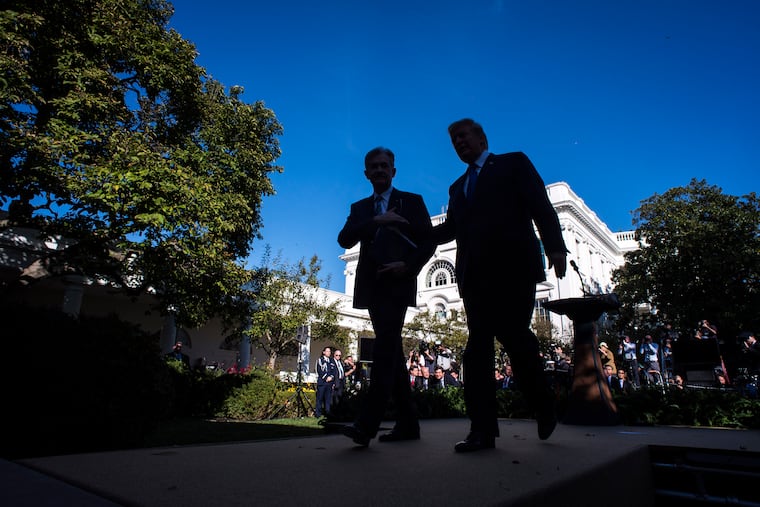
President Donald Trump is demanding the Federal Reserve lower interest rates significantly.
To get that done, he is attempting to take control of the Fed. He may soon get his wish, but his actions could be counterproductive.
The softening job market may not be fixed by rate cuts
That job growth is softening is not an argument. Why it is moderating is a subject for debate.
Many economists believe the slowdown is largely due to uncertainty over the impacts of tariffs, as well as the transition to AI.
Expectations play a major role in business hiring and investment decisions, as well as consumer spending on big-ticket items and even necessities.
Put simply, if you feel good about the future, you buy, hire, or invest more. If you are worried about the future, you hunker down.
And if you are uncertain, you generally stand pat.
Significant uncertainty over the impact of tariffs on the economy seems to be a major factor driving business hiring decisions.
When we look at the so-called weakness in the labor market, we see modest job gains but no major problems. Job openings are falling, but layoffs are not rising significantly.
That points to firms watching and waiting until they understand where the economy is going.
A second explanation for the sluggish hiring is the rapidly spreading use of AI. This is diminishing the need for workers, which is what AI is supposed to do.
To improve job growth, it’s critical to resolve the uncertainty over the impacts of tariffs on economic growth and prices. But we may have to accept that — at least during this AI transition period — firms will not be hiring robustly.
Would cutting rates help or backfire?
The alternative view is that high interest rates are the cause of our economic ills, and that if we cut rates sharply, growth would boom.
That’s doubtful.
The Fed has a dual mandate: maximum employment and stable prices.
Full employment is not 0% unemployment.
For those who are unemployed — because they’ve lost a job, just entered the labor force, have outdated skill sets, or for many other reasons — it takes time to find a new job. That friction in the labor market means there will always be people unemployed.
Economists define full employment as the lowest rate where there are enough workers to meet growing demand without triggering wage inflation. That is generally viewed as roughly 4.25%.
The current national unemployment rate is 4.3%, or full employment.
At full employment, a rate cut that increases growth could put pressure on labor costs and prices, which brings us to the second part of the dual mandate: stable inflation.
Stable inflation is not zero inflation
If inflation is 0% and the economy weakens, prices could start declining. In a deflationary environment, consumers and businesses stop buying. By waiting, they can get things later at a lower price.
The result is a downward spiraling economy that is difficult to fix.
Conversely, when prices rise too rapidly, consumers and businesses rush out to purchase goods and services to beat the price increases. That accelerates demand and inflation.
The Fed considers 2% to be the level where consumers and businesses don’t make decisions based on inflation expectations. Since inflation has averaged 2.5% this year, well above the Fed’s target, it is logical for the Fed to keep rates high.
And this is where tariffs come in. They present a risk of even higher inflation.
The impact of tariffs on inflation may not be a one-shot deal
Those who support lower interest rates argue that tariffs will impact prices for only a short time.
Economists like to simplify things so they can model policy decisions. In this case, the argument is that to the extent that tariffs are passed through to consumers, it will happen almost immediately and then disappear.
Under certain circumstances, that is possible. But these are not normal times, and that assumption makes little sense.
First, the tariff increases are significantly larger than the previous levels. Businesses will not likely risk dramatically reducing sales if they immediately pass through the huge tariff cost increases.
The second constraining factor is the nature of the current president. Businesses fear retribution if they quickly and significantly hike prices, especially if they blame tariffs. The better part of business valor is to start slowly and then moderately expand the cost pass-throughs.
It would not be surprising if it takes two to three years before businesses fully embed the tariffs in their prices.
If inflation in the 2.5% to 3% range persists over the next few years, it could become the perceived norm, leading to an even longer period of high inflation.
Finally, there is the question of whether a Fed rate cut would actually increase economic growth.
The Fed only affects short-term rates. If cutting rates increases inflation fears, longer-term rates on loans for vehicles, houses, or business capital expenditures might actually rise. That would slow growth.
A president controlling the Fed is a disaster waiting to happen
Another reason to question the effectiveness of rate cuts in growing the economy is the president’s drive to politicize the Fed.
The effectiveness of any nation’s Central Bank, such as the Fed, is that its actions are perceived as being based strictly on economic concerns, not political ones.
How many times have you heard a president plead for the Fed to raise rates?
Exactly zero.
No president ever wants higher interest rates. But sometimes, the Fed has to raise rates and keep them high to fight inflation.
The fear is that a politicized Fed will not fight inflation wholeheartedly. That would raise inflation expectations, and longer-term rates would rise, again slowing growth.
What should the Fed do?
The Fed is likely to cut rates on Sept. 17.
Should it? Not necessarily.
Reducing short-term rates will not lower the tariff price increase threat, address the issue of uncertainty, reduce the impact of AI on job growth, or necessarily increase growth. Instead, a sharp rate cut could raise concerns that the Fed is now politicized.
If the Fed does cut, hopefully it will do so cautiously.