James Murdoch, intent on ‘thoughtful journalism,’ buys half of Vox Media
The deal includes Vox Media’s podcast network as well as New York magazine, a publication once owned by Murdoch’s father.
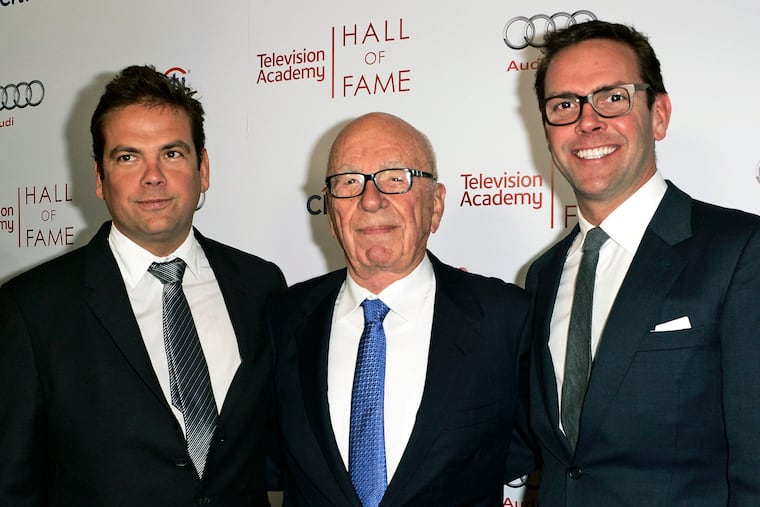
James Murdoch is acquiring roughly half of Vox Media, a dramatic expansion in American media for the younger son of media mogul Rupert Murdoch.
The deal includes Vox Media’s podcast network as well as New York magazine, a publication once owned by Murdoch’s father.
Murdoch, 53, emphasized that he was not looking to acquire a “daily news business” but rather wanted “longer-form, thoughtful journalism that can really speak to the culture,” he told The New York Times in an interview Tuesday. “We want to create platforms where really amazing, talented people can come and do the best work of their lives.”
The deal is the biggest acquisition for Murdoch since he and his family struck a $3.3 billion agreement last year to resolve a painful battle over the control of its media empire, which includes Fox News and News Corp., the parent company of The Wall Street Journal.
Murdoch left the board of News Corp. in 2020 amid disagreement over the company’s direction and spoke out against the “ongoing denial” of climate change at some of its outlets. So is he trying to do something deliberately different from his father this time around?
“No,” said Murdoch, who is buying the Vox Media properties through his company, Lupa Systems. “I’m just trying to build a great business.” He said his father’s previous ownership of New York magazine held no special significance for him.
The deal is also a coda for an earlier era of digital publishing. Vox Media was one of a spate of digital properties, including BuzzFeed and Vice Media, that raised hundreds of millions of dollars at sky-high valuations a decade ago. But Vice has since gone bankrupt; BuzzFeed recently said it was selling a 52% stake for $120 million, a small fraction of its earlier $1.7 billion valuation. Vox Media was reportedly worth about $1 billion in 2015, when it mostly encompassed websites — not a robust podcast network nor a print magazine.
Lupa Systems declined to disclose the price of its Vox Media deal, but people familiar with the matter said it was more than $300 million. It is expected to close in the coming weeks.
The new Vox Media will operate as a subsidiary within Lupa Systems — but will, ideally, according to Murdoch, also collaborate with other companies backed by Lupa Systems. Those include the parent company of Tribeca Film Festival; the owner of Art Basel; and Bodhi Tree Systems, which backs a popular streaming service in India. Murdoch and his wife, Kathryn, have separately backed news startups such as The Bulwark and The 19th.
Vox.com, an explanatory journalism outfit founded in 2014 by Ezra Klein, Matt Yglesias and Melissa Bell, is also included in the sale.
But several other websites owned by Vox Media, including The Verge and Eater, are not. They will continue operating under a new independent company, still unnamed, and will be overseen by the company’s president, Ryan Pauley.
Sitting beside Murdoch in Lupa Systems’ sun-splashed downtown Manhattan office in New York City, Jim Bankoff, the CEO of Vox Media, said he “wanted a long-term steward” who cared about innovation but also “quality and ethics in journalism.” He also opted to stay with the half of Vox Media devoted to “multimedia talent,” now under Lupa Systems.
“As the present CEO, and the person who cares about it all, and was the architect of it all, I would say that I couldn’t be more excited for both halves,” he said.
Bankoff said he was proud of his company’s ability to endure and grow despite technological, cultural and financial challenges like the “decimation of search traffic.” For many publishers, declines in search traffic — a result of the rise of summaries generated by artificial intelligence — have taken a wrecking ball to digital advertising revenue.
“We didn’t just stand still and complain about that, although we have every reason to complain,” said Bankoff, who co-founded Vox Media in 2011. “We innovated, and we built creator-led businesses with the podcast network,” which then yielded new advertising opportunities. Podcasts generated more than $80 million in revenue for the company in 2025.
Vox Media has taken a thoughtful and disciplined approach to podcasts, both in content and in business development. Its roster has nearly 50 shows, including “Pivot” with Kara Swisher and Scott Galloway; “Today, Explained”; and podcasts hosted by academics, therapists and athletes.
Conversations between Bankoff and Murdoch began last year after Vox Media received an offer for its podcast network from another suitor, the pair said. While Bankoff decided not to pursue that deal, it led to negotiations with Murdoch, whom he had met decades earlier.
The talks accelerated when Lupa Systems concluded that New York magazine and the podcast network were the two assets that “fit together,” Murdoch said. He eventually asked Bankoff to “hurry up” his decision-making for the potential sale of the magazine.
Murdoch has had a front-row seat through the perils and promise of digital media, having led 21st Century Fox’s investment in Vice Media and having helped build Star, the Indian streaming service that was sold to Disney as part of its acquisition of 21st Century Fox. For Lupa Systems, he is putting an emphasis on quality and experiences that do not rely on the “mechanization of advertising,” which he said encouraged the creation of shallow media.
In a landscape inundated with AI “slop” and “packaged media,” he believes that audiences find podcasts more “authentic.”
“It’s fun, it’s differentiated, and it has scarcity value,” Murdoch said, describing the kind of company he’s building.
This article originally appeared in The New York Times.