Labor unions mobilize to challenge advance of algorithms in workplaces
The AFL-CIO and other labor groups are working with state legislators across the nation to develop AI regulations designed to protect workers.
As employers and tech companies rush to deploy artificial intelligence software into workplaces to improve efficiency, labor unions are stepping up work with state lawmakers across the nation to restrict its use.
The renewed drive to regulate AI could change how workers are exposed to AI in their jobs and complicate industry plans to roll out technology such as robotaxis or tools that track individuals’ productivity. It comes after the Senate killed a proposed federal moratorium that would have banned states from regulating AI for the next 10 years.
In Massachusetts, the Teamsters labor union is backing a proposed state law that would require autonomous vehicles to have a human safety operator who can intervene during the ride, effectively forbidding truly driverless rides. Oregon lawmakers recently passed a bill supported by the Oregon Nurses Association that prohibits AI from using the title nurse or any associated abbreviations. The American Federation of Labor and Congress of Industrial Organizations, a federation of 63 national and international labor unions, launched a national task force last month to work with state lawmakers on more laws that regulate automation and AI affecting workers.
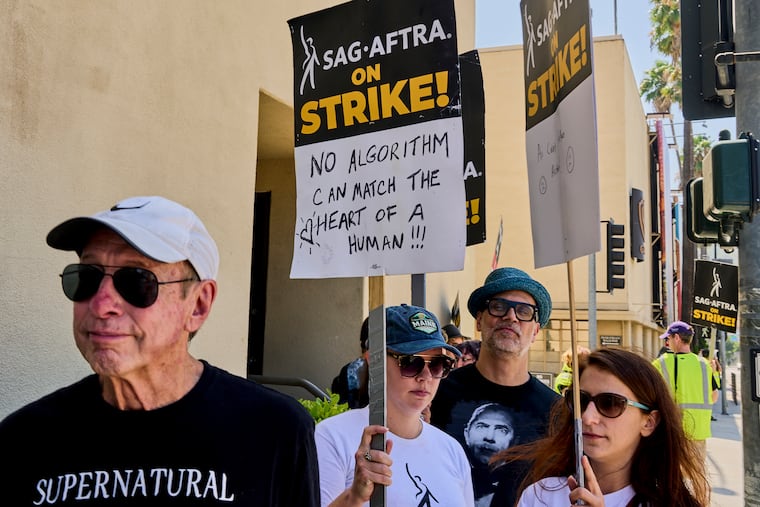
Union leaders say they must intervene to protect workers from the potential for AI to cause massive job displacement or infringe on employment rights. The technology has already become a sticking point in some labor disputes, such as the Hollywood writers strikes in 2023.
In February, Gallup found that one-third of workers in the United States feared AI would lead to fewer job opportunities. AI proponents and some economists argue that in the past, technologies that have disrupted some careers also created many new jobs.
Lorena Gonzalez, co-chair of the new AFL-CIO task force on AI, said last week that AI was set to become a defining issue for the labor movement, similar to the impact in the 1990s of the North American Free Trade Agreement, which created a free-trade zone in North America and drove major changes in U.S. employment including the outsourcing of manufacturing jobs to Mexico.
“We cannot allow AI and technology to be our next NAFTA,” she said on an episode of the podcast Power at Work released Tuesday by the Burnes Center for Social Change at Northeastern University. “It is up to us to determine what kind of society we want to live in and what kind of regulations we live around that protect us.”
President Donald Trump has rolled back AI rules introduced by President Joe Biden and made clear he wants to give the tech industry and its clients free rein with the technology.
The AFL-CIO task force plans to help unions take on problematic use of AI in collective bargaining and contracts and in coming months and develop a slate of model legislation available to state leaders, modeled on recently passed and newly proposed legislation in places including California and Massachusetts.
“As soon as the [federal] moratorium got taken out, there was an urgency of ‘How do we prepare other states to move forward,’” Gonzalez told the Washington Post. She is also president of the California Federation of Labor Unions, which supports a proposed state law that would prevent employers from primarily relying on AI software to automate decisions like terminations or disciplinary actions. Instead, humans would have to review decisions. The law would also prohibit use of tools that predict workers’ behaviors, emotional states, and personality.
“If we don’t start thinking about how to protect workers, we’re going to have a lot of problems,” said Democratic State Sen. Jerry McNerney, who introduced the California bill. “People will be dismissed and demoted from jobs without sufficient cause.”
Proposals like McNerney’s have met pushback from some tech companies and employers. Rob Atkinson, president of the Information Technology and Innovation Foundation, a tech industry trade group, said societal progress often comes from “worker-replacing technologies” that sometimes lead to the decline of certain jobs such as elevator operator or gas station attendant.
“The AFL-CIO’s efforts to limit AI-driven productivity will only lead to slower wage and economic growth,” he said in an emailed statement Post. “Rather than engaging in a Luddite-inspired campaign against a critical new technology, organized labor should push Congress to improve programs for displaced workers.”
Seth Harris, who served as Labor Secretary under President Barack Obama and labor adviser to Biden, said despite the considerable unknowns about the effects of AI on jobs, it is reasonable to try to blunt risks to workers. “This is the critical moment, not only for AI guardrails, but for collective bargaining over AI in workplaces and industries,” said Harris, who is now a senior fellow at the Burnes Center.
In Massachusetts, the Teamsters have argued that autonomous vehicles threaten public safety as well as jobs and fought the expansion of Alphabet’s robotaxi service, Waymo, into the state.
The union declined to comment but cited a July statement by Tom Mari, president of Teamsters Local 25. “Waymo is steamrolling into cities throughout our country without concern for workers or residents,” his statement said. “They’re doing this because they want to make trillions of dollars by eliminating jobs.” Waymo did not respond to a request for comment.
Mari’s local supports a bill currently in the Massachusetts Joint Committee on Transportation that requires autonomous vehicles to have a human safety operator who can intervene during the ride.
“We can’t just be the Wild West where tech companies can experiment on our roads unregulated,” said Massachusetts State Sen. Paul Feeney, a Democrat, who introduced the bill to the state legislature. “Let’s make sure we’re introducing commonsense regulations that keep people safe and employed.”