Bill to raise minimum wage to $25 an hour will be introduced in Senate
The minimum wage would be raised to $25 an hour under a new bill to be introduced by Sen. Chris Murphy (D-Connecticut) on Thursday, in a bid to enthuse the working-class voters who have abandoned the Democratic Party.
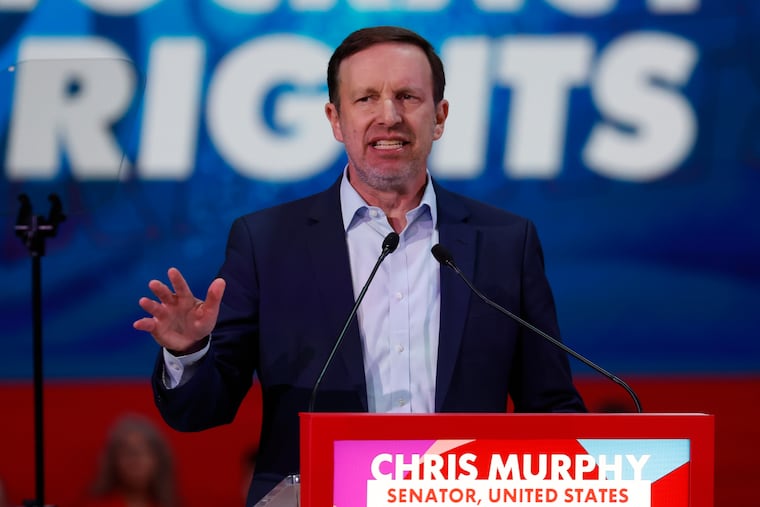
The minimum wage would be raised to $25 an hour under a new bill to be introduced by Sen. Chris Murphy (D., Conn.) on Thursday, in a bid to enthuse the working-class voters who have abandoned the Democratic Party.
The legislation, dubbed the Living Wage for All Act, has a companion bill already introduced in the House.
Murphy, whose name is frequently floated as a potential 2028 presidential candidate, said he is pushing his party to take more aggressive stances on affordability, following its punishing defeats in the 2024 elections.
“Democrats need to offer solutions that are as big as the problems people are facing,” Murphy said in an interview. “The way you solve people’s basic economic problem — not having enough money to pay the bills — is by making a minimum wage be a living wage.”
The bill would incrementally increase the minimum wage from its current rate of $7.25, with the first jump to $12 an hour in the first year of enactment. Major corporations would have six years to work up to a $25 minimum wage, while smaller employers would have a 13-year runway. The legislation would also do away with subminimum wages for tipped workers, such as restaurant servers, youth workers and workers with disabilities. Nearly half of the American workforce makes less than $25 an hour.
The legislation is unlikely to get very far in this Congress, with Republicans in control of both chambers, but the $25-an-hour push is one of the more significant proposals aimed at boosting Americans’ wages, which have been rising but not as quickly as inflation, especially in recent months.
Some 34 states, territories or districts, including Washington, D.C., have increased the minimum wage above the federal minimum, according to the National Conference of State Legislatures.
Saru Jayaraman, president of One Fair Wage, a left-leaning advocacy group that worked with Murphy on the bill, credited support for a $25 minimum wage for primary wins in competitive races in Illinois, New Jersey, Pennsylvania, and California. She said she has heard support for the proposal from liberal and MAGA voters alike.
The $25 figure was drawn from calculations by MIT that analyzed a living wage, which takes into account costs such as food, childcare, healthcare, housing and transportation.
Democrats have long advocated raising the federal minimum wage from its current $7.25, but Murphy’s bill would set the highest floor of any proposal in the Senate. Rep. Delia C. Ramirez (D., Ill.) is leading a House version of the bill, which she introduced earlier this year with wide support across the Democratic caucus. A similar bill by Sen. Bernie Sanders (Ind., Vt.) would set a $17 minimum wage and has 33 Democratic senators as cosponsors, including Murphy.
Murphy’s bill also has the backing of Democratic Sens. Richard Blumenthal (Connecticut), Andy Kim (New Jersey), and Ron Wyden (Oregon).
Congress has not raised the federal minimum wage since 2009, though only about 1% of workers make $7.25 an hour or less.
Business groups have often campaigned against raising the minimum wage, suggesting that the economy works best when employers are responsive to market forces.
A higher federal minimum wage could create “really damaging consequences,” including businesses closing or cutting jobs, especially in rural areas where the cost of living is low, said Ryan Bourne, an economist at the libertarian Cato Institute.
He said the rising average wage shows that state and local governments are already responding to market changes.
“I think it makes much more sense for it to be set at a local level where policymakers have a better sense of the local industries,” Bourne said.
Murphy called those kinds of arguments a “red herring,” saying cities that have already established a $15 minimum wage have not seen major adverse effects. He said the staggered adoption would help assuage employers’ concerns.
“The business community cried murder, and the job losses they predicted did not materialize,” Murphy said.
Alex Jacquez, the chief of policy and advocacy at the left-leaning Groundwork Collaborative and a former Sanders aide, helped craft a $15 minimum wage proposal that Democrats attempted to include in their climate and economic policy bill in 2021. He said the surge in wage growth as the economy recovered from the coronavirus pandemic has led more liberal policymakers to believe that a $15 minimum wage would now be too low.
“It’s also an organizing tool,” he said. “It’s something big and bold that people can hang on to and run on and be able to see the Democrats are fighting for them.”
So far, most congressional action has tried to address affordability through tax cuts, including the child tax credit, covid-era Affordable Care Act credits or the numerous tax cuts in Republicans’ One Big Beautiful Bill.
While Murphy supports programs such as the child tax credits and student loan forgiveness, he said tax cuts have proved insufficient in motivating voters.
“People don’t want to be written a check. People want to work for pay,” Murphy said. “[Tax breaks] are designed to compensate for a rigged system. Why don’t we just unrig the system?”