U.S. tariffs take a bite out of Germany’s iconic nutcracker industry
With 95% of its sales bound for the U.S., Steinbach Nutcrackers has been crunched by tariffs and rising shipping costs.
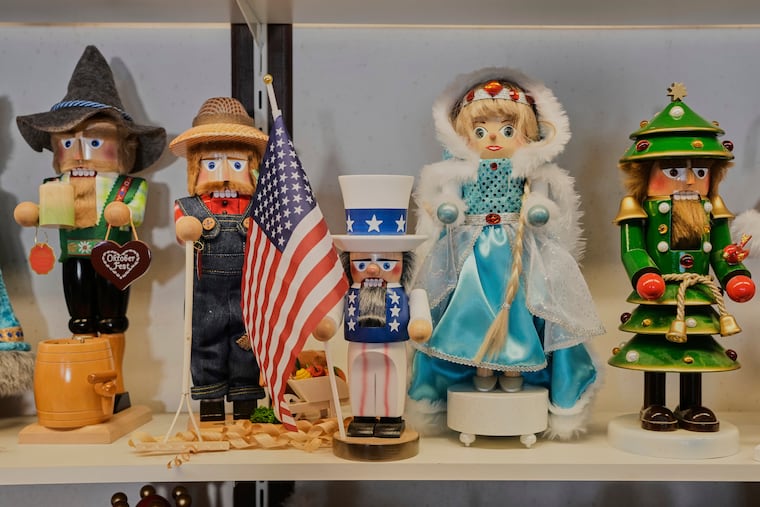
MARIENBERG, Germany — In a workshop tucked into the rolling hills of eastern Germany’s Ore Mountains, rows of wooden soldiers stood at attention. Their red coats gleamed and their square-jawed mouths — designed to crack nuts but mostly decorative — formed the trademark stiff grin of Steinbach Nutcrackers.
For decades, these handmade figures have sailed across the Atlantic and into American homes, filling mantels and collectors’ shelves and appearing in countless Christmas card photos. Alongside gingerbread houses and fir trees with all the trimmings, they are one of the most recognizable German exports of the holiday season.
This year, however, tariffs imposed by President Donald Trump have given the stern-faced ornaments a new reason to grimace: About 95% of sales by the family-founded manufacturer, Steinbach Volkskunst, come from the United States, and the company’s most reliable market has become its biggest bureaucratic headache.
Under a deal between Trump and the European Union reached earlier this year, most exports to the U.S. are subject to a 15% tariff. Separately, the Trump administration also ended the “de minimis” exemption — a rule that had allowed small parcels under $800 to enter duty-free.
The move was aimed at curbing low-cost imports from Chinese e-commerce giants such as Temu and Shein. But for niche businesses that rely on direct-to-consumer shipments, like Steinbach, that change hit even harder than 15% tariff.
“The biggest concern wasn’t price — it was instability,” CEO Rico Paul said, standing in front of a glass cabinet filled with colorful nutcrackers. “Policies changed depending on political mood. For us, planning ahead is essential. One day, the rules were one way, the next day they changed.”
For six months after Trump’s inauguration, confusion reigned. Initially, the president threatened tariffs of 30% or more on most goods, prompting the E.U. to ready plans for retaliation. The deal on 15% tariffs, reached in late July, ended that uncertainty.
But in late August, Trump issued an executive order ending the de minimis exemption, meaning a slew of new paperwork and bureaucracy.
Costs rose and delays mounted as Customs and Border Protection grappled to keep up with the surge in new parcels requiring clearance. With the holiday season approaching, Steinbach faced the possibility of its nutcrackers getting stuck in customs warehouses.
More than half of Steinbach’s business comes from online orders shipped directly to American doorsteps, and customers soon felt the increase. Prices are up roughly 25% compared to last year, because of the tariffs and customs costs, as well as rising wages.
“In the United States, our name is extremely well known,” Paul said. “We’re practically synonymous with the word nutcracker.” The outsize U.S. demand for Steinbach products, he added, “was always an advantage — until the tariff dispute.”
American affection for Steinbach’s products seems undiminished by the price increases. “We were worried Americans wouldn’t pay more,” Paul said, pulling up a fresh order from Monticello, Fla., on his phone. “But the loyalty is incredible. They’re still buying, even if it’s more expensive.”
That loyalty stretches back to the 1950s, when U.S. service members stationed in postwar Germany discovered the nutcrackers and brought them home as souvenirs. They quickly became a cultural shorthand for an authentic European Christmas.
The nutcracker legacy itself is older. In Saxony’s Ore Mountain region, miners began carving these wooden figures in the 1600s, meant to bring protection and keep evil spirits at bay during the darkest months of winter.
French author Alexandre Dumas’ adaptation of E.T.A. Hoffmann’s 1816 story “The Nutcracker and the Mouse King” later inspired Tchaikovsky’s 1892 ballet The Nutcracker. The ballet, initially a flop in Russia, became an American holiday institution in the mid-20th century — catapulting the nutcracker to global fame as a Christmas icon.
On a late November morning at the Steinbach factory, about 40 artisans carved, sanded, and painted wooden limbs, while sewing machines upstairs stitched miniature outfits. Outside, snow settled on fir branches as workers packaged the finished products for their long journey.
One detail is new: a bright yellow sticker on every box, addressed to the person who will decide if the toy enters the United States smoothly: “Dear U.S. Customs Officer,” it says, “Thank you for keeping the trade flowing.”
It may be wishful thinking. In October, U.S. news outlets reported that thousands of packages had stalled in customs hubs under the new rules. Some carriers reportedly disposed of abandoned shipments.
“Because of changes to U.S. import regulations, we are seeing many packages that are unable to clear customs due to missing or incomplete information,” UPS, the shipping company, said in a statement. “Our goal is to speed every package to its destination, while complying with federal customs regulations.”
In late November, UPS said that its brokerage team was clearing more than 90% of packages on the first day — but not without complications.
Still, Steinbach nutcrackers continue to sell well, particularly those with pop culture and political themes.
Last year, Steinbach introduced a pair of nutcrackers dubbed “Republican” and “Democrat,” bearing more than a passing resemblance to Trump and Kamala Harris. The Republican model sold out before Election Day.
Prices for the smallest nutcrackers start at about $150, while the largest and most intricate figures cost more than $700. Alongside traditional soldiers and Santas, Steinbach has embraced the American appetite for nutcrackers in all forms, including Star Wars stormtroopers, Wizard of Oz characters, and even Pope Leo XIV.
But the tariffs and customs delays have prompted Steinbach to seek a work-around. “We are building a warehouse in Pennsylvania and hiring staff,” Paul said.
The nutcrackers will still be made in Germany — local craftsmanship remains a central selling point — but preshipping and storing finished goods in the United States stands to insulate the business from further regulatory whiplash. The tariffs and additional costs of maintaining and staffing the warehouse will be passed on to customers, but the move should eliminate paperwork and delays for shipments to individual buyers.
Steinbach is not alone. Across Germany, exporters large and small are recalculating.
“The escalation of U.S. import duties — now effectively averaging 15% on key industrial goods — has hit Germany particularly hard,” said Andreas Baur, foreign trade expert at the Munich-based Institute for Economic Research. “If you take January to September and compare it to the previous year, we have a decline [in exports] of about 8%, and for cars around 14%.”
But beyond automakers, chemical giants, and heavy industrial goods, the regulatory shift has quietly reshaped the fate of artisans whose exports trade more in memories than volume.
On the outskirts of Dresden, a 90-minute drive northeast of the nutcracker workshop, the sweet smell of raisins and butter filled Bäckerei Gnauck in the district of Ottendorf-Okrilla.
Bäckerei Gnauck is one of about 100 bakeries permitted to bake true Dresdner Christstollen — a dense fruitcake that is tightly regulated by the Dresden Stollen Protection Association.
Here too, the lifting of the de minimis rule has left fifth-generation baker Marlon Gnauck kneading frustration into this year’s cake loaves.
Stollen, another German Christmas tradition that has gone global, has deep roots in and around Dresden, where it first appeared in the 14th century as a simple, butter-free loaf made under strict Advent fasting rules.
That changed in 1491, when Pope Innocent VIII issued the “Butter Letter,” allowing bakers to enrich the dough. Spices, candied fruit, and almonds followed and, by the 18th century, Dresden bakers were presenting enormous loaves to royalty, securing the bread’s vaunted holiday status.
Today, mass-produced versions fill German supermarkets, but only a small group of certified bakeries may call their loaves Dresdner Stollen. Dotted with raisins, and carefully folded together before being baked and doused in confectioners sugar, Stollen is supposed to represent the image of a swaddled baby Jesus.
Every holiday season since 1999, Gnauck, a fifth-generation baker in his family, has shipped some of his stollen to Americans — half as corporate gifts, he estimates, and a quarter to families with German ancestry.
He has enjoyed hearing from happy customers, even those who make him wince with their “American innovations” such as toasting stollen or spreading it with peanut butter.
“Just a good slice of stollen, with a cup of coffee — that’s it, ” he said. “That’s how it should be enjoyed.”
But now a single two-kilogram shipment, with postage and duties, costs more than $170, he said as he attached the required documents to parcels bound for Dorchester, Mass.; Raleigh, N.C.; and Houston.
“You’re looking at paying between $60 and $70 in import charges for a two-kilo stollen,” Gnauck said. “The product costs 50 euros [about $59]. Shipping is almost another 50. And then roughly $70 of customs and administrative fees.”
Only about 2% of Gnauck’s sales are to the United States, but the time required for paperwork and the additional costs for longtime customers have tainted the festive cheer. Gnauck’s verdict: “The Grinch lives in the White House,” he said. “Because what he’s actually doing is completely ruining the gifts.”
In October, after the first seasonal orders were shipped across the Atlantic, Gnauck temporarily stopped shipping to the U.S. after customers complained about unpredictable costs.
“We called the next 50 customers who had placed an order,” he said. “A quarter of them canceled. Another quarter of them reduced their order to a 1 kg, and the rest said they’d pay no matter what.”
Sending stollen to America was never economically logical, he said. “It was emotional. A gesture. And now that gesture is expensive.”
Some Dresden bakeries have stopped exporting to the United States altogether. But like Paul, the Steinbach CEO, Gnauck isn’t ready to quit. Both men said they simply want one thing from Trump: predictability.
Paul said a limited-edition nutcracker resembling Trump at the Resolute Desk — with a price tag of $399 — has nearly sold out. “The president is sitting at his desk and is signing a declaration, granting the Steinbach company duty-free status for all eternity,” he quipped.
For now, that remains fantasy: a wooden wish for stability in a season built on nostalgia — and customs logistics.