Has pickleball’s popularity peaked? These Philly businesses hope not
Pickleball’s popularity has skyrocketed, and courts have been popping up all over the Philadelphia region.
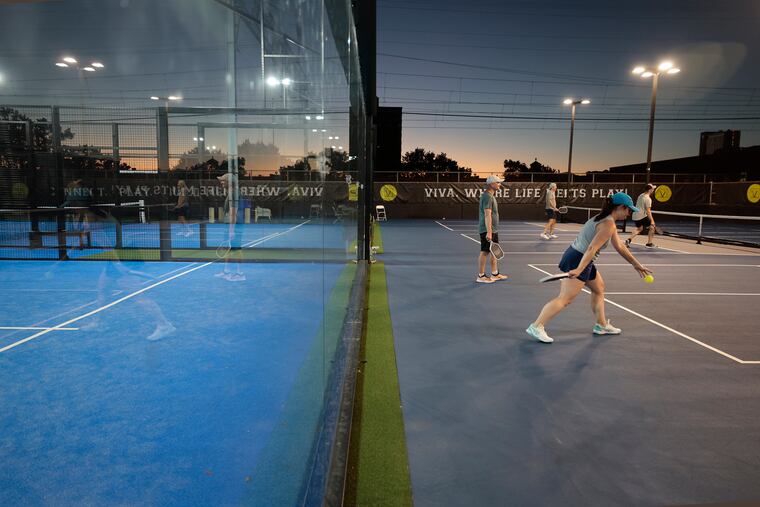
What do vacant retail spaces, garages, malls, and industrial buildings all have in common? Many have been repurposed into dedicated pickleball venues.
Pickleball courts have been popping up all over the Philadelphia region — indoor and outdoor, many privately owned or operated by chains, and some sponsored by or partnered with local government.
While they’ve been prolific, these facilities aren’t instant moneymakers. Local businesses offering the sport have been strategic and made adjustments in efforts to make a profit.
“Folks who invest in pickleball need to make sure they do a sound economic impact study and run the numbers to understand what a complex will support,” said Justin Maloof, chief competition officer of USA Pickleball, based in Scottsdale, Ariz.
Pickleball’s skyrocketing popularity
Pickleball, a combination of tennis and ping-pong, is the fastest-growing sport in the U.S., with about 20 million players in 2024, according to the Sports and Fitness Industry Association (SFIA)’s 2025 Topline Participation Report. The sport grew by 223% in three years, with every age group seeing increased participation.
Venues offer memberships and pay-as-you-go options, with costs varying widely. Some municipalities offer play free of charge with no membership or court time fees. Other clubs have multitiered packages ranging in price up to $350 per month. Without a membership, hourly fees can run upward of $15 per hour.
With close to 16,000 pickleball locations, including 4,000 new sites in 2024, according to SFIA, competition is stiff and business models for new venues continue to evolve.
“We are seeing a definite shift toward permanent pickleball courts,” Maloof said. “In the early years, most of the pickleball courts were temporary or converted courts, including underutilized basketball or tennis courts or hardwood gymnasium floors.”
Those makeshift courts employed temporary nets and line markings that were often created from tape or chalk. As demand grew, players gravitated to dedicated courts with permanent nets and clear lines. Investors refit existing buildings or converted outdoor spaces, which has been quicker and more cost-effective than building new facilities from scratch.
Keeping start-up and operating costs low
When Viva Padel & Pickleball opened in June in East Poplar, the founders invested just under $1 million on an outdoor venue featuring four pickleball and four padel courts. One of the Viva investors already owned the lot that had previously been used for parking.
To entice clients, the group created a business model built on multiple tiers, ranging from a pay-as-you-go plan for casual players to a monthly fee premium plan for folks who play every day.
“The flexible business model allows people to buy in and test it out,” said cofounder and CEO Mehdi Rhazali. “We can target many different audiences.”
In the first three months, the club acquired 150 members in addition to drop-in players. That was a successful enough start to open a second indoor facility, set to open this fall.
For their second location, the investors partnered with the Magarity family, who have repurposed their tennis club in Flourtown into a pickleball and padel venue. They felt that converting to pickleball and padel would bring in more participants and more community usage, Rhazali said.
The clubs will run independently so joining one will not give players membership to both.
“With an indoor model, you have to cap your membership” to avoid overcrowding, Rhazali said. “We are planning on offering a lot of programming and options for members and nonmembers in the Flourtown location.”
The cost to refit an outdoor surface, most often a former basketball or tennis court, is $35,000 to $40,000, according to Carl Schmits, chief technology officer for USA Pickleball, based in Lake Oswego, Ore. That covers just the cost of the surface, not buying or leasing the space, or outfitting the venue.
The indoor court facility build-out is accelerating, driven by franchise operations including Life Time and Dill Dinkers, Schmits said. Closed retail spaces, such as former Bed Bath & Beyond stores, are being repurposed for pickleball, with 10 courts per facility on average.
For a smaller venue, perhaps a former garage or manufacturing facility, it costs about $10,000 to refinish the floor, create separations between the courts, and add lighting, Schmits said.
“A smaller operation would ideally need to see revenue of over $100,000 per year per court,” Schmits said.

Popular in Europe, padel has gradually gained fans in the U.S. The game is a mash-up of tennis and squash, played on a court the size of a pickleball court. The biggest difference is that a padel court is surrounded by a mesh cage and backed by a glass wall.
Using those walls is part of the strategy. It’s a 360-degree sport, so the ball can come from any angle. Paddles are solid with perforated holes, and the ball resembles a tennis ball.
“It’s very dynamic and demands a lot of athleticism,” said Mehdi Rhazali, cofounder and CEO of Viva Padel & Pickleball in East Poplar and Flourtown. “It’s easy to pick up and very difficult to master.”
Rhazali sees great future growth in padel. Currently, many courts are in private clubs not available to a mass audience.
“There’s a lot of demand but very little supply,” he said. “We want to make it more accessible.”
Overcoming challenges
Delco Turf & Pickle will celebrate its first anniversary on Nov. 27. The locally owned venue offers nine indoor courts and an outdoor surface, open 24 hours a day, 7 days a week. Half of the building is a turf field for other sports.
On the pickleball side, the Boothwyn business started as a pay-as-you-go club, and then began offering memberships three months later. Last month they added additional tier levels.
“We are trying to get the word out that we are here, we do a great job, and we have a great product,” said Adam Devlin, general manager and director of pickleball operations. The first year was a learning experience, he said.
By the time their infrastructure was in place, many local players had already committed to other clubs. This year, investors are counting on cold weather to bring in business, as many of the other courts nearby are outdoor.
To keep staffing and overhead low, the club is fully automated. Clients use an app to sign up, pay, and enter the facility. Staff are on-site during busy times.
Filling off-peak time remains a challenge for most clubs.
At the Delco club, the turf side of the venue picks up the slack, getting business from school and community groups. At Viva, Rhazali’s group is pursuing partnerships with schools and businesses to provide team-building events at the facility.
Local government hops on the pickleball bandwagon
Many municipalities, from the Philly suburbs to the Shore, offer pickleball, sometimes in repurposed tennis or basketball courts. Generally, their fees cover the costs of upkeep and staff and may be supplemented by the local government.
“Anything that gets people off the couch and active is a healthy thing,” said Doug Horton, competition and tournament director for 08085 Pickleball, which covers Woolwich and Logan Townships. “It brings people together and builds relationships.”
The two Gloucester County towns, just a few miles apart, share 14 pickleball courts, eight in Woolwich Township and six in Logan Township. The Woolwich courts were built and paid for by the developer who erected the surrounding homes in June 2024, as a perk to the community. The Logan courts, once a skate park, were recently repurposed to meet the demand for pickleball.
The club, which has more than 1,000 members, offers free memberships with no charge for court time. Anyone is welcome to join, but memberships are required as a way to assess the level of each player and ensure games are competitive.
The Logan program is recognized and supported as an official sport by the township, similar to their youth programs. In Woolwich Township, sponsorships, fees for lessons, leagues and tournaments support the program without the use of tax dollars.
Pickleball has also been available in Philadelphia’s Dilworth Park this fall, through a partnership between City Pickle and Center City District, a business improvement district. City Pickle offered season passes and open play time, as well as select open play sessions for no cost.
As more courts and venues pop up, pickleball will eventually reach a point of saturation in the region.
“In the early ’80s there was a heavy build-out of racquetball and tennis facilities, with the perspective ‘If we build it, they will come,’” Schmits said. “In hindsight, we look at how many closed.”
To area businesspeople, he cautioned: “Be sure to do the due diligence to understand the economic impact in your area.”