Tailoring a fresh start
Vintage boutiques and handmade jewelry stores now span Fabric Row alongside family-run textile shops as the commercial corridor tries to stay relevant amid changing consumer habits.
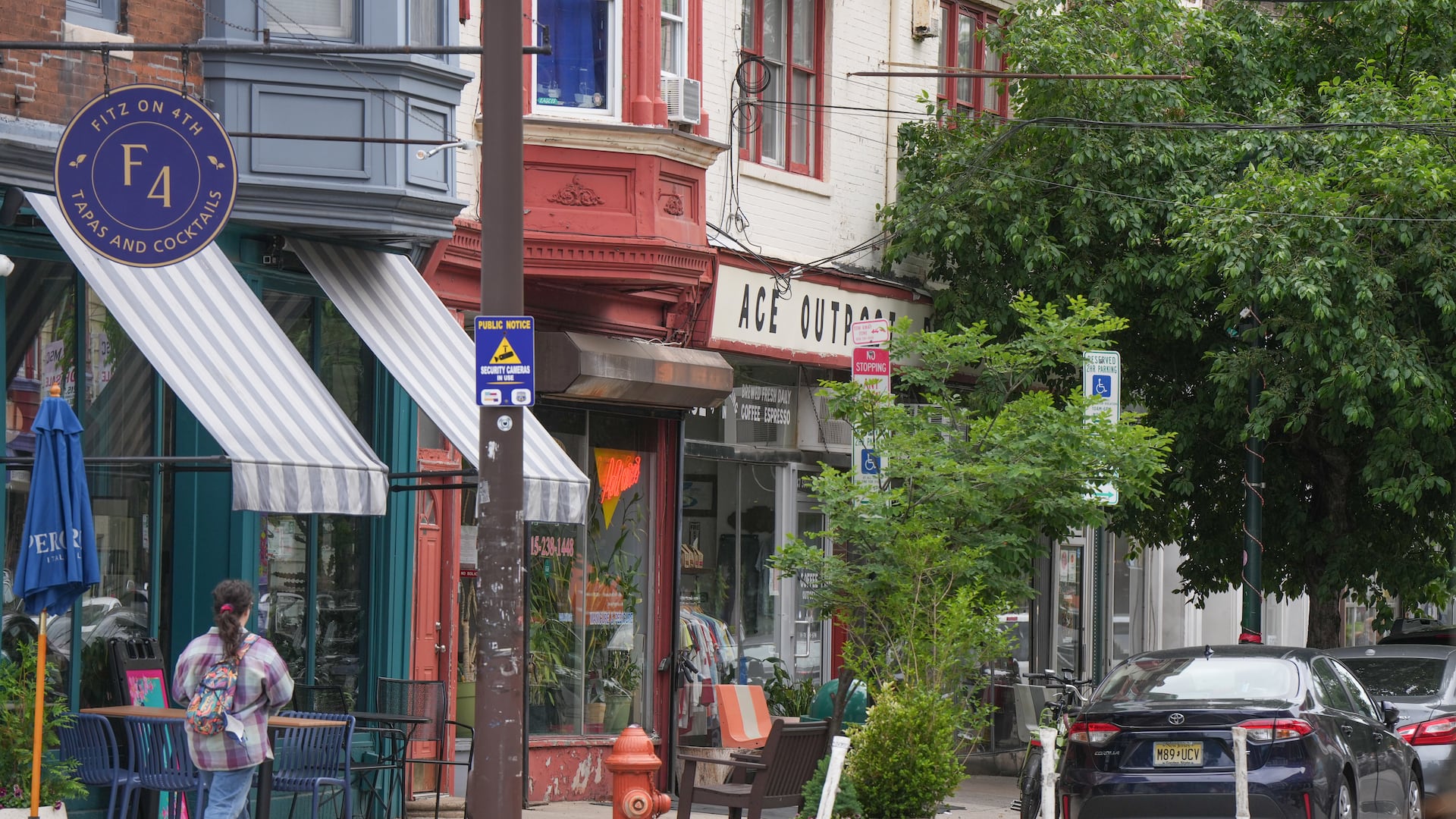
For decades, Philadelphia’s historic Fabric Row was defined by bolts of fabric stacked floor to ceiling inside family-run textile shops. The stretch of South Fourth Street between Bainbridge and Catharine Streets, long associated with Jewish immigrant merchants and garment-making, built its identity on utility: a place people went to sew, mend, and make things themselves.
But today, a different kind of fabric is stitching the neighborhood together.
Vintage boutiques sit beside upholstery suppliers. Handmade jewelry shops neighbor old-school textile stores. During the neighborhood’s monthly Fourth Friday events, shoppers drift between late-night retail events carrying vintage denim, handmade ceramics, and tote bags filled with secondhand finds.
What has emerged on Fabric Row is not exactly a reinvention, but an evolution — one shaped less by developers or corporate investment than by small-business owners trying, often precariously, to keep brick-and-mortar retail alive.
“There’s a sense of community that has grown more each year I’ve worked on this street,” said Emily Hawkins, manager at Moon+Arrow, who has worked on Fourth Street since 2018. “To me this isn’t just a shopping district but a strong community of people that want to build and participate in something special together.”
Still, the neighborhood’s evolution is happening against a difficult economic backdrop. Independent retail nationally continues to operate on narrow margins, and Fabric Row is no exception. Several business owners emphasized that while foot traffic has improved, long-term stability remains uncertain.
The changes raise broader questions about what kind of commercial corridors survive in cities like Philadelphia — and whether neighborhoods built on independent creativity can remain financially sustainable once they become destinations.
“It takes significant grit to navigate a small business today,” said Jen Zimmerman, who co-owns Sweet Peel Vintage with Abby Codrea. “The community is what keeps us going and allows us to thrive.”
A rare sense of teamwork
A sense of collaboration is repeatedly cited by business owners on the block, many of whom describe Fabric Row less as a competitive retail corridor and more as a mutual-support ecosystem. Shop owners share resources, refer customers to neighboring stores, and maintain group chats to troubleshoot everything from permits to marketing ideas.
“Our days often begin at Ace Outpost for coffee, where we catch up with other locals,” said Zimmerman. “These brief interactions help us stay connected, promote one another, and share resources.”
Several owners said the atmosphere feels increasingly rare in an era when independent retail is under intense pressure from rising rents, e-commerce, and changing consumer habits.
That support extends to customers, too. At Moon+Arrow, Hawkins says, shoppers frequently ask where to eat, buy a leather jacket, or find stationery nearby — questions that send them deeper into the neighborhood rather than out of it.
“If you’re visiting Moon+Arrow,” she said, “you’re also visiting every shop from South Street to Catharine.”
Rising instability
But beneath the optimism surrounding Fabric Row’s revival lies a more familiar story about independent retail in American cities: rising rents, unstable leases, and the fear that the very qualities making a neighborhood desirable can eventually price out the businesses that built it. Many shop owners say the corridor’s growing visibility has brought more foot traffic and energy to Fourth Street — but also growing uncertainty about what comes next.
“Rent increases are always a concern for small businesses that do not own their buildings,” Zimmerman said.
Kelly Braun, owner of At My House, says she’s already noticing “a shift in landlord expectations,” adding that two iconic businesses, Essene and Bus Stop, closed down last year. “I think the city needs to do more to protect its small businesses,” she said.
Braun says many independent business owners feel unsupported by the city as costs continue to rise. “Philadelphia makes it hard to be a small-business owner in a way that sometimes feels like the city wants less of us, not more,” she said.
The owner points to rising commercial rents and recent tax changes, including the elimination of the city’s $100,000 Business Income & Receipts Tax exemption, which she says has impacted many small businesses. “Commercial rents are going up so fast that some spaces are starting to feel New York-priced without any of the protections New York businesses get,” she said.
Still, Braun believes independent businesses are central to the city’s identity. “Small businesses are a huge part of what makes neighborhoods feel alive,” she said. “They bring creativity, culture, and personality to a city in a way chains never will.”
Even some of the corridor’s most established businesses are facing instability. Moon+Arrow, which has operated on Fourth Street since 2011, will relocate in 2027 after its building was sold. Hawkins says the shop previously underwent a similar transition when developers purchased its former location in 2019.
At the same time, many owners insist the neighborhood’s appeal comes precisely from the fact that it has resisted overcommercialization.
Fleishman Fabrics & Supplies, one of Fabric Row’s longest-running businesses, traces its roots on Fourth Street back to the 1930s. Joshua Fleishman, a third-generation owner, says today’s mix of vintage stores, boutiques, and fabric shops reflects the corridor’s long history of adaptation.
“The diversity of today is a modern continuation of using fabrics in different ways,” he said. “We are here for the makers and creators, and those are forever.”
Shoppers increasingly view the area as “Vintage Row,” a natural extension of its textile history. “There’s something special about having an entire area in Philly dedicated to garments and items with a history to them, as opposed to buying new,” Braun said.
Fabric Row’s history
Historical continuity matters to longtime observers of the neighborhood, too.
Michelle Palmer, founder of the Fabric Museum — an online archive preserving the history of textiles and Philadelphia’s garment industry — says Fabric Row has always evolved to survive. Jewish immigrant merchants once evolved from selling rags from pushcarts to specializing in dress fabrics during the Depression and home decor textiles after World War II. “Keeping up with the times was their secret to survival and success,” she said.
Palmer sees today’s vintage stores, handmade boutiques, and resale shops as part of that same lineage: businesses responding to changing consumer desires while preserving the street’s identity as a place centered around material culture, creativity, and reuse. “The new growth in business is probably about giving customers what they want,” she said.
For now, Fabric Row exists in a delicate balance: a shopping corridor increasingly popular because it feels local, personal, and collaborative, even as the economic forces reshaping cities threaten exactly those qualities.
The neighborhood’s future may depend on whether that sense of collective investment — between shop owners, customers, and the community itself — can continue to hold.