Holiday traditions, more than deals, draw Philly-area Black Friday shoppers to Cherry Hill Mall
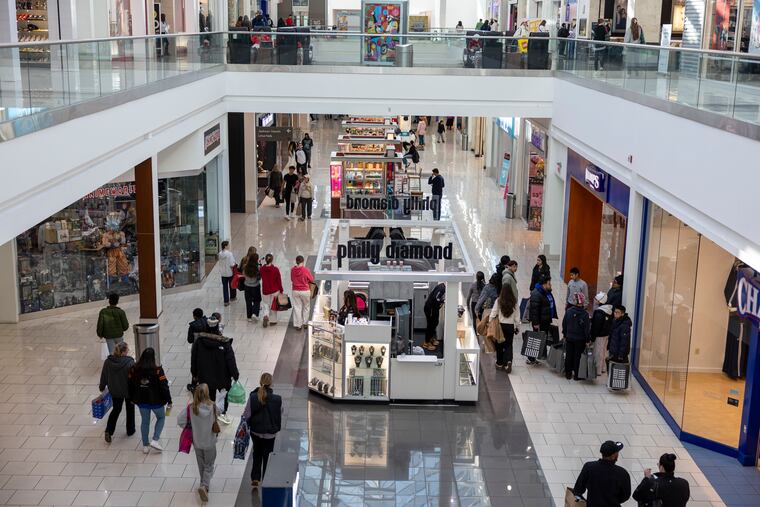
Despite inflation, rising prices, and the omnipresent e-commerce ecosystem, a familiar Black Friday hustle was in the air at the South Jersey mall on Friday morning.
Stephanie Greenleaf has Black Friday down to a science.
Every year, the Moorestown resident hosts Thanksgiving. The next morning, she, her sister-in-law, and her mother hit the Cherry Hill Mall early. They start at Nordstrom, then head to Soma for pajamas, Urban Outfitters for her teenagers, and anime stores for the younger kids.
“We have it down,” she said, standing next to a Christmas ornament display around 8:30 a.m.
“As my mom always says, ‘I just want to be out in it,’” she added. “It’s not the same when you’re sitting on your couch.”
Despite inflation, rising prices, and the omnipresent e-commerce ecosystem, a familiar Black Friday hustle was in the air at the Cherry Hill Mall on Friday morning. Shoppers filed into the parking lot early, toting shopping bags and holiday-flavored lattes. Labubus and puffer jackets were displayed in store windows. Teenagers flocked to Abercrombie and Zara.
While some retailers reported business as usual, others described the South Jersey shopping destination as more subdued than in years past as consumers contend with an uncertain economic landscape and e-commerce giants continue to cut into a market long dominated by malls.
Black Friday, then and now
The term “Black Friday” has Philly origins. Beginning in the 1960s, tourists would descend on Philly the day between Thanksgiving and the annual Saturday Army-Navy football game. Philadelphia police reportedly began calling the day Black Friday after they were forced to work long hours and manage heavy traffic and unruly crowds. Years later, Americans would latch onto the tale that Black Friday got its name because it was the day retailers would move from being “in the red” to being “in the black” (finally making a profit after running a loss).
The retail-oriented holiday has morphed over the years from a one-day shopping bonanza to a month of deals. Now, the pervasiveness of e-commerce has muddied the Black Friday tradition, forcing retailers to attract shoppers both online and in stores.
Barbara Kahn, professor of marketing at the University of Pennsylvania’s Wharton School, calls this an “omni-channel experience.”
“It’s really more of an integration between both modalities now‚" Kahn said.
Two major changes stick out to Kahn. First, the ability to compare prices online (and now with AI) has made shoppers more “price sensitive,” forcing retailers to stay competitive. Second, stores are turning to “experiences” to draw people in through giveaways, events, or exclusive items.
“Part of what people are shopping for is not necessarily the utility of buying a particular item,” Kahn said. Rather, it’s the experience “wrapped around the actual purchase.”
Despite these changes, a record number of shoppers were expected to hit stores, and the holiday is still largely understood to be the biggest shopping day of the year.
Keeping the ‘Black Friday experience’ alive
Shoppers at the Cherry Hill Mall said they had come out on Black Friday for the nostalgia more than for once-a-year deals.
Karrim Gordon, 48, said he is “not at all” a regular Black Friday shopper. But, with his young son in tow, the South Philly dad said he wanted to give his kids the true “Black Friday experience.” They got to the mall when it opened at 7 a.m. and hoped to hit Psycho Bunny for his son, then Aéropostale and Pop Mart for his daughter.
Daniel Leslie, 23, of Franklinville, said an Instagram ad for a sneaker deal had caught his eye. He was the first in line at a shoe store Friday morning, walking away with a pair of Timberland boots and a pair of Nike Air Force 1 sneakers for $20 each.
Was economic anxiety curbing his holiday shopping? Not really, Leslie said.
“The deals are just too good to pass up.”
Economic doom and gloom didn’t deter Alicia Hall, 54, from hitting the mall, either.
Hall is a Cherry Hill Mall regular, driving over from Philly a few times a month to browse. For years, she would wake up early and wait in line for the big sales. Now, she said, “nothing is open like it used to be.”
Though she sometimes thinks about looming economic concerns, “retail therapy” remains an important part of her life.
“I go to work every day, and I work hard,” she said. “I might as well spend it.”

Inquirer Cherry Hill
This suburban content is produced with support from the Leslie Miller and Richard Worley Foundation and The Lenfest Institute for Journalism. Editorial content is created independently of the project donors. Gifts to support The Inquirer’s high-impact journalism can be made at inquirer.com/donate. A list of Lenfest Institute donors can be found at lenfestinstitute.org/supporters.