What can theater bring to the workplace? This Philly firm is betting on the power of role play.
A local marketing firm created an immersive experience in which co-workers solve workplace challenges in fictional settings. Here’s why.
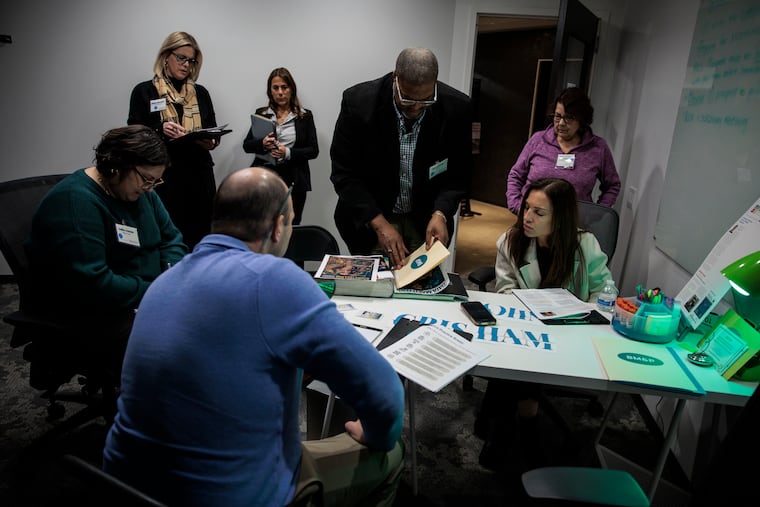
Employees of Spark Quality Support Center normally provide support for early childhood programs in Philadelphia. But one afternoon last August, they pretended to be travel agents.
Their task was to pitch a vacation package to a family. But several challenging prerequisites emerged: The grandmother was too old to fly, one sibling didn’t get along with another sibling’s spouse, and it needed to be a child-friendly plan.
The family drama kept unfolding, said Julie Beamon-Jackson, a project director at Spark. The faux travel agents had to reconvene, strategize, and adjust their pitches. For these 28 employees, from two teams that tend to be siloed, the activity broke the ice a bit, she said.
This role-playing exercise was delivered by Seagrass, a new employee learning program from the Philadelphia marketing firm Octo Design Group, in which work teams are immersed in a “realm” that presents fake challenges allowing participants to practice real skills.
Wendy Verna, founder and president of Octo Design Group, says she started offering the Seagrass workshops last year because she noticed a need to strengthen soft skills in the workplace.
She had noticed that despite her successful marketing campaigns, her clients’ bottom lines weren’t moving. She realized they were facing a human hurdle. Some employees don’t know what questions to ask, how to convert a sale, or how to upsell a potential client, she said.
“They don’t know how to identify that the person who came in for the burger should also be drinking a beer and get french fries and then also order a dessert,” said Verna.
Management teams might view this as a workplace culture issue, says Verna, and some try to solve it with an office ping-pong table or after-work happy hour. That doesn’t fix things, she says. “The problem is that we really need to hone in on these soft skills.”
Verna describes the realms as a “live-fire experience that takes you through an emotional roller coaster,” not unlike an escape room — the popular entertainment model in which players sift through in-person challenges. But here, it’s for work situations.
During a realm, “you might get embarrassed, you might fail,” Verna says. And that’s the whole point. “We need to understand how people do in the real world.”
Going through the realm
A two-hour Seagrass session for 10 to 20 people will cost an organization at least $6,500. A full-day experience with multiple rooms and actors starts at $10,000.
But on a Wednesday evening in January, a dozen participants from different workplaces got to experience a realm for free, at a borrowed office space in Center City. Verna had invited them in an effort to market the workshops.
Their task: Build an advertisement to attract a potential client and then prepare a pitch to represent them at a fictional law firm. Participants spent the evening gathering clues about the potential new client, with live actors checking in every so often to keep them on task. They even had a closet full of blazers to throw on for the pitch.
There is levity in the session, with smiles and laughing — these are adults role-playing work settings after all. And there are also moments when individuals get the opportunity to shine. One professional lends their legal expertise as the group makes a key decision. A participant who’s good under pressure adeptly handles an incoming (faux) phone call.
Calie Condo, vice president of partnerships at Campus Philly, who attended the realm in January, described the experience as akin to “a high-pressure cooker scenario,” and said it could prove useful for young workers to fail in a safe space.
In the realm, people need to work “shoulder to shoulder,” noted Jaime Picozzi, of GHR Healthcare in Blue Bell, a friend of Verna’s who also attended the January realm. And that’s something many people have moved away from in their work, she noted.
“There’s probably a whole generation, or there’s a whole subset of professionals — I think they might lose their mind if they were put into an experience like Seagrass.”
Why soft skills matter at work
A relatively new idea has emerged in recent decades: that it’s possible to teach so-called soft skills, like public speaking, leadership, communicating effectively, and having constructive disagreements, says Maurice Schweitzer, who teaches negotiations courses at the Wharton School.
“We assume that so many of these things are just innate,” he said. “In reality, these are things we can work at. Everybody can get better at these things if we practice and get feedback.”
Many people learn these skills by observing their parents, peers, and teachers, but they don’t typically receive formal training or feedback, says Schweitzer. It’s a haphazard trial and error process, he says.
“By the time people enter the workplace, they’re going to have very unequal backgrounds, experiences, and abilities,” he says.
As Verna was setting up the realm business, she wondered where she had picked up her own soft skills. It was through her mentors, she realized.
But the pandemic cut out in-person interaction for many when offices were fully closed. And in today’s hybrid work world opportunities for in-person encounters are reduced.
The most effective way to communicate is in person, says Schweitzer. Interactions that help build relationships happen when running into someone in the hallway at work and asking them about their commute, or weekend, or kids, he says.
Many local employers now require at least some in-office time. But, Verna notes, simply being physically present in the office doesn’t shake remote work tendencies.
After employees swipe their badge into their office building, “They might close their door, they might be on a Zoom in the office — so they’re working from home in the office,” Verna said. That means few in-person interactions.
A combination of face-to-face and electronic communication is now common in workplaces, and that means figuring out how to socialize differently, says Schweitzer.
Employers in recent years have noticed skills gaps among young workers in areas such as receiving constructive criticism or proper cell phone etiquette in the office. Young workers who lack these soft skills started their careers over Zoom and Slack, the Wall Street Journal noted.
“If you’re a manager, if you’re a new employee, you’ve got to figure out, OK, if I’m only in the office three days a week, or if I have some team members that are only on Zoom, how do I make these connections?” said Schweitzer.
More than degrees
In a promotional video for Seagrass, workers find themselves in compromising situations: running late for a client meeting, having connectivity issues while taking an important call in a public space, acting standoffish toward a colleague’s request.
The video ends on the phrase: “The future needs more than degrees.”
Verna acknowledges that completing a degree or certificate is a huge accomplishment, but she contends that soft skills set people apart. They affect “the way you enter a room, where you sit around the table, how you say hello.”
That kind of strong presence was what Propell Credit Union had in mind when it brought a Seagrass realm to its Ridley Park location last fall, for a 13-employee group.
“How they interact, their confidence levels, the things that they say, all of that is the very first impression when you come into Propell Credit Union,” said Kerry Hallam, the credit union’s head of retail services.
In their realm, the participants were legal professionals tasked with pitching a client. They had to listen carefully and think quickly on their feet as calls came in. The group took it seriously, Hallam said.
“If you didn’t know better, you would have thought that those were real clients that they were trying to win over,” said Hallam.