How businesses can help employees save for their kids with a Trump IRA | Expert Opinion
Employers can contribute to these IRAs for children of their employees. Tax professionals say the program has pros and cons for savers.
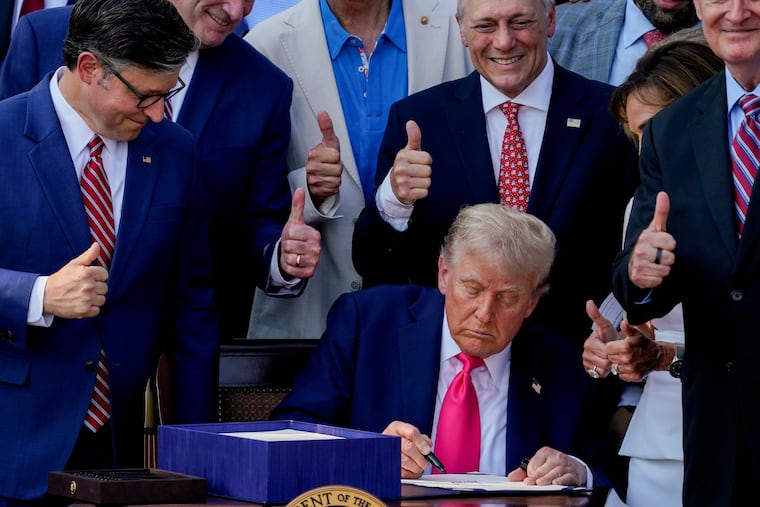
There’s a new savings option for children as part of the One Big Beautiful Bill Act. It’s called the 530A account, otherwise known as the Trump IRA.
Name aside, it’s yet another tax incentivized way that both parents — and their employers — can help children save for the future.
Launching July 4, these new accounts will be available for any child under 18. Each year, as much as $5,000 can be contributed to a child’s account. Employers are allowed to contribute up to half of that amount ($2,500) per year to their account belonging to their employee’s dependent without it counting as taxable income.
“For clients who haven’t started saving yet, this is a great on-ramp,” said Logan Connell, a Philadelphia-based tax strategist. “For clients who already have funded investment vehicles, this is a supplement, not a replacement.”
The contributions are made from “after-tax” earnings, but the accounts can then grow tax free. Contributions are not required, and different from a traditional Individual Retirement Account (IRA), evidence of earned income is not required. Contributions can still be made even if the child contributes to another IRA from a summer job or other paid work.
Another big incentive: If a child is born between Jan. 1, 2025, and Dec. 31, 2028, the government will also make a one-time contribution of $1,000 to the child’s account. Funding is coming in part from the Treasury Department but also from privately held companies, foundations, and philanthropists.
Parents will be able to make investment choices, although the funds can only be invested in American companies and mutual funds. Each child may have only one Trump IRA. Investments grow tax-deferred, so no tax is due on the account proceeds until funds are withdrawn.
“It’s free money that grows tax-deferred,” says Fahmin Fardous, a financial planner with wealth management firm Zenith Wealth Partners in Philadelphia. “That means the child will pay taxes on the amount they withdraw, which will be based on their tax bracket at the time, which in many cases will be lower than the parents’ bracket today. It’s hard to say no to that.”
During this period, the parents are named beneficiaries of the balance. But after the age of 18, the child becomes the beneficiary and can withdraw whatever funds have accumulated without interest or penalties. Or they can leave the balance to grow like a traditional IRA. The federal government estimates that contributing $5,000 per year from birth will accumulate approximately $742,000 by the age of 27 and $13 million by the age of 55.
Although it seems like a no-brainer, some financial managers point out the downsides.
Because they’re restricted to U.S. based funds, the Trump IRAs have fewer investment options, warned Art McHenry, a tax adviser at Silver Snakes LLC in Ridley Park. Contributions to a Trump IRA, while tax-free to the recipient, are not tax deductible to the company or person making the contribution. Other accounts, he points out, may be better for some families.
“For example, 529 plans, which can be used for qualified education expenses, allow contributions to grow tax-free as opposed to tax-deferred, with much higher contribution limits,” he said. “Traditional IRAs and Roth IRAs offer greater investment flexibility, are not limited to education, and may have stronger long-term tax advantages.”
Connell says Trump Accounts “earn their place” as the retirement layer on top of a 529, not instead of one. He also warns that the regulations are not finished, and there are still open questions.
“The money is completely locked up for the entire growth period with no access for emergencies, which is a real problem for lower-income families who arguably need this program the most,” he said. “Unlike 529 plans, Trump Accounts have no explicit statutory language protecting contributions under the annual gift tax exclusion, meaning larger contributions could technically require a gift tax return right now.”
Fardous recognizes these limitations but argues that IRAs, while a “powerful” option, can have their downsides.
“You generally have to wait until you’re 59½ years old to access the money,” she said. “With the Trump IRA, the child gains access to the account at 18. That money can then be used for education, a first home purchase, and/or starting a business.”
While some details are still being finalized, Fardous acknowledged, she feels that the accounts still provide much-needed flexibility.
“When you consider how many different paths young people take today, having a savings vehicle that can actually follow the child’s path, rather than forcing a path to fit the account, is a meaningful differentiator,” she said.
For Connell, the biggest benefit is simple.
“Free government money compounding in a low-cost index fund for 18 years,” he said. “If an employer matches that, an employee is essentially stacking free money on free money.”
And, Connell added, “when you pair that with a smart Roth conversion after college, an employee is potentially handing their child a seven-figure tax-free retirement account.”
To get an account set up, parents need to fill out Form 4547 and submit to the IRS. The federal government will then send notification for next steps.