Outrage, confusion in South Korea after Georgia immigration raid
The country pledged to invest $350 billion in the U.S. in a trade deal and is now reeling at actions seen as counter to the spirit of the pact. Officials also call for clearer U.S. visa guidelines.
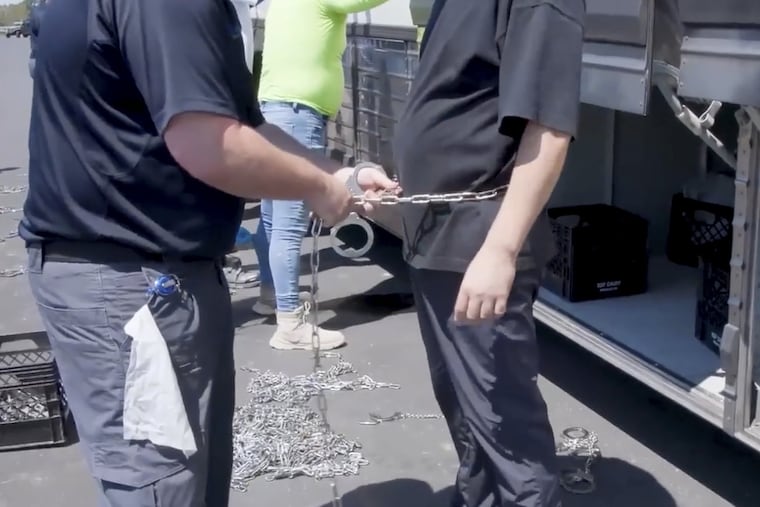
SEOUL — The large-scale immigration raid on a Hyundai-LG battery factory in Georgia has sent shock waves across South Korea, a U.S. security ally that has this year pledged to invest hundreds of billions of dollars in the U.S. and is now balking at what many here view as the Trump administration’s bad-faith actions.
Opposition lawmakers, former government officials, and newspapers across the ideological spectrum are expressing outrage at the raid in which more than 300 South Korean nationals were arrested, calling the administration “unusual,” “impulsive,” and “contradictory.”
“I’m really speechless and furious,” said Choi Jong-gun, former vice foreign minister. “We spend a lot of money in the United States and we get slapped in the face.”
The arrest of 475 workers last week at the plant in Ellabell, Ga., was the largest worksite enforcement operation to take place so far in President Donald Trump’s second term.
South Korean Foreign Minister Cho Hyun traveled to Washington on Monday amid fallout from the raid on Thursday. The Foreign Ministry said Cho will work toward the “voluntary departure,” rather than deportation, of all South Korean citizens so that they can be repatriated on chartered flights as soon as possible. The employees are expected to return to South Korea as early as this week.
But there is broader alarm here about what the actions mean for South Korean companies that have invested in the U.S., drawn in large part by Washington’s efforts to boost economic cooperation between the two nations as a strategy to counter China’s growing economic dominance.
And there is frustration at “America First” sentiments that say South Korean companies are a part of a “bait-and-switch” promising jobs for Americans but illegally hiring its own nationals instead, an allegation by Tori Branum, a Georgia Republican running for Congress in 2026.
South Korean media have focused on Branum, who describes herself as an “America First” candidate. She said she tipped off immigration authorities about the battery plant and talked to an agent from Immigration and Customs Enforcement about her concerns over the legal status and treatment of workers there.
“Her justification of ‘protecting American jobs’ rings hollow when her actions sabotage Georgia’s long-term prosperity,” wrote one South Korean business publication, CEO News, saying Branum was using the issue to gain a political edge in her campaign.
South Korean companies like Hyundai and LG, which jointly operate the plant in Georgia, ramped up their investments in the U.S. under President Joe Biden’s administration, which offered incentives for semiconductor and electrical vehicle production.
Then, as part of a recently agreed trade deal with the Trump administration, South Korea agreed to invest $350 billion in the U.S. to help revitalize American manufacturing — which Trump has welcomed with open arms.
South Korean President Lee Jae Myung visited Hanwha Philly Shipyard late last month, joining U.S. officials to promote a trade, investment, and military partnership they said should vastly increase employment and production at the Philadelphia shipyard.
South Korean business leaders said South Korea and its shipbuilders, led by Hanwha and Hyundai, have targeted $150 billion for Korean investments in U.S. shipbuilding, including at least $5 billion for improving the Philly yard.
In March, Trump called Hyundai’s investments in the U.S. — including the Georgia project — “beautiful.” But the images of South Korean workers shackled during the raid say otherwise, their compatriots say.
“We are there to help boost up American industries … and once they are set up, there will be good infrastructure for increasing American employment,” said Choi, the former vice foreign minister. “But what we saw was those Koreans chained with handcuffs and treated as if they were terrorists or a bunch of thugs.”
The raid comes during a rocky period between Washington and Seoul, during which Trump eventually settled on a 15% blanket tariff for South Korea in response to its $66 billion trade deficit.
But tensions seemed to be easing last month, when South Korea’s left-leaning President Lee held a chummy summit with Trump in Washington, the two of them touting cooperation and the strength of the bilateral relationship.
Chosun Ilbo, South Korea’s largest daily newspaper, raised concerns about what the raid would mean for future investments.
“Why target South Korean factories when Taiwan and others are also building plants in the U.S.?" the conservative paper wrote in an editorial Monday. “[Seoul] should convey domestic concerns — such as, ‘Should we continue investing in the U.S.?’ — to U.S. authorities and demand strong guarantees to prevent recurrence.”
Hankyoreh, a left-leaning news outlet, on Monday criticized the U.S. for damaging ties between the two allies.
“The U.S.’ double-dealing behavior of demanding massive infusions of capital from South Korea, only to use immigration raids to intimidate the companies making these investments, is extremely regrettable,” Hankyoreh wrote.
Steven Schrank, a special agent in charge of Homeland Security Investigations in Georgia and Alabama, said in a news briefing Friday that some of the workers had entered the country illegally, some were working in violation of their visas, and some had overstayed their visas. He said the arrests were part of an ongoing, monthslong investigation.
South Korean politicians and corporate leaders are calling for clearer visa guidelines from the U.S.
It is unclear what type of visa the detained workers used. But for more than a year, South Korean businesses have faced challenges navigating the U.S. visa process given the cap on specialized work visas, such as the H-1B, and they have used other short-term visas that left the workers in a “gray zone,” said James Kim, president of the American Chamber of Commerce in Korea.
That meant engineers helping establish plants like the Hyundai-LG factory would enter on a visa waiver called the Electronic System for Travel Authorization or the B-1 business visa. Both allow visitors to do certain business activities, like attending conferences or business meetings, but they are not intended for paid employment in the U.S.
A lawyer for several workers detained in Georgia says many of the South Koreans rounded up in the immigration raid are engineers and equipment installers brought in for the highly specialized work of getting an electric battery plant online.
Atlanta immigration attorney Charles Kuck, who represents four of the detained South Korean nationals, told the Associated Press on Monday that many were doing work that is authorized under the B-1 business visitor visa program. They had planned to be in the U.S. for just a couple of weeks and “never longer than 75 days,” he said.
“The vast majority of the individuals that were detained by U.S. Immigration and Customs Enforcement that were South Korean were either there as engineers or were involved in after-sales service and installation,” Kuck said.
Kuck said no company in the U.S. makes the machines that are used in the Georgia battery plant, so they had to come from abroad to install or repair equipment on-site — work that would take about three to five years to train someone in the U.S. to do, he said.
“This is not something new,” Kuck said. “We’ve been doing this forever, and we do it — when we ship things abroad, we send our folks there to take care of it.”
While neither government has revealed details about all the workers’ visas, it’s not unusual for foreign companies to save time and money by sending workers from abroad to set up U.S. factories, and then train U.S. workers, said Rosemary Coates, executive director of the Reshoring Institute, a nonprofit that encourages U.S. manufacturing.
“We saw the same thing happening in the ’80s with Japanese carmakers setting up U.S. factories, and in the ’90s with German carmakers,” she said.
The latest incident is a “hiccup” in the decades-long relationship between the two nations, but it’s an opportunity to clarify uncertainties around these visa issues, especially for the companies that want to continue to invest in the U.S., Kim said.
Inquirer staff reporter Joseph N. DiStefano and Associated Press contributed to this article.