Musk’s SpaceX reveals its finances for the first time
SpaceX’s revenue soared to $18.7 billion in 2025, up 33% from a year earlier, but the company also lost more than $4.9 billion last year.
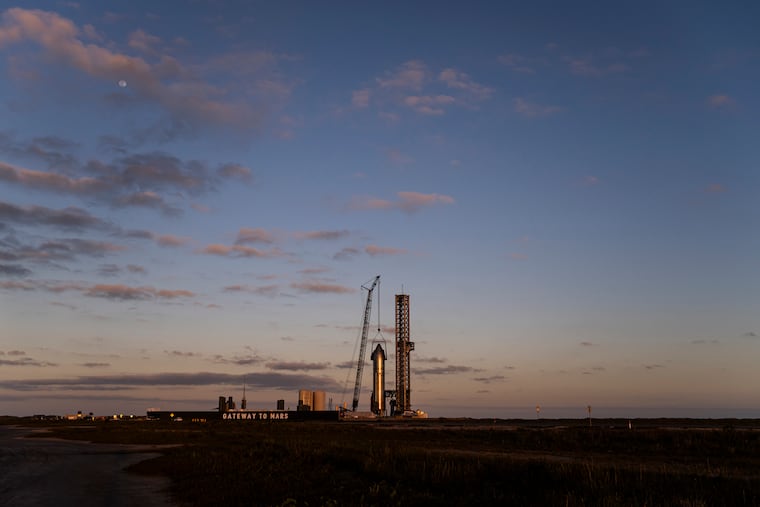
LOS ANGELES — SpaceX, Elon Musk’s privately held rocket and satellite maker, has long been something of a financial mystery, even as it became synonymous with audacious plans to reach the stars.
That changed Wednesday, when the company revealed just how lucrative its rocket launch and satellite internet businesses have been.
SpaceX’s revenue soared to $18.7 billion in 2025, up 33% from a year earlier, the company disclosed in a filing required of firms that are seeking to go public. In the first three months of this year, revenue rose to $4.7 billion from $4.1 billion in the same period a year ago.
But the company lost more than $4.9 billion last year, compared with a $791 million profit in 2024, as capital expenditures nearly doubled to $20.7 billion from heavy spending on artificial intelligence development. In the first three months of this year, SpaceX lost almost as much money as all of 2025, recording a $4.3 billion loss.
SpaceX, which also owns the social media platform X and xAI, the maker of the Grok chatbot, drew back the curtain on its finances for the first time as it prepares for what could be one of the largest initial public offerings to date. The company, which values itself at $1.25 trillion, is aiming to reach the stock market as early as next month and could try to raise $50 billion to $75 billion from the offering.
If successful, SpaceX’s IPO could pave the way for other enormous offerings, including from AI companies Anthropic and OpenAI, which is also preparing to file confidentially for an IPO in the coming weeks. Last week, Cerebras, an AI chipmaker, kicked off the expected wave of offerings and rose 68% on its first day of trading, becoming the largest public offering so far this year and the biggest of any technology firm since 2019.
A strong public markets debut for SpaceX would bring generational riches to Wall Street, the company’s employees and, of course, Musk, who is already the world’s richest person and could become its first trillionaire.
Musk and a SpaceX spokesperson did not respond to requests for comment.
How closely Musk is tied with SpaceX was made clearer in the filing. He owns around 50% of the company’s shares outstanding and controls more than 85% of the shareholder votes because of a class of super-voting shares, according to the filing. Gwynne Shotwell, SpaceX’s president and chief operating officer, was the only other executive listed in the filing to hold a seven-figure chunk of the super-voting shares.
Based on SpaceX’s current $1.25 trillion valuation, Musk’s ownership stake is worth more than $635 billion.
“SpaceX is his company,” Jay Ritter, an IPO expert at the University of Florida, said of Musk’s stake.
Founded in 2002, SpaceX has grown into one of the world’s leading space companies by developing partially reusable rockets with the goal of eventually taking humans to Mars and making people multiplanetary. In the United States, SpaceX accounts for 5 of every 6 launches into space, according to Georgetown University’s Center for Security and Emerging Technology.
In February, Musk merged SpaceX with xAI, which already owned the social network X. Since then, he has expanded the company’s goals, declaring that SpaceX would build artificial intelligence data centers that orbit Earth, create a facility to manufacture complex AI chips and develop human colonies on the moon.
Potential investors would be financing those moonshots, which have drawn skepticism, given Musk’s optimistic timelines for these goals. The billionaire has also shifted SpaceX’s focus from taking humans to Mars in recent months.
The company is preparing another test launch of Starship, its largest rocket, on Thursday. Musk has said Starship will eventually take people to Mars and bring data centers to space.
SpaceX’s most lucrative business is Starlink, its satellite internet service, which had 10.3 million subscribers at the end of March, double from a year earlier, according to the company filing. Last year, Starlink recorded about $4.4 billion in income from operations, also more than double the year prior.
In its filing, SpaceX said it had “the largest actionable total addressable market” in “human history,” estimating that at $28.5 trillion. That included a $1.6 trillion market for Starlink; $370 billion from “space-enabled solutions”; and $26.5 trillion in AI, which included an estimate of $22.6 trillion for AI “enterprise applications.”
While much of SpaceX’s capital expenditures have been on artificial intelligence, the company’s filing suggested it was already seeing business opportunities from its investments. After building two large data centers known as Colossus 1 and 2 in Tennessee, SpaceX struck an agreement with Anthropic for the AI startup to rent its computing power for $1.25 billion a month for the next three years, the filing said.
The document said the company’s objectives had “no precedent” and acknowledged risks including rocket launch failures, spending on AI development, the scaling of Starlink and potential reputational harm associated with Grok, which had 6.3 million paid subscribers at the end of March.
Musk has previously shown a distrust for the scrutiny and disclosures that come with running a public company. In 2018, amid turmoil and shareholder pressure at his electric carmaker Tesla, he tried to take the company private, leading to a protracted fight with the Securities and Exchange Commission. He has criticized the agency, as well as short sellers in Tesla’s stock.
“There’s a lot of pressure, like, immense pressure on a public company to not have a bad quarter,” Musk said in a 2023 interview livestreamed on X, suggesting that short-term disclosures do not help long-term thinking. “This can actually result in a less efficient operation where you’re going to great lengths at the end of the quarter to not disappoint people.”
This time, Musk has ensured that he has a viselike grip on his company. With his voting control, “Mr. Musk will have the power to control the outcome of matters requiring shareholder approval, including election of all our directors, and to control our business and affairs,” the filing said.
Before Wednesday’s public release of its IPO prospectus, SpaceX had hosted some shareholders and potential investors at its facilities in California, Texas and Tennessee to showcase its services. Most companies going public meet with potential investors after their financial numbers are disclosed, to gauge interest in buying their shares, in a process known as a roadshow.
SpaceX’s IPO would create other winners beyond Musk. Those would include Peter Thiel’s Founders Fund, a venture capital firm that invested in SpaceX in 2008, and Valor Equity Partners, whose founder, Antonio Gracias, is a close friend of Musk and sits on SpaceX’s board.
Goldman Sachs, Morgan Stanley, Bank of America, Citigroup and JPMorgan Chase, which were competing for top billing as underwriters on the prospectus, were informed Tuesday night that Goldman Sachs would be the lead underwriter, in a coup for the bank, two people familiar with the situation said.
SpaceX did not say how many shares it will sell in the IPO or at what price. It will trade on the Nasdaq under the symbol SPCX.
This article originally appeared in The New York Times.