This Rittenhouse hotel almost canceled a family’s July 4 reservation last minute. What if it happens to you?
The hotel found rooms for the family after escalating the issue. But it could happen to others in Philadelphia a tourism expert explains.
Chris Denno saw the stars align in August when he realized a once-in-a-lifetime vacation was within Amtrak distance from his home outside Washington.
The FIFA World Cup was coming to Philadelphia at the same time as America’s 250th anniversary: Denno could usher his teenage boys through the ambiance of Philly summer nights and delight his Paris-born girlfriend with the nonzero chance that France could play its Round 16 World Cup match on July 4 at Lincoln Financial Field.
“I remember telling my kids, ‘This is something you’re going to remember for the rest of your life,’” Denno said about Philly’s “can’t-miss” summer.
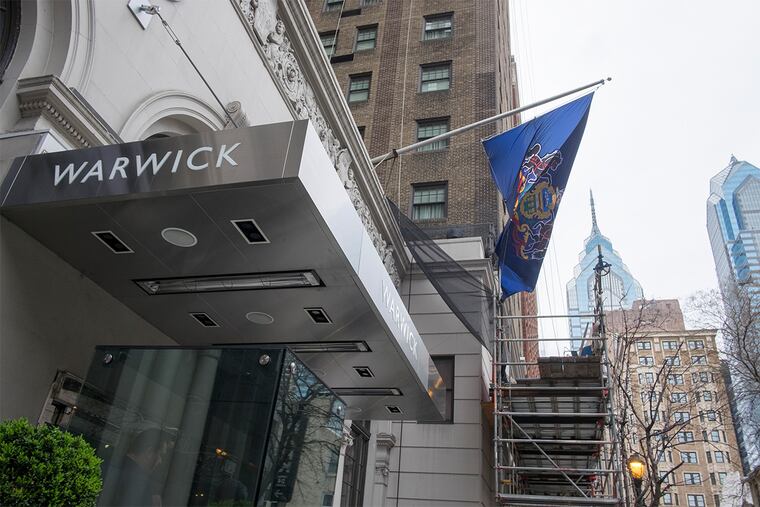
Ready to splurge on the one family vacation per year they can afford — nearly 11 months before July 4, 2026 — Denno booked two rooms at Rittenhouse’s elegant Warwick Hotel from July 3 to 5, in a central location to all the sights he hoped to show his boys. Denno likely saved hundreds of dollars booking so early, he said, securing both rooms for the weekend at $870 total.
Half a year later and three months out from the trip, however, Denno received an email: “We sincerely regret to inform you that, due to unforeseen circumstances related to our ongoing renovation project, the Warwick Rittenhouse Hotel is unable to honor your upcoming reservation,” the Warwick Guest Experience Team wrote to Denno.
“How could the hotel be undergoing renovations during what is being billed as Philadelphia’s biggest tourism weekend in years?” Denno thought. To make matters worse, Denno said, Marriott, who owns and operates the Warwick, offered to reaccommodate the family at the Philadelphia Airport Marriott, which he said would defeat the purpose of the vacation.
“I am not willing to relocate to an airport or outlying property, as the purpose of booking nearly a year in advance was to secure a centrally located hotel for this major event,” Denno wrote back.
Fortunately for Denno, he was informed on Thursday, a week after the initial cancellation, that the Warwick had found rooms that would be suitable for the family, despite the ongoing renovations, he said. But Denno wondered: If he hadn’t escalated the issue to corporate, and The Inquirer hadn’t asked Marriott about the cancellation, would he have been out of luck? At one point, he had been debating whether to find other lodging or cut his losses and take a refund.
Marriott has not responded to requests for comment.
“I have had these issues with Airbnb before, where an Airbnb will cancel toward the last minute,” Denno said. “I figured I would avoid that entirely by going through a big national hotel chain. So it’s kind of disconcerting knowing that they can do the same thing.”
Why do hotels cancel at the last minute?
Michael Sheridan, a Temple University professor of hospitality and tourism who was a hotel manager for years, said that how the Warwick handled the Denno family’s reservation is standard operating procedure for hotels.
Hotels will cancel reservations for myriad reasons, and the cancellation can be legal, Sheridan said. The most common reason for canceling on a guest can be renovations that are falling behind schedule, but many times, it can be the industry practice of “overbooking.”
Airlines and hotels book more reservations than they can fulfill to guarantee high occupancy in case guests cancel, and to maximize profits by charging guests willing to pay more for a room. The airline or hotel would just have to reaccommodate or refund the lower-paying guest it is canceling on, Sheridan said.
On top of overbooking, there are also contractual obligations hotels need to uphold when an organization reserves blocks of rooms that the hotel legally has to honor. The folks who get the short end of the stick tend to be lower-paying single-room guests that the hotel overbooked, Sheridan said.
Often, it can be a combination of all three.
“Leisure travelers are generally more price-conscious, and they book far out. Now we’re on crunch time, we’re less than two months away from the World Cup,” Sheridan said. “The people booking hotels now are willing to pay more. So, whether it’s ethical or not, it happens in the industry,” Sheridan said of overbooked rooms going to the highest bidder.
What can customers do about last-minute hotel cancellations?
There is not much a customer can do in trying to retain that canceled room, as hotels are allowed to cancel, Sheridan said.
However, even if that room is going to someone else, customers can still put on the charm, flex their member loyalty, and raise the issue with higher-ups to get an “equivalent” accommodation. Because there is not much legal framework around hotel reaccommodations, Sheridan said, it mostly comes down to a company’s policy, which he says is “usually rebook within your brand.”
“If we were talking about the Marriott Downtown, they’re going to try to put you in another Marriott, most likely at the Marriott Airport,” Sheridan said.
But just because a hotel tries to rebook you within its brand, that doesn’t mean it doesn’t have other tricks up their sleeve. Marriott owns close to 20 hotel brands in the Philadelphia area where it could feasibly rebook customers.
Go a step further, Sheridan said, and many of these hotel staff have worked among competing hotels and brands. This means that even if a hotel brand does not have available rooms, staffers can make back-door deals with other hotel chains to accept your reservations. It is not common, but it is possible, said Sheridan, who employed this as a hotel manager.
All of this will fall on deaf ears, Sheridan said, if customers don’t begrudgingly put on a “happy face” when engaging with hotel booking agents.
“Kindness goes so far in these situations. It goes much further than being angry, and I know it’s a tough situation because these customers thought they covered all of their bases — and they did," Sheridan said. “So they’re probably not the happiest right now, but they’ll get further if they try to keep on that happy face until they get the reaccommodation they’re after.”
Should you flex your member loyalty?
Even loyalty and rewards club members can have their rooms canceled, as Denno has been a Marriott Bonvoy member since 2009. Sheridan said to lean on that loyalty because it will signal that you are a repeat customer.
But, as with airlines, the higher tier your membership is, the more likely the hotel is to reaccommodate you.
“If they’re just a standard loyalty member, who uses the program once or twice a year, that’s not much of a benefit in this situation,” Sheridan said. “However, if they have status, and the higher the level, the more flexibility there is.”
Especially in higher levels often referred to as “platinum” or “diamond,” those members have a “do not cancel, do not walk” requirement included in their membership.
Can I get a refund for a canceled hotel room?
If a hotel cancels your reservations, “the refund is absolutely on the table,” Sheridan said. In fact, in many cases, the hotel prefers guests take the refund because “it kind of gets them off the hook.”
However, if your main goal is to vacation during that same time window, then the refund for the reservation likely will not have the same purchasing power as it did when you initially booked many months prior.