Your carry-on bag followed the rules. So why was it gate-checked?
Understand when and why it happens so you can avoid getting tagged.
You’re a smart packer. You can squeeze all of your belongings into a personal item and carry-on bag. Both pieces comply with the airline’s luggage and fare restrictions. When you test them in the airport’s baggage sizer, they fit as perfectly as a glass slipper on Cinderella’s foot.
And yet, the agent still gate-checks your bag, a practice that is becoming more common as planes fill to capacity and as securing overhead bin space feels like a sport.
In a recent earnings call, Southwest chief operating officer Andrew M. Watterson reported “a modest increase in gate-checked bags.” The airline started charging for checked bags on May 28.
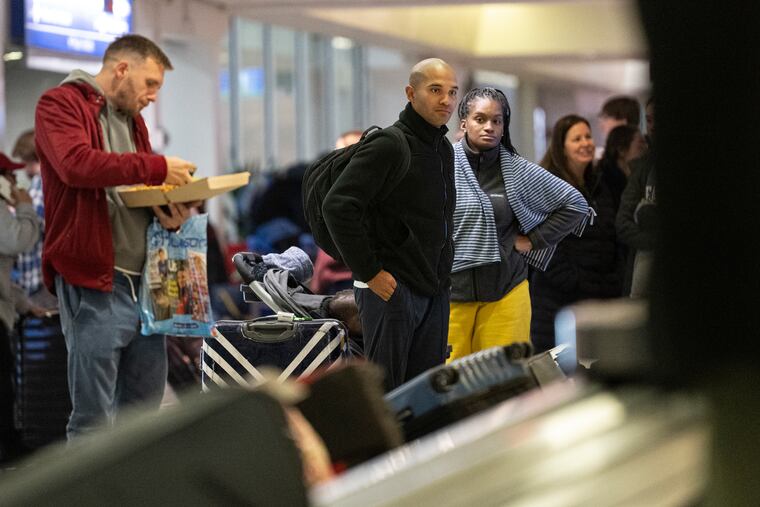
Ages ago, savvy passengers used to angle for a gate check to avoid paying checked-baggage fees. These days, nimble travelers want their carry-on with them in the cabin. Trekking to baggage claim can feel like an expedition, especially in large, sprawling airports. Retrieving a bag from the jetway is quicker, but you still have to wait for the ground crew to fetch the bags from the luggage hold.
Airlines can also mishandle gate-checked bags. In May, U.S. airlines lost, damaged, delayed, or purloined nearly 207,500 bags (0.49 percent of handled bags), according to the Transportation Department’s Air Travel Consumer Report. The data does not distinguish between checked and gate-checked bags.
Gate checks may be avoidable, however. You just need to understand when and why airlines tag carry-on bags.
Tiny bins and packed overhead space
Airlines gate-check bags primarily for space. Either the overhead bins are full or too narrow to accommodate carry-ons, including ones that match the carrier’s size specifications, said Summer Hull, senior director of content at the Points Guy travel site.
“They have done their calculations, and they’re anticipating that they are at, or about to be at, the maximum number of bags they will be able to fit inside the cabin of the aircraft,” she said. “Is that always 100% accurate? Probably not.”
Each airline has its own method for determining when the agents should start checking bags. The motivation, however, is similar: to depart on time.
Southwest, in its financial results call, said it is using “a machine-learning tool that predicts the number of gate-checked bags needed for each flight.” This process helps its staff “to act early and keep the operation running smoothly.”
In a statement to the Washington Post, Delta said it relies on a “strategic, data-driven process.”
“Airport teams use estimators to determine how many carry-on bags need to be gate-checked for each flight,” the airline said by email.
On a recent Delta flight from Boston to Washington, the gate agent said the plane would need to check 25 carry-on bags. Onboard, several bins had open space.
Scott Laird, a travel writer who frequently covers the airline industry, said the decision may be based more on efficiency than accuracy.
“They may just check bags because they want to save time and not have the agent running up and down the jetway to see if the overhead bin space has been taken yet,” he said.
The size of the aircraft is a major factor as well.
Smaller, regional aircraft often have shallow overhead compartments that can’t handle boxy luggage, such as hard-side roller bags. According to United Airlines’ website, passengers on CommutAir, a partner that operates 50-passenger Embraer ERJ145 planes, are permitted one personal item in the cabin. United Express, the airline’s regional arm, will gate-check bags free of charge because of “limited space.”
Early in the boarding process, gate agents will ask for volunteers to relinquish their bags. If not enough people respond, the staff will resort to a mandatory gate checks. If you must gate-check your bag, remember to remove keys, money, medication, electronics, spare lithium batteries, and other valuables, then place them in your personal item.
Pickup on the jet bridge or in baggage claim
The type of tag determines the baggage pickup point.
In general, if the airline employee hands you a valet tag — a paper square with a string, frequently seen dangling on strollers, car seats, and other mobility accessories — you will collect your bag from a cart on the tarmac or on the jet bridge.
If you receive a printed tag with a barcode and airport codes, you will retrieve your luggage from baggage claim at your final destination. If you have a connection, the airline will facilitate its transfer.
If slim bin size is the issue, you don’t have to immediately cede your bag. Ask the flight attendant if you can try to fit the item in the overhead compartment. If the same type of plane accommodated your bag to your destination, share that success story with the flight crew on the return trip. You’ll have better luck squishing a soft bag, such as a backpack or duffel, than a stiff roller bag.
“Sometimes you can talk them into trusting you that it indeed fits,” Hull said. “But if you’re getting resistance, then you should do whatever they want you to do. And if they want to gate-check it, then that’s fine.”
Once the agent has printed a tag linked to the baggage tracking system, you no longer have negotiating power.
“It’s a foregone conclusion that they’ll be checking your bag,” Laird said. Contesting the gate check could lead to a disagreement that could delay the flight, he added.
Removing the tag on the jet bridge is not recommended. Laird said the ramp agents will count the bags in the luggage hold and cross-reference that figure with the number of bag tags. If you rip off the tag, you can disrupt the carefully calibrated operation.
“Their computer system knows how many bag tags have been issued,” Laird said. “So if your bag was tagged but then it doesn’t match the count, it throws off their numbers.”
It can also upset weight and balance calculations, Laird said. If the airline expects to load 30 bags in the front and 30 bags in the back but a few are missing, he explained, “it increases the propensity for delay because it increases the possibility that you need to make changes to weight imbalance.”
How to avoid a gate check
First, make sure your bags are in compliance with the airline’s carry-on dimensions and fare restrictions.
When booking a flight, choose a larger plane with more capacious overhead bins. Hull said she tries to avoid regional carriers. Since packed flights fill up space faster, search for routes with fewer passengers, such as during off-peak days and times.
The earlier you board, the lower the risk of a gate check. Book a higher-priced ticket or seating category that allows you to board early, or pay extra for priority boarding. Join the airline’s frequent-flier program, and start accumulating points to improve your boarding tier or earn early boarding privileges. Or consider using the airline’s credit card, which comes with perks, Hull said.
“Aside from buying first-class tickets, be sure that you have at least a credit card for the airline you most frequently fly, because they typically let credit card holders on earlier in the process than those without,” she said.
Hull reminds passengers to arrive at the gate early and line up as soon as the agent calls their group number.
“Being toward the front of your group as opposed to being toward the back can influence whether or not you make it in before the overhead space is claimed,” Hull said.
If all of these tricks fail, there is an upside to waiting for a checked bag.
Several airlines guarantee that a bag will arrive on the carousel within 20 minutes of the plane landing. Any longer and Delta passengers can earn 2,500 miles; Alaska Airlines, SkyWest and Horizon Air customers can receive 2,500 miles or a $25 discount on a future flight.
“They’re pretty good about getting the bags to you on time,” said Laird, who has banked thousands of miles through Alaska’s program, “but when they don’t, it’s a nice ‘I’m sorry.’”