Thousands of Penn graduate student workers could soon strike
The 3,400-member union GETUP-UAW, which includes teaching and research assistants, has been negotiating with the university for a year on a first contract.
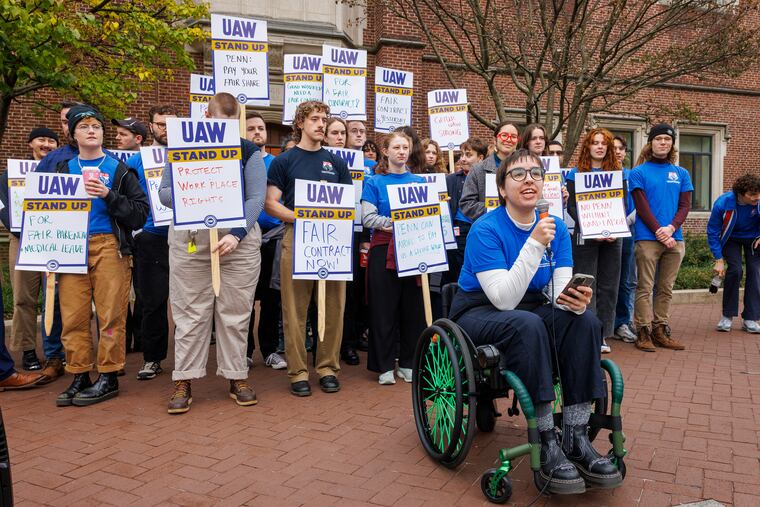
Graduate student workers at the University of Pennsylvania have voted to strike if their union calls for it, as they work toward a first contract with better pay and benefits.
The graduate students, who research and teach at the university, voted to unionize last year, after two decades of organizing attempts.
The union’s total membership is about 3,400, and 2,416 participated in the strike vote. Of them, 92% voted in favor of calling a strike if needed to reach an agreement.
“As the city of Philadelphia’s largest employer and a world-class research institution, Penn must do better by the workers that ensure its continued success,” Katelyn Friedline, a bargaining committee member and Ph.D. student, said at a news conference earlier this month.
The union, Graduate Employees Together-University of Pennsylvania (GET-UP) is part of the United Auto Workers (UAW), which represents groups of university workers across the country, including Penn postdoctoral researchers and research associates who voted to unionize in July.
The strike vote comes amid a wave of labor actions across Penn and other campuses. During contract negotiations in 2023, Temple University graduate workers went on strike for 42 days. The same year, Rutgers University educators, researchers, and clinicians walked off the job for a week.
Since 2023, resident assistants at Penn, Temple, Drexel University, and Swarthmore College have also unionized. This month, graduate student workers also voted to form a union at Pennsylvania State University.
GET-UP has been bargaining with Penn since October 2024, but sticking points include wages, healthcare coverage, and more support for international student workers.
A strike would be disruptive, said Sam Schirvar, a Ph.D. candidate in history and sociology of science, and would be a “last resort” for the union.
“A work stoppage would really inhibit the basic teaching and research functions of Penn, and would make it very difficult for it to operate as it does as an academic institution,” said Schirvar, who has been organizing with the union for over five years.
A university spokesperson, Ron Ozio, said via email on Thursday that Penn has been bargaining in good faith with the union.
“We believe that a fair contract for the union and Penn can be achieved without a work stoppage, but we are prepared in the event that the union membership votes to authorize a strike,” said Ozio.
What are graduate workers asking for?
“There’s still a lot of room between the kinds of things that we’re calling for and the kinds of things that management is proposing,” said Schirvar.
Wages
The majority of the bargaining unit is made up of Ph.D. students who are paid an annual stipend, while workers pursuing master’s degrees receive hourly pay.
Stipend workers make a minimum of about $39,000 annually, and hourly workers have no university minimum, Schirvar said.
In its most recent proposal, the university offered $19 an hour for hourly employees and a minimum of $44,000 for the annual stipend starting in July 2026. The union is asking for a minimum wage of $37 an hour for those paid hourly and $55,500 for those on an annual stipend upon ratification of the contract.
“While we’re asking for these things because it would make meaningful and life changing differences in our own individual lives, it also helps keep Penn a competitive, world-class institution,” said Friedline.
Healthcare improvements
The union is asking for the university to cover the full cost of health insurance for graduate student workers including dental, vision, and dependent coverage. The university already pays full healthcare benefits for graduate student workers, and some dental reimbursements depending on their department, said Friedline.
Support for international students
The union is also asking for more protections for international student workers on visas, who represent roughly a third of the bargaining unit, said Friedline. That support is important at this time, Friedline said, “amidst a national anti-immigrant political climate.”
The union wants Penn to reimburse up to $3,000 of immigration expenses, bar immigration enforcement agents from entering nonpublic areas of campus unless legally required to, and alert the union if access is granted for a search or arrest warrant.
Guruprerana Shadadi, a second-year Ph.D. student in the computer science department and an international graduate worker from India, said he had to cover the costs of moving to the U.S. before getting his first paycheck from the university, which included visa expenses.
“I was lucky enough to be able to afford this, but I know several international graduate workers who found it extremely hard to go through this process,” he said. “Receiving a livable wage and higher stipends would go a long way for international students who literally have to start from zero to set up their lives here when they move to the United States.”
Vacation days
The union is asking for 20 paid vacation days and 20 sick days in a year. University leadership has said that this proposal exceeds what full-time staff get in their first few years. The university has proposed five paid days off per fiscal year and noted in a proposal that workers can “request flexibility in scheduling” when sick.
Penn doesn’t currently have a centralized paid time-off policy for graduate student workers, and employees may be grading student work, preparing teaching materials, or working in a lab during the university’s academic breaks, said Schirvar.
Why are graduate students organizing now?
The academic job market has changed in recent decades, said Adrienne Eaton, a distinguished professor in the Rutgers School of Management and Labor Relations. In the past, graduate student workers might have been more willing to get paid less, knowing that time would ensure they could get good jobs later on.
“You could kind of sacrifice those wages, that salary for a while, because you were pretty sure that when you finished, you were going to be able to get a tenure track job — and that just hasn’t been true, probably more like 20 years, depending on what field you’re in,” she said.
Meanwhile, the cost of living has risen, said Eaton. “Those stipends that used to be kind of OK, I think, have gotten to be viewed as much more inadequate.”
Whether or not Penn graduate workers actually strike, Eaton noted that passing a strike authorization vote typically sends a message.
“It’s a leverage tool in bargaining to kind of let the employer know we’re serious about this, and you need to be serious about what you’re doing at the bargaining table,” she said.