‘America First’ stock trade loses its shine as AI, policy woes linger
Investors are increasingly looking overseas as economic uncertainty and chaos roil the U.S. markets and the dollar weakens.
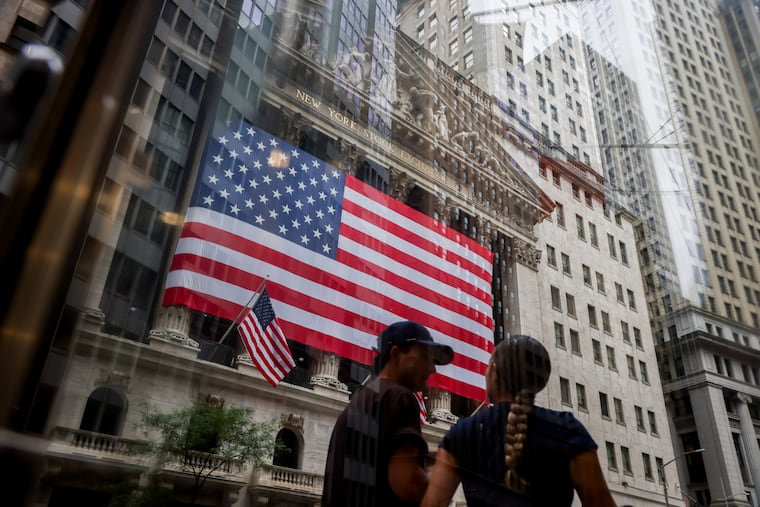
The U.S. stock market is having what, for the longtime envy of the world, amounts to something of a comeuppance.
The S&P 500 Index just spent February churning not far from an all-time high, with bouts of selling offset by rapid dip-buying. In the end, the index went essentially nowhere. Overseas, the trading was much rosier.
The MSCI World excluding U.S. index rose nearly 5%, beating the U.S. benchmark by the most since the depths of the financial crisis in 2009. American equities now trail the world by more than 9 percentage points so far in 2026. Last year, international stocks topped the U.S. by 12 percentage points, the most since 1993.
It’s starting to look like a trend with staying power — even as a dramatic escalation in the Middle East conflict unsettled markets in the United States and around the world. Strategists at UBS downgraded U.S. equities to a neutral weighting — hardly a mark of shame, but unbecoming for a market home to the world’s most valuable companies. Investors have already eased up, with just $26 going to the U.S. out of every $100 sent to an equity fund this year, according to Bank of America.
The reasons for the shift in investing preferences are well worn. The U.S. economy’s heavy tilt toward tech and services leaves it vulnerable to disruption from artificial intelligence tools. The Trump administration’s chaotic trade policies have made long-term business planning exceedingly complex. The U.S .outperformed for so long, a new front-runner was bound to emerge.
The latter point has taken on greater meaning in recent weeks, as investors survey European and Asian markets and see companies trading with cheaper valuations than in the U.S. but with similar prospects to grow earnings.
“The way we frame it is very simple: the equity risk premium in the U.S. is close to zero,” said Alessandro Valentini, director and fundamental portfolio manager at Causeway Capital Management. “Outside the U.S., equity risk premia are higher, meaning investors are being paid more to take risk. That matters, especially after seeing how volatility played out in 2025.”
Turbulence has been a constant in the U.S. market so far this year. The Cboe Volatility Index has repeatedly pushed above 20. Realized volatility hit the highest level since November, and intraday swings have widened.
Much of the turmoil stems from the so-called AI scare trade, which roiled market sectors time and again in February. But the Trump administration has also waded deep into industrial and commercial policy, at times picking winners in industries in ways irreconcilable with long-term capitalist precedents.
The Supreme Court’s ruling that struck down much of President Donald Trump’s tariff scheme has left businesses and consumers uncertain of what policy is in force. The White House has implemented a new 10% global tariff and is working on an order to raise it to 15%, though those levies last only 150 days unless Congress authorizes them — an unlikely scenario ahead of November’s midterms.
“This may continue to result in better performance for non-domestic assets,” said Gina Martin Adams, chief market strategist at HB Wealth Management. “Presumptions that the U.S. market will remain the most investor- and business- friendly are challenged with policy volatility, and capital may continue to diversify to other global areas of stability as a result.”
A growing number of investors agree, going by flows tracked by BofA. American stocks haven’t been this out of favor relative to international peers in more than five years, according to chief investment strategist Michael Hartnett. Here, too, the stat isn’t entirely damning; the U.S. is just less exceptional than it had been.
U.S. policy volatility has become a longer-term tailwind for the rest of the world, said Aniket Shah, global head of Washington, sustainability, and transition strategy at Jefferies.
“The U.S. has of course become much more politically uncertain,” he said. Investors are asking, “Do I need 80% of my assets in a country that is a little politically wobbly? Maybe not.”
European equities, especially industrials, defense, and banks, look most attractive, according to Adrian Helfert, multi-asset strategies chief investment officer at Westwood. Increased government spending on infrastructure, energy projects, and weaponry should boost those sectors. Financial firms in the region also stand to benefit, he said.
“This isn’t a ‘hide from the storm’ trade, it’s a structural re-rating story that’s only in the early innings,” he said.
Even after the decline in February, the S&P 500 trades less than 2% away from its all-time high and at more than 20 times its 12-month forward earnings, still higher than the valuation elsewhere. At the same time, earnings growth in the U.S. may have peaked, making it difficult to justify paying a premium.
“The American market is still more expensive than the European market. So you still have a valuation argument,” said Soliane Varlet, a portfolio manager at Paris-based Mirova. In Europe, she said, “you have incremental news which is more positive, and maybe more uncertainty in the U.S.”
The dollar’s weakness is also a thing to watch, as it could give more tailwinds to emerging markets.
“If these dynamics lead to a structurally weaker U.S. dollar, the case for geographic diversification strengthens,” said Jung In Yun, chief executive officer at Fibonacci Asset Management Global in Singapore.
“In that environment, profit-taking in crowded U.S. positions and a gradual rotation into other equity markets, as well as a dispersion of liquidity away from mega-cap technology into broader sectors, appears increasingly likely.”