Philly-area union officials say they’re not backing down as federal agencies cancel contracts
The EPA and VA have canceled union contracts for workers in recent days. Local union representatives say they can still support federal workers in several ways.
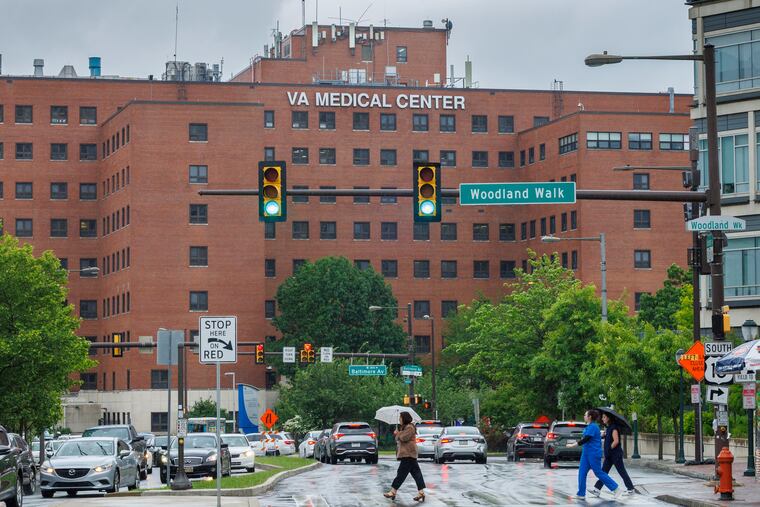
On Monday, Karen Ford-Woods brought bins to work to pack up the union office at the U.S. Department of Veterans Affairs medical center in West Philly.
Items that needed to be gone by end of day Tuesday included employee files, union banners, and plants, said the president of the union local that represents Philly-area VA employees.
At the Environmental Protection Agency’s office in Center City, Brad Starnes, president of AFGE Local 3631, started emptying the union space months ago in anticipation of an order to do so.
“I saw this as an inevitable outcome of the change of administration,” Starnes said Monday.
President Donald Trump’s administration moved to cancel union contracts for federal workers across agencies in recent days, and as a result, some union officials in Philadelphia are changing how they conduct their work.
In March President Donald Trump, citing national security, issued an executive order directing some federal agencies to end collective bargaining agreements. Since last week, the VA, the Environmental Protection Agency, the U.S. Citizenship and Immigration Services, and the Federal Emergency Management Agency have canceled contracts for many bargaining unit employees represented by the American Federation of Government Employees (AFGE), the largest federal union, as well as other employee unions.
The U.S. Department of Agriculture also reportedly canceled contracts with thousands of employees in its animal health and food inspection agencies, according to Reuters.
It’s just the latest move from the Trump administration to target unions and the federal workers they represent. Workers have been dealing with widespread attrition, including layoffs, since Trump took office.
“This is all in retaliation for AFGE basically standing up for our contractual rights and our statutory rights,” said Philip Glover, AFGE national vice president for District 3, which includes Pennsylvania and Delaware. As of January, the union represented roughly 9,400 federal workers in and near Philly, among about 800,000 the union represents in the U.S. and abroad.
AFGE also has been feeling the impacts of Trump’s policies internally — losing members and cutting staff. The union’s District 3 has lost dues-paying members, and within AFGE, there has been a reduction in force of staff, said Richard Gennetti, an AFGE national representative for the region.
Union leaders are pledging to still support federal workers, lobby elected officials, or go to court.
“The union is still here,” said Ford-Woods at the VA. “We’re never gonna stop fighting for the union. When [the] union first started, we didn’t have contracts. That’s something that you have to work to get, but that doesn’t mean you don’t have a union.”
Anger, fear, and resolve
At the Veterans’ Benefits Administration Office on Wissahickon Avenue on Monday, people were “crying at their desks,” according to a union representative, who asked to speak anonymously out of fear of workplace retaliation.
The employees were “thinking that they’re going to get fired because there’s no union to protect them,” the union representative said.
For months, morale at the VA has been in a downward spiral, but now it’s “dead,” the union rep added. Ford-Woods noted that VA employees are fearful and discouraged.
For its part, the VA has said that going forward, agency staff will spend more time serving veterans instead of “union bosses.”
“Too often, unions that represent VA employees fight against the best interests of veterans while protecting and rewarding bad workers,” VA Secretary Doug Collins said in a statement. “We’re making sure VA resources and employees are singularly focused on the job we were sent here to do: providing top-notch care and service to those who wore the uniform.”
At the EPA, workers are angry, Starnes said. “It’s sort of a ‘here we go again’ — the latest swipe at the worker.”
Starnes added that for some workers, this latest move is strengthening “their resolve to continue to do the work of the agency and to do what they can do to reverse what is happening within our agency in this country.”
In some ways, the Trump administration’s targeting of federal employees has become the “best recruiter,” Gennetti said.
“They have made the need for a union manifestly known to lots of people, and lots of people are joining up because they see how terrible the workplace is becoming, and how much they need the union presence,” he said.
What can a union do?
The union office at the EPA’s Center City location has served a practical purpose, says Starnes.
“It allowed us to conduct meetings in a private way, meet with staff in a secure location — but we’ll meet that need in other ways, as we must,” he said.
Some union work formerly took place during an employee’s workday under the EPA union contracts, Starnes said. Now the union plans to connect with federal employees after work.
“Essentially union work becomes an after-hours endeavor,” Starnes said. “We’ve rescheduled meetings to accommodate the need to not overlay our activities with those of EPA official duty.”
And federal workers still need support, says Starnes, such as the EPA employees who were placed on administrative leave in July for their association with a letter expressing critique of the current agency’s leadership.
“They’re in a situation that the union feels staunchly was unfair, retaliatory and — it’s baseless. This is just to create fear, which it has done successfully,” Starnes said.
The union will still need to collect dues because “it just costs money to do what we do” — which can include paying for attorneys, Starnes said.
AFGE started transitioning workers to its own electronic payment platform to collect union dues during Trump’s first term, instead of relying on the agencies deducting the money from employee paychecks.
On Tuesday, AFGE also announced it was restructuring some departments out of its headquarters.
In a statement, AFGE national president Everett Kelley said the union is carrying out the changes to “sharpen our advocacy, strengthen our legislative efforts, and ensure our communications and education efforts reach every member, ally, and decision-maker who needs to hear our voice.”
‘An attack on one is an attack on all’
AFGE has been around since the early 1930s but didn’t get officially recognized by the federal government until President John F. Kennedy signed an executive order in 1962, said Glover.
“We were representing employees long before we had recognition,” he said. “We’re not going anywhere, as far as that goes. We’re gonna keep helping our members.”
Part of making their presence felt lies in relentlessly lobbying elected officials.
“One thing I’m letting members of Congress in the district know is that we’re going to start sending individual members’ problems to them,” Glover said. “If they don’t want to stand up for us and make sure that we have our union rights, then they can go out and fix problems for these constituents.”
Gennetti, one of the national representatives for AFGE District 3, said the state’s Democratic lawmakers have been strong voices in Congress, but he also named two swing-district Republicans, U.S. Reps. Brian Fitzpatrick and Rob Bresnahan, as allies.
The union can also support workers through workers’ compensation, Equal Employment Opportunity cases, the U.S. Merit Systems Protection Board, as well as go to court and lobby, union leaders said.
Under union contracts, AFGE has had to go through a grievance process when an issue arises with an employer, said Glover.
“Years ago, before we were basically recognized, there were a lot more court cases. Federal employees would sue their managers. They would sue their agencies,” he said. “I guess we’re back to that, or we may be back to that — our lawyers will have to tell us this.”
Ed Welch, president of AFGE Local 2058, which represents National Park Service employees in Philadelphia, said federal workers losing union contracts is “appalling”
NPS employees, who fall under the Department of Interior, still have their contracts intact but Welch believes every employee should see it as a rallying call for solidarity.
“An attack on one is an attack on all, and it is not only unlawful, but it runs against what this country is about,” he said.