The future of white-collar work may be unionized
Law firms, banks, and tech companies are seeing an uptick in employees choosing to organize.
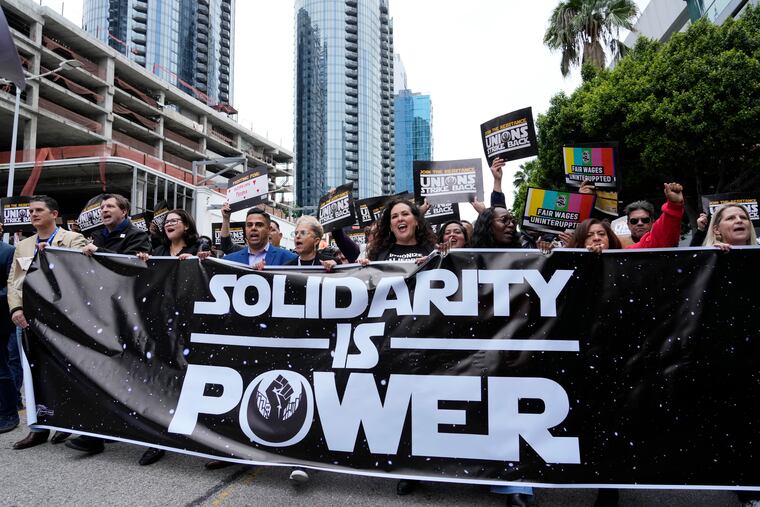
Danielle Olivas never questioned her job security as a bank teller for Wells Fargo until her district manager in Artesia, N.M. — who had worked at the company for more than 30 years — was laid off.
Concerned, she called Sabrina Perez, a colleague in Albuquerque whose branch had unionized in December 2023. Thirteen months later, Olivas and her coworkers unanimously voted to unionize themselves, joining 27 other branches located across the country. It has been the first successful union drive at a major U.S. bank in decades, and one of the clearest signals of labor’s changing face in America.
In 2024, a record-low 9.9% of U.S. workers were members of a union, according to the Labor Department, but interest is soaring. An August Gallup poll found that nearly 70% of Americans approve of organized labor, and last year, unions filed twice as many petitions seeking elections compared to 2021, according to federal data. With layoffs and automation eroding the stability traditionally associated with knowledge jobs, the future of white-collar work might include some tried and tested ways to protect one’s job.
“The introduction of new technologies has eroded both pay and prestige of these jobs, and I think that’s making workers feel that the kind of career path that might have been available to the generation before them is starting to seem less accessible,” said Joseph McCartin, a labor historian at Georgetown University.
White-collar workers are fueling some of that interest, and union drives could become more common in the coming years for professional workers in high-earning sectors, McCartin said.
One factor is declining job security in white-collar industries, a trend particularly apparent to tech employees. Since 2020, tech companies have unleashed rounds of mass layoffs, inspiring calls for worker protections across the industry. In 2020, employees at Kickstarter, a crowdfunding platform, formed the first union at a major U.S. tech company. The union helped secure layoff terms significantly above the industry average at the time, including up to six months of healthcare and severance, according to Dannel Jurado, a senior engineer at Kickstarter and union organizer.
More unions have since established themselves at tech companies. In 2021, workers unionized at Alphabet, Google’s parent company, and last year, employees at Bethesda Game Studios, owned by Microsoft, also organized.
“The way layoffs happened at Google, where it wasn’t clear what the reason for people getting laid off was, definitely created a sense of job insecurity and mistrust,” said Parul Koul, a software engineer at Google and president of the Alphabet Workers Union.
Another driver has been artificial intelligence threatening to replace entry-level knowledge work. Few white-collar industries epitomize the challenge of integrating AI into workflows more than the practice of law. While many legal experts say AI will have a transformative impact by automating repetitive research tasks, some also fear it will dilute entry-level associate roles at law firms.
“Unionization is a really important part of the way that we need to address the implementation of AI into law firms,” said Benjamin Sachs, a labor law professor at Harvard Law School.
Unions that represent public defenders and paralegals have existed for decades, but few large firms have entertained calls to unionize. In 2023, New York City-based Outten & Golden, a firm specializing in employment law and workplace-related matters, became one of the first private law practices to voluntarily allow unionization when its 24 associates agreed to organize. Larger firms with more diverse focus areas, however, might face more structural hurdles, Sachs said.
Federal law bars employees who work in a supervisory role from joining a union, a distinction that is hazy even for entry-level workers in most law offices and white-collar firms at large. White-collar unions might also face an unfavorable political climate, after an executive order by President Donald Trump earlier this year stripped workers of union rights at dozens of federal agencies, a move organizers have likened to union-busting.
Another obstacle is culture. Intense competition at prestigious law firms, banks, and tech companies makes many workers “culturally predisposed to be anti-union,” according to Sachs. But that might not be the case forever. Support for unions tends to be highest among younger workers, and more union drives could have a domino effect. Following Wells Fargo’s successful organizing campaign this year, workers at JPMorganChase, the country’s largest bank, are reportedly discussing an effort of their own.
“There always seem to be cultural barriers, until there are not,” Sachs said.