Gossiping about the boss? It might be a good thing, per new study
Rebecca Greenbaum, a professor at the Rutgers School of Management and Labor Relations, co-authored a study on workplace gossip published in the Journal of Business Ethics.
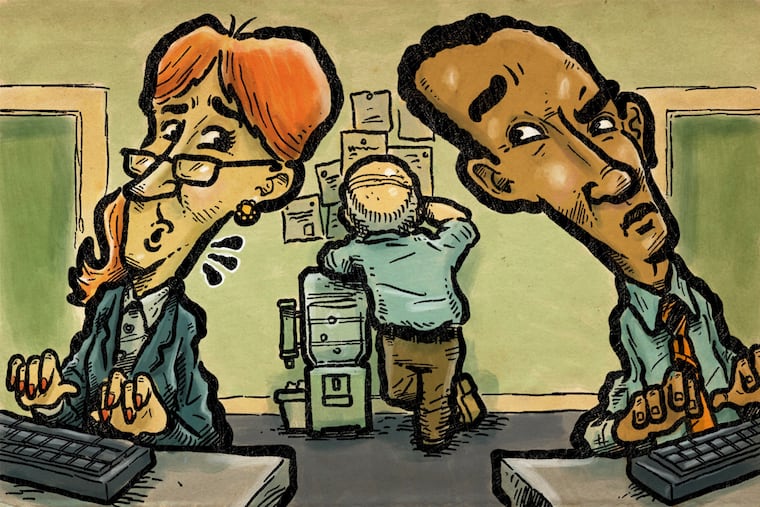
Gossip often gets a bad rap.
It can be seen as frivolous or hurtful, and not typically encouraged.
Still, “there seems to be something about it that makes people a little bit giddy, or excited to be gossiping,” says Rebecca Greenbaum, a professor at Rutgers University School of Management and Labor Relations.
In a recent study, Greenbaum and co-authors focused on the role of gossiping in the workplace. They found that talking about the boss behind their back can present a benefit: bonding among colleagues, and more cooperation. Their findings were recently published in the Journal of Business Ethics.
The study surveyed hundreds of participants who were asked to report if they had gossiped about the boss that day and how they acted afterward. Colleagues of some of the participants were also surveyed.
The study results show that on days when employees talked about the boss, they were likely to experience negative feelings such as guilt or shame, and avoid the boss. After gossiping, employees also reported feeling more of a sense of belonging with their colleagues.
“It doesn’t necessarily mean we’re saying ‘go out and gossip’ because we want you to feel closer to one another,” said Greenbaum. “It’s just that it provides one explanation for why people probably do engage in gossip, because they are getting this benefit from feeling closer to one another.”
This conversation has been edited for length and clarity.
What role has gossip typically played in the workplace? Is it positive? Negative?
In most of the research [until now] … oftentimes it was just looked at more negatively, or it was [discussed] much more in terms of being the victim of gossip. So if I found out someone was speaking poorly about me, how would I feel? I would probably feel angry. I’d feel hurt, I’d feel sad.
But where [we] really took this in a different direction was focusing much more on the person engaging in the gossip. From that standpoint, not as much research had been done in terms of how people react to their own behavior. So for example, do people really see it as bad? That was one thing we were curious about.
What do you hope people will take away from the study?
Keep in mind the boss is someone who can give you rewards, they can punish you — so it’s a little bit more high-stakes to talk badly about a boss compared to maybe just you talking bad[ly] about a coworker or neighbor or something like that.
We have these emotional reactions sometimes because they serve to protect us. So if you feel … shame and guilt, [for example], it’s telling you that you need to course correct.
We not only need to protect ourselves individually, but we have this relational need that has to do with our survival too. When people gossip, and then they respond to that gossip by feeling emotionally closer, and like they belong with their group a bit more, that can also facilitate a person’s sense of survival.
If you have this common enemy, like a boss who’s a jerk to you and he’s mean, sometimes it can feel even better for your sense of belonging to gossip about him.
Why does it matter if colleagues feel connected to one another?
Oftentimes people have to engage in teamwork. You need to cooperate, collaborate, come up with creative ideas together, advance some type of project. Even if you aren’t necessarily working together, there’s another big aspect of what we do in organizations, which is not engaging in counterproductive behaviors towards one another. [A colleague might say], “I have a kid at home who’s sick, I was supposed to give this presentation. Can you give it?” If we feel closer with one another, we might be more willing to cooperate with some of those requests that come our way.
What if you and colleagues like the boss? How do you build that sense of bonding?
If we have leaders who are good to us, we’re more willing to help them out. There’s basically a role modeling effect where people within the workforce end up treating each other with more dignity and respect too. So if you have a good boss, that’s actually the best scenario, because you don’t have to gossip and experience some of those negative types of emotions.
Are there any other benefits of having a bad boss?
I’m asked about this a lot, because I’ve been studying dysfunctional leadership for so long. I know there’s some research out there that shows that, for example, if you do have an abusive boss — that boss who might yell at you, ridicule you, tell you you’re stupid, whatever it may be — sometimes it can get people behaving better, performing better, but it’s short-lived.