How past stardom led Moa Bönnemark, one of Sweden’s best in squash, to improve at Drexel
The senior won her seventh consecutive Swedish senior women’s squash championship. She’s been able to learn from Drexel coach John White, who was once the best squash player in the world.
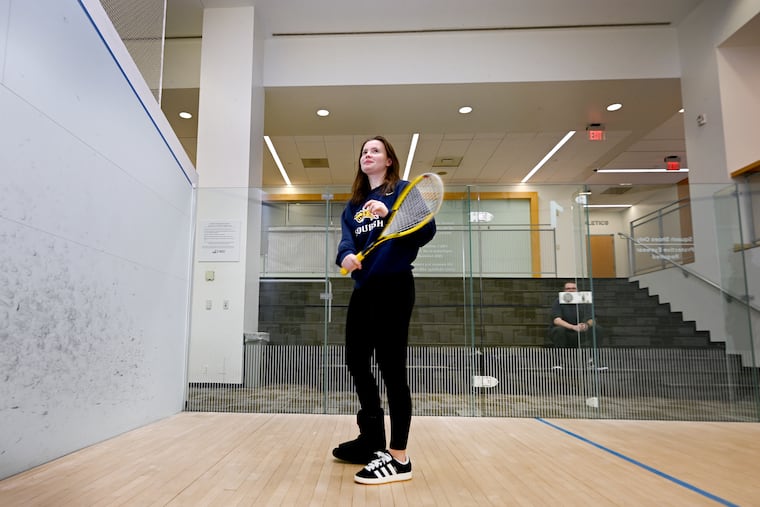
Moa Bönnemark had the opportunity to go home during winter break. For the Drexel senior, home is Malmö — a large, coastal city in Sweden. But she didn’t have much downtime.
Bönnemark, a member of Drexel’s squash team, had business to take care of.
For the seventh consecutive year, Bönnemark looked to win the Swedish senior women’s squash championship in January — a record for the tournament. She entered the tournament as the No. 1 seed.
“It’s a little bit of pressure when you come home,” Bönnemark said. “You kind of need to prove that you have developed and that you’ve been training hard. But I think it’s easier, in one way, to go home because I know the type of level that I am at. … I don’t mind a bit of pressure.”
Matchups in squash tournaments are played in a best-of-five format. Through the tournament’s first three rounds, against Sweden’s best players, Bönnemark did not need to play a game four. The championship match proved more of the same as Bönnemark swept No. 2 seed Malin Frank, 11-7, 11-8, and 11-3. After her record-breaking championship win, an ocean away from her college, she posed on the podium wearing a Drexel squash sweatshirt and a gold medal around her neck.
The Drexel men’s and women’s squash teams are led by John White, who has been at the helm since 2011. In total, there are 31 varsity women’s squash teams in the United States, mostly bunched along the East Coast. This past season, the Drexel women’s team finished 9-9 and ninth in the College Squash Association.
In her four years at Drexel, Bönnemark has amassed a 51-44 record in singles matches, with 56.86% of her wins being three-game sweeps. Since Bönnemark arrived on campus, the Dragons have gone 40-32 overall, with the team’s best season coming during her freshman campaign. That year, the Dragons finished 13-4, the fifth-best overall record in the CSA.
White, like Bönnemark, is not from the United States. White, 52, hails from Queensland, Australia, but is a Scottish national. Like his star player on the women’s side, White competed at the highest level of the sport before settling into coaching. During a professional career that spanned from the late 1990s to his retirement in 2008, White garnered 13 Professional Squash Association World Tour titles. In March 2004, he was ranked the best player in the world and is widely considered one of the hardest hitters in squash history.
“John has a lot of knowledge about the game,” Bönnemark said. “When he’s giving me tips, I make sure to listen because he knows what it takes to be one of the best ones.”
Added White: “[Bönnemark] was probably one of the easiest athletes to work with, where she just figured it out. She was coachable, and she’d listen, and you could see her put it into play. Then she got to know the game so well.”
Collegiate squash in the U.S. has long been dominated by international talent, and Drexel is no exception. Of the 28 players on the men’s and women’s teams, just five were born in the States.
“We want to get as many international kids on to see the campus,” White said. “They’ve got to love the campus. They got to want to come and study here, and then know that they’re going to fit into the team culture that we’ve got. And if they do fit in that, their level [of play] increases. They want to compete more because they’re not just competing for themselves.”
For Bönnemark, who began playing squash at 8 years old, the sport began to take over her life after she was selected to represent Sweden in the under-15 European Squash Championships. Around the same time, she enrolled in Malmö Idrottsgymnasium — a Swedish high school for elite athletes that allows students to specialize their studies while receiving some of the country’s best individualized athletic training.
» READ MORE: Squash players like Amanda Sobhy gambling on more attention for the sport in U.S.
In high school, Bönnemark gravitated toward Drexel because of the newfound excitement around squash in Philadelphia. At the time, the Arlen Specter Squash Center — which now hosts the U.S. Open Squash Championships yearly — was under construction. Also, the sheer amount of squash players in the city was exciting to her, especially coming from a country where the community around the sport is much smaller.
Now, in her senior year, she has fully embraced the city she discovered through squash.
“I really like Philly. I think it’s a beautiful city, and there’s a lot of things to do,” Bönnemark said. “I don’t really have any hobbies outside of squash and school — just hanging out with the team and my friends. Especially now, when the weather gets a little bit better, it’s nice to just sit out here on campus or in the city.”
With Bönnemark graduating in the spring, White is confident that she will stay in touch with him and the program — as the majority of alumni do. For the 15-year head coach, that has been the most rewarding experience.
“Some of the alumni, they’re now starting young families,” White said. “They bring their little kiddies in. They’re still wearing Drexel [apparel]. It’s a whole family, it’s not as soon as they graduate, I don’t want to see them anymore.”