Penn State’s Dan Barefoot came late to skeleton, but it was worth the wait
Barefoot decided to take up the Olympic sport at age 26 while working at a West Chester landscape architecture firm. Now 35, he competed in two skeleton events at this year's Winter Games.
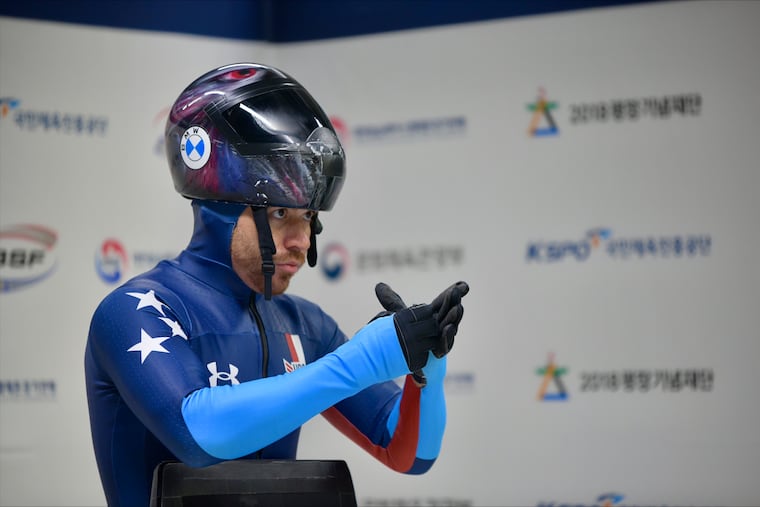
Penn State alumnus Dan Barefoot adjusted to a new full-time career when a winter in West Chester, Pa., left him searching for something more. A Google search at age 26 introduced him to skeleton, a sport he would quietly pursue before it carried him to the Olympic stage.
The 2026 Milan-Cortina Winter Games were Barefoot’s first time competing at the Olympics, and it was an unprecedented road. He had recently graduated from an intensive five-year landscape architecture program, often resulting in him spending six to eight hours in the studio per day. The transition to post-graduate life in West Chester provided Barefoot with more free time, leading to his discovery of skeleton.
“I started looking up winter sports, and thank you to bobsled for being alphabetically at the top. I clicked on that, and I read about it, and I was like, ‘Man, I think I could try out for this,’” Barefoot said.
» READ MORE: Isabeau Levito falls during free skate, finishes with total score of 202.80 at the Winter Olympics
And what began as curiosity quickly became a personal challenge, one he chose to pursue quietly.
“I wasn’t telling anybody,” said Barefoot, who competed in the first week of the Games but did not medal. “I wasn’t telling my friends, co-workers, or family.”
Much of what Barefoot relied on in skeleton, he traces back to the habits formed long before he ever touched a sled. The sport rewards sustained focus after the visible action ends, traits he learned through years of detail-heavy academic work.
“You have to have attention to detail and interest the whole time,” said Barefoot, a native of Johnstown, Pa. “We only go down the track for like a minute, but to get good at that, it’s like hours and hours and hours of mentally doing it. Pretending you’re doing it, lying on a sled, watching YouTube videos from past races, working on your equipment, which is way more time than a lot of people prefer.”
This progress brought unexpected pressures, and confidence became something to manage as carefully as speed or technique.
“You can quickly lose confidence in what you’re doing,” Barefoot said. “You can be the same guy, no issues physically, exactly the same, and play completely different from day to day, because it’s all in your head. So it’s balancing all those small pieces [that] is actually the hardest thing.”
» READ MORE: U.S. beats Canada 2-1 in overtime to win Olympic gold in women’s hockey
As his training progressed, the idea became reality. Barefoot earned enough points to qualify for a tryout at the Olympic Training Center in Lake Placid, N.Y., marking the first moment he felt compelled to share what he had been working toward.
“I just witnessed, I encouraged, and I was amazed the whole time,” said David, Dan’s brother, on his journey toward the Olympics.
For much of his career, that balance was driven internally. But this season, Barefoot noticed a change.
“This year, the external motivation has ramped up, and I wasn’t really expecting it,” he said. “When I showed up here, it felt more like a win for my community than it was for me.”
Penn State overseas
While his family played a central role, the support behind Barefoot extended far beyond them. Two Penn State students express what it means to have Dan Barefoot compete in the Olympics
“As part of the Penn State community, sports are a huge part of our campus culture. It’s truly inspiring to see an alum compete in the Olympics and watch the community rally in support.” shared Lucas Conlon, a senior. “ It’s thrilling to see a Nittany Lion on the big screen.”
Nick Harrison, a junior, added “It’s so amazing to see Penn State represented 4,000 miles away from home. I do triathlons, so seeing Dan accomplish this after college is really motivating.”
For Barefoot, those reactions underscored his unconventional path. He didn’t discover skeleton until after college, a fact he says he hopes resonates with people watching from afar.
“Oh, I love that,” Barefoot said. “I didn’t even try out until I was 26. It’s never too late.”
The support extends further. Barefoot’s social media has been filled with messages from co-workers, friends, and even celebrities, including Jason Kelce and Flavor Flav.
“We’re talking to celebrities, people that you watch growing up, people you see on TV and now they’re dapping you up every time you see them,” Barefoot said.
Beyond the Olympics, Barefoot said he is looking forward to rebalancing time between his work and the people closest to him. The conversation eventually turned lighter, touching on his last name and the unexpected ways it has followed him onto a much larger stage.
“I feel like it’s one of those names that really would connect,” Barefoot said. “I’ve reached out to a couple partnerships. It’d be awesome.”
The idea made him laugh, but it also reflected how much his world has expanded through a few minutes of competition built on years of preparation.
Barefoot arrived at the Olympics expecting to compete only in the men’s skeleton event, where he finished 20th with a combined time of 3 minutes, 49.86 seconds. The result marked the culmination of a journey that began quietly years earlier, far from Olympic ice.
Then, a day before the mixed skeleton event, his Games unexpectedly continued.
Paired with Kelly Curtis, Barefoot returned to the track for the mixed competition, where each athlete completed one run and their times were combined. The duo finished 10th, with Curtis recording a 1:01.30 and Barefoot posting a 1:00.13 for Team USA.
For Barefoot, the extra run offered another marker of how far an unplanned path had taken him.