Miffed at the depth chart? James Franklin lets Penn State players rank themselves
The Nittany Lions head coach said when the players rank themselves the results are similar to how the players are ranked on the coaches' depth chart.
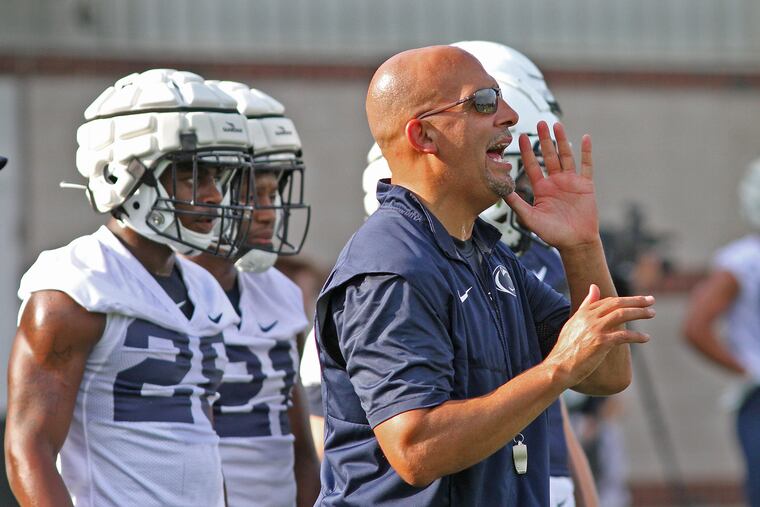
At most places in this land of college football, players look at the depth chart as mapped out by their coaches and wonder why they’re not starting, or how they got to be a third-stringer when they feel they’re playing better than the two guys ahead of them.
Penn State certainly is no exception to the practice, but its players can get answers from their own teammates on where they stand. Head coach James Franklin allows his players to rank others at their same position around the time the season’s first depth chart comes out.
Franklin does have the final word, but he thinks that giving the players a chance to rank themselves is valuable.
“It’s a really good discussion,” Franklin said Tuesday at his weekly media teleconference. “I think a lot of times it’s great information for the players. I think a lot of times when it’s just the coaches doing it alone, they will look at it and say, ‘Oh well …’ and be able to rationalize or justify whatever is going on.
“But when they’re hearing it from their peers, and more often than not it aligns with how the coaches see it, there’s value in it.”
Franklin said the ratings started with cornerbacks coach Terry Smith in his meeting room, and that the entire team adopted the practice the last two years. He said magnets are placed on a board with the coaches’ rankings and the players’ rankings. Each player ranks the other players at his position – offensive linemen rating other offensive linemen, wide receivers rating other wide receivers, and so on.
“A lot of guys may be a little bit further down the depth chart and may be disgruntled,” Franklin said. “It really creates a healthy discussion. Then it also allows those guys to hold each other accountable in the room and say, ‘No, this is why I’ve got you ranked fourth, or this is why I’ve got you ranked fifth. You’re not doing these things the way you need to do them consistently.’
“I think that feedback and that accountability, not just from the coaches to the players, but the players within each other. I think that’s a really powerful thing.”
One might think that carrying out the rating process in front of teammates could be a bit awkward, but the players don’t think so.
“You don’t really get the bickering of, ‘Why am I not playing?’ and things like that,” senior cornerback John Reid said. “When your friends are telling you the reality and things like that, you take it as, ‘I need to improve.’ The ranking in the room by the players is usually the depth chart. I don’t think it’s ever been wrong.
“You’ve got to check your sensitivity at the door. That’s what Coach Smith always says, ‘You can’t be sensitive. You’ve just got to look at it like you do anything, a challenge.'”
Offensive tackle Will Fries said the ratings have been “beneficial” to the linemen.
“I think it’s definitely helpful to know where you’re at, know what your peers think about you,” he said. “Then you can kind of get with those guys and see where you think they can improve and things like that.”
Franklin said “there’s some really good stuff going on” with his assistant coaches in the way they conduct their meetings. He really liked the ratings system.
“I think you should want your teammates to hold you accountable,” he said. “You should want the coaches to hold you accountable. That’s the only way that you’re going to truly grow.”