Sam Brown looks to blend his international experience with St. Joe’s field hockey’s winning ways
Brown, in his first head position in college field hockey, has served under coaches with ties to the area. Now, the New Zealand native is looking to experiment while sustaining the Hawks' success.
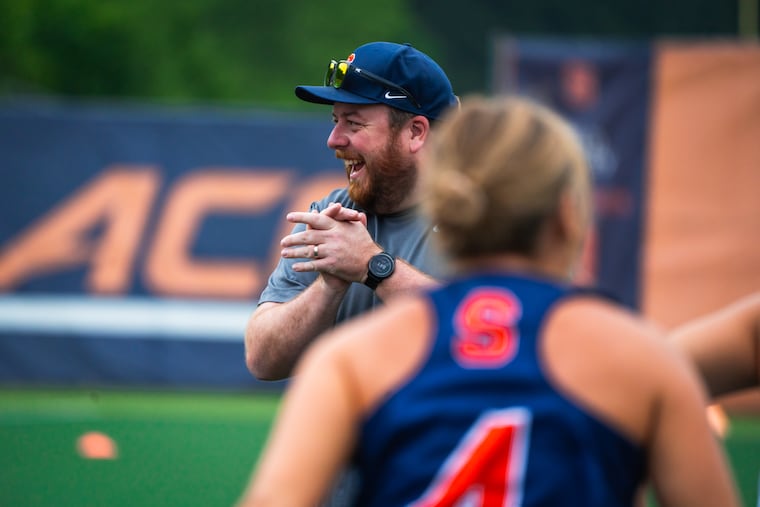
Even before setting foot on campus this spring as the new St. Joseph’s field hockey coach, Sam Brown was familiar with the program.
Brown had more than the typical scouting report on the nationally renowned Hawks after his three seasons as an associate head coach at Syracuse. He was part of former St. Joe’s coach Lynn Farquhar’s staff with the Orange.
Now, it’s Brown’s turn at the helm for the Hawks, and his background and experience are bringing a new perspective to what it means to play St. Joe’s field hockey.
Learning from Farquhar
Despite the four-year gap from when Farquhar was last at St. Joe’s and when he took the reins, Brown said he still sees traces of “Lynn Farquhar hockey all through” the program.
“One is the way that the student-athlete group competes,” Brown said. “Competition and being present, whether it’s training, whether it’s a game, that’s something that’s always been part of Lynn’s coaching since I’ve known her.”
With regard to what former coach Hannah Prince created during her four seasons at the helm with the Hawks and what Farquhar has laid the groundwork for, Brown said his focus is on making sure St. Joe’s is “still the premier school in the A-10 conference for field hockey.”
The Hawks have won the Atlantic 10 tournament championship the last five consecutive seasons and eight over nine seasons.
» READ MORE: After building a powerhouse at St. Joe’s, Hannah Prince wants to bring Penn State field hockey back to winning ways
But he’s also bringing his own philosophies in his first position as a head coach to the program, which posted a 12-10 record last fall.
In his first collegiate head coaching position, Brown is bringing to the Hawks what he learned from coaching under Farquhar and James Madison coach Christy Morgan, a USA Field Hockey and Philadelphia Sports Hall of Famer. Brown spent four seasons at JMU before joining Syracuse’s staff.
“I think the little bits that I’ll try to add will be based around creativity. I love trying to do things differently and not reproducing the same cookie cutter type [of] hockey,” Brown said. “So, I hope, over time, that will be a big part of what people notice about the program.”
International perspective
As a New Zealand native, Brown’s background is one that allows him to add some creativity to what the Hawks have been doing. Brown also has the experience of having played the game on a men’s team from age 4 to his early 20s.
When Brown was coaching in New Zealand, many field hockey coaches were encouraged to get experience outside of the country, which took him to England. Once Brexit happened in 2020, Brown had four weeks to find a new job, bringing him to the United States and collegiate field hockey.
“I love the NCAA system,” Brown said. “I think it’s one of the best resourced leagues in the world for field hockey. It’s definitely something that I’ve grown into [and] love being a part of.”
Knowing both sides
Around the world, Brown said the gender population for field hockey players is a lot closer to a 50/50 split. But in the United States, field hockey is predominantly a women’s game, and is only offered as a women’s sport in the NCAA.
Of the 83 Division I field hockey teams in the NCAA, only about a quarter have a male coach. But Brown has experience coaching both men’s and women’s programs at the club level in New Zealand, England, and the United States.
During his first six years in the U.S., Brown has continued to coached the men’s game as well, as the head coach of Team USA’s under-18 boys’ team in 2021. He was also an assistant coach with the under-22 women’s team in 2022, during a four-match series against Chile.
His knowledge of both sides of the game offers a perspective that can help the Hawks. One of the main differences in the men’s competitions is the distance in passing options that exist, and it’s something he wants to experiment with at St. Joe’s.
“The women’s game is getting there, and it’s something that I think we have the ability to exploit with the roster we’re going to have going into next fall,” Brown said. “Hopefully we’re able to use some of those skills.”
Building relationships
While Brown’s international experience has shaped him as a coach, it’s his time under other college coaching staffs that has readied him for this position, because of the different degree of involvement required for a coach at the NCAA level.
“You’re involved in a lot more of the student-athletes, the different areas in their life, and there’s a lot more networking that goes on with professional development, with personal development and holistic growth,” Brown said. “I’ve been thankful for the exposure [Farquhar has] given me to those parts of the job.”
The one advantage Brown has with a roster that includes several international players is his own experience of being away from home.
“My hope is that through my experience coaching and playing around the world, I’m able to relate to those athletes and hopefully provide some comfort for them when they are missing home,” he said.
Phase one
Creating a bond with the athletes is one part of the job. The other is continuing the success for a program where postseason runs are expected.
Syracuse made the NCAA Tournament in each of Brown’s three seasons under Farquhar. This time, Brown hopes to lead his team to the tournament, while navigating the transition that comes from adjusting as a new coach.
» READ MORE: The Dawn Staley Legacy award honors Philly’s Big 5 women’s basketball coaches
But similar to what Morgan and Farquhar did while he was coaching under them, Brown hopes to offer returning assistant coaches Maggie Dickman and Beth Riley the support they need to take ownership of certain areas of the team, which can help ease the transition.
Whatever it takes to get St. Joe’s back to the NCAA Tournament for the sixth consecutive season starts in the “first phase” of an adjustment plan the program is undergoing. And during this phase, Brown’s plan is to lean on authenticity.
“I will lean on being really real with the player group,” he said. “The hope is that if they can see me as being real and vulnerable and a person as well as a coach, hopefully they’re comfortable opening up quickly to provide the same. It’s a relationship. It’s mutual. It’s something that is really important to a cohesive team.”