Report: Temple makes offensive lineman Giakoby Hills among highest-paid Group of Six players
Hills, a redshirt freshman, started all 12 games for the Owls this season at left tackle.
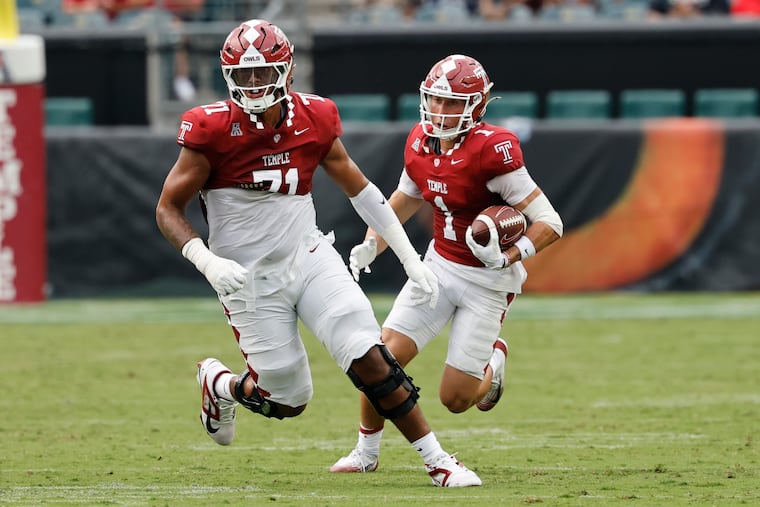
Temple left tackle Giakoby Hills agreed to a multiyear deal to stay with the Owls, according to a report from 247Sports. Hills reportedly will become one of the highest-paid players among the Group of Six conferences.
Hills committed to Temple from Morristown (N.J.) High School in 2024. He redshirted in his freshman season and was expected to remain a backup during the 2025 season.
Starter Kevin Terry suffered a sprained knee during a scrimmage on Aug. 9, thrusting Hills into his spot. Hills, 6-foot-5 and 290 pounds, spent the rest of training camp as the starting left tackle while Terry was on the mend, and made his first collegiate start in Temple’s 42-10 win against Massachusetts on Aug. 30.
» READ MORE: Temple denies report it declined a bowl bid
Even when Terry returned in September, Hills remained the starter. The redshirt freshman was a key part of a Temple team that averaged 147.4 rushing yards per game. He was also the blindside blocker for quarterback Evan Simon, who broke the team’s single-season record by passing for 25 touchdowns.
Hills was one of six Temple players with a top-50 Pro Football Focus grade with a 73.5 through 12 games.
With Hills returning, Temple has locked down a potential cornerstone for the team under coach K.C. Keeler.
Last week, Keeler and general manager Clayton Barnes spoke about the importance of multiyear contracts. They make it easier for the Owls to retain core players and help compete with Power Four conferences who may be offering those players more money.
“Without multiyear contracts, we wouldn’t have a chance to keep our best players,” Keeler said. “So some of those guys who are going to be sophomores, going to be juniors, say, ‘Here’s the plan to grow you,’ and that gives them a lot more security. Whereas a lot of Power [Four conferences] aren’t going to give a guy a multiyear contract.”