Judge dismisses lawsuit by Villanova’s Kris Jenkins against NCAA
A U.S. District Court judge in New York ruled that Jenkins' suit was barred by the 2017 Alston v. NCAA class action settlement. Jenkins hit the winning shot in 'Nova's 2016 national championship win.
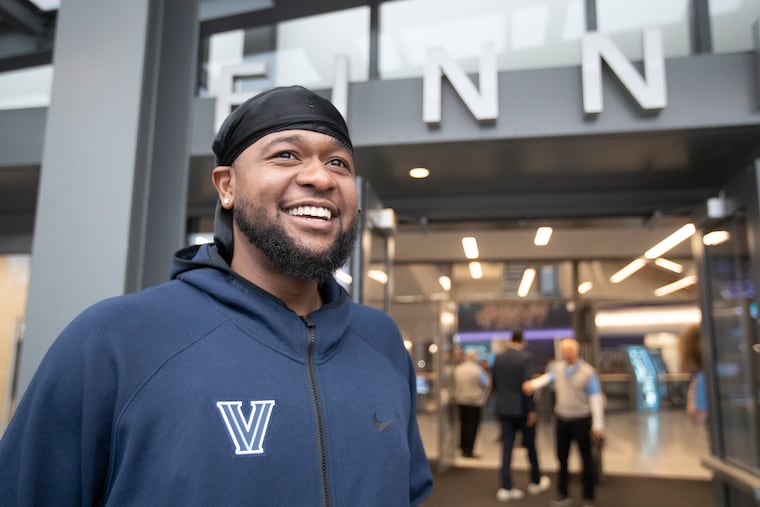
A federal judge in New York ruled Monday to dismiss the antitrust suit brought earlier this year by former Villanova basketball player Kris Jenkins against the NCAA and some of its member conferences.
Judge Denise Cote of the U.S. District Court for the Southern District of New York said Jenkins’ suit against the NCAA and conferences, including the Big East, which he played in, was brought too late and is barred by the 2017 Alston v. NCAA class action settlement.
“It is undisputed that Jenkins was a member of the Alston class and did not opt out of that litigation,” Cote wrote.
Jenkins did not immediately reply to a request for comment. His attorney, Kevin T. Duffy Jr., said they planned to appeal but declined to comment further.
Jenkins, whose three-point buzzer-beater lifted Villanova to the 2016 national title over North Carolina, filed the lawsuit in April and sought damages for the name, image, and likeness compensation he was unable to receive while at Villanova. In addition to the NCAA, Jenkins sued several conferences: the Atlantic Coast, Big 12, Big East, Big Ten, Pac-12, and Southeastern.
The suit argued that the named parties violated “antitrust laws and common law by engaging in an overarching conspiracy” that fixed the amount student-athletes could be paid and cut them out of the market.
Jenkins wanted the money he “would have received” if not for the NCAA and its conferences’ “unlawful restraints on pay-for-play compensation,” a share of television revenue and media broadcast uses of his name, image, and likeness, and money he may have received from other third-party opportunities, according to the initial suit.
“You want your respect as a man, as a human being,” Jenkins told The Inquirer in April. “Obviously all the other stuff that comes with it. More importantly, to just continue to fight for what’s right.”
Monday’s ruling stands to make that more difficult. Judge Cote wrote that because Jenkins was a member of the Alston class action, he was barred by that December 2017 settlement from pursuing legal action.
» READ MORE: Why Kris Jenkins filed a lawsuit that could ‘blow up the House settlement’ if successful
Alston v. NCAA, which challenged the “interconnected” set of NCAA rules that capped the amount of compensation an athlete could receive for his or her athletic services, went all the way to the Supreme Court. Along with the O’Bannon v. NCAA case, it was among the groundbreaking proceedings that eventually laid the groundwork for the landmark House v. NCAA settlement that forever changed college sports.
Jenkins argued that his claims were not barred because he challenged some rules not raised in the Alston case, but his suit relied on “facts that post-date Alston,” Cote wrote, such as when the NCAA in 2021 suspended its bylaw that prohibited athletes from receiving payments for their name, image, and likeness.
“None of these arguments permits Jenkins to escape the effect of the Alston release and judgment,” Cote wrote. “Jenkins was a student-athlete from 2013 to 2017. Therefore, any claims that he may have had are claims that arise from anticompetitive conduct that occurred during that period. The NCAA’s suspension of a Bylaw in 2021 did not alter either the substance of his claims [nor] the breadth of his release of those claims.
“The fact that Jenkins may have identified components of that framework, specifically two NCAA rules, that may not have been the specific focus of the Alston class pleading is immaterial.”
Cote also ruled in favor of the NCAA and the conferences named in the suit when they motioned to dismiss the case based on the grounds of timeliness, saying Jenkins’ suit was barred by a four-year statute of limitations.
The House v. NCAA settlement was at the crux of why Jenkins filed his suit. The settlement left the Big East out of the lion’s share of back payments dating to 2016. Jenkins, whose career at Villanova ended in 2017, would have been in an “additional sports class” that would receive minimum payment compared to football players and men’s and women’s basketball players from the power schools. He decided to opt out of the House class.
It is difficult to quantify exactly how much money Jenkins’ championship-winning shot was worth, although his initial 127-page filing made an effort to. It said Jenkins’ shot, literally nicknamed “The Shot,” and Villanova’s championship victory were the reason behind William B. Finneran’s $22.6 million gift to renovate the now-named Finneran Pavilion and support the men’s basketball program. The filing notes that Villanova received an uptick in applications to the university. The campus footprint has greatly expanded since 2016.
The NCAA and Big East, the suit said, have benefited greatly from the shot and continue to use it in promotional videos.
“Everybody can see the value,” Jenkins, 32, said earlier this year. “Everybody knows the value.”
Jenkins had a brief professional career before a hip injury forced him to stop playing in 2020. He rejoined the Villanova basketball program in a support staff role that year and has been around the program off and on at times since then.