It’s not too early to be thinking about your new deck | Expert Opinion
A new outdoor space takes a lot of planning and money to create, whether you hire a local business or put one in yourself. Here’s what to consider.
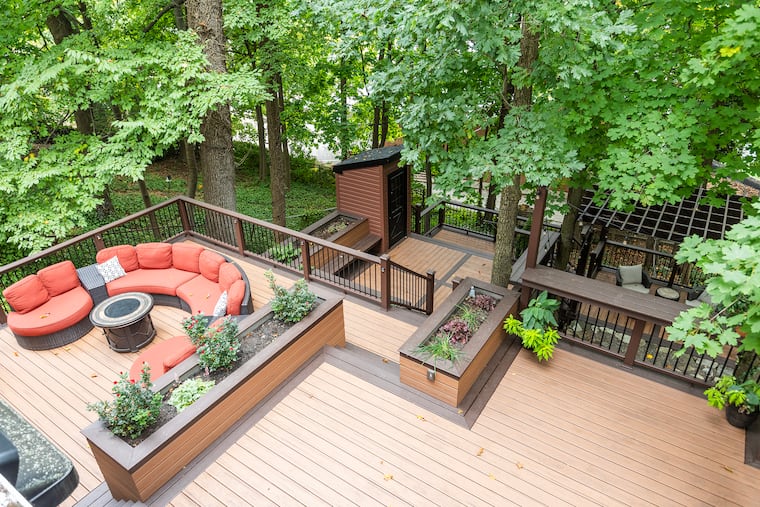
Despite our region’s snowy winter, it’s not too soon to be thinking about outdoor entertaining in the spring. Build (or rebuild) a deck off your home, and you’ll have a spot for grilling or chilling.
But it takes a lot of planning and money to create one, whether you hire a local business or — for the super-handy — put one in yourself. Here’s what to consider.
What kind of deck?
The size and type of your home often determine the type of deck you need. But for most homes, these outdoor spaces tend to be either the same width or slightly less wide than the structure they serve. You don’t want a deck that dwarfs your house — a 20,000-square-foot deck would look ridiculous on your 1,500-square-foot bungalow.
If you already have an older deck with visible signs of rotting wood or sagging supports, you might need to replace it. “People don’t always understand that decks have a life cycle, like roofs,” said Michael Beaudry, executive vice president of the North American Deck and Railing Association, a nonprofit membership association offering education and credentialing to industry members. “It’s usually a question of repair or replace.”
Decking materials range from pressure-treated lumber to pricier composites (recycled wood and plastic like Trex, Fiberon, and TimberTech) to expensive wood species like cedar, redwood, or teak. A decking contractor can show you samples and go over factors such as durability and cost.
You can check out Consumer Reports’ ratings of decking materials to compare prices, features, and maintenance. The big advantage of going with composite materials is that they’re maintenance-free.
Layout considerations
Your yard’s size, elevation, drainage, and tree cover will greatly affect how you design your deck. If your outdoor space slopes, a multilevel deck can step down with your yard. If existing trees don’t shade your deck, you can add a pergola, awning, or other way of shielding yourself from the sun. If your neighbors can see into your yard, you might angle the deck differently or install a privacy hedge just off the deck.
Most decks are rectangular or square, but they can be almost any shape you’d like, including triangular or round.
Construction and permitting
Building a new deck is as much an engineering job as a construction one. If you’re installing a new one, in most areas it’ll need to be permitted and inspected, and you might consider hiring an architect or landscape architect to help with the plans.
It takes engineering and knowledge of load-bearing principles and building materials to create a safe, stable deck. The grade of the wood or composite material, the spacing of the joists, beams, and posts, and the overall design of the deck impacts how much weight it’ll hold.
“It’s important to think about what you want on your deck — a hot tub, seating for a bunch of people,” Beaudry said. “A good deck builder tends to overbuild, using two-by-eight boards when the project only calls for two-by-sixes.”
Most decks are designed to support 60 pounds per square foot including the weight of the deck (the “dead load”) as well as whatever people and things you put on it (the “live load”). Decks require adhering to local building and safety rules and regulations. These range from HOA size limits to setback distances or structural requirements set by your city, town, or even neighborhood. The height of railings and the placement of and pitch of stairs may also be dictated by local code.
Don’t hire a deck builder unless the company will navigate the permitting process for you.
How to find a deck builder
Many general contractors, fence builders, and carpenters also build decks as part of larger projects. But if you need a new deck or a complete replacement of an existing one, you might as well go with a company that specializes in them. Until April 5, Inquirer readers can access Checkbook’s ratings of local deck builders at Checkbook.org/Inquirer/decks.
Once you’ve identified some possible contractors, ask them lots of questions. Go over your plans and ideas with them, and ask about their experience with your type of job. These conversations will likely provide you with lots of new ideas.
Get references and check them. Ask past customers if the company gave them money-saving solutions, if the work was as attractive and as well done as expected, whether it passed inspection on the first try, if the company stuck to its agreed-upon prices, and whether it minimized disruption to their lives.
To protect your finances against big damage claims, ask companies for proof that they carry general liability and workers’ compensation insurance.
Get a solid contract
Get at least three fixed-price bids; it’s the only way to make sure you don’t overpay. Get a formal contract in writing specifying payment terms, deadlines, and who will be doing the work. It should include a detailed description of the work, including drawings of deck plans, and details on building products.
The contract should include start and end dates, and a warranty on work and materials, preferably one lasting several years.
Insist that the contract include requirements that the company obtain and pay for necessary permits, and arrange for government inspections, if required. The contractor also should obtain approvals by any homeowners’ association or historic district.
Arrange to pay as little as possible until the work is finished and you are satisfied. If your job requires a lot of materials, it’s reasonable to pay a deposit against these expenses. But paying for everything or almost everything at the end gives you the most leverage to get the work done properly.
Deal promptly with problems. Understand that no one can anticipate every possibility. If problems happen, work with your contractor to reach a solution.
Delaware Valley Consumers’ Checkbook magazine and Checkbook.org is a nonprofit organization with a mission to help consumers get the best service and lowest prices. It is supported by consumers and takes no money from the service providers it evaluates.