As temperatures heat up, it’s time to think about upgrading your HVAC. Here’s how to do it right.
Replacing your home’s heating or cooling equipment can cost thousands.
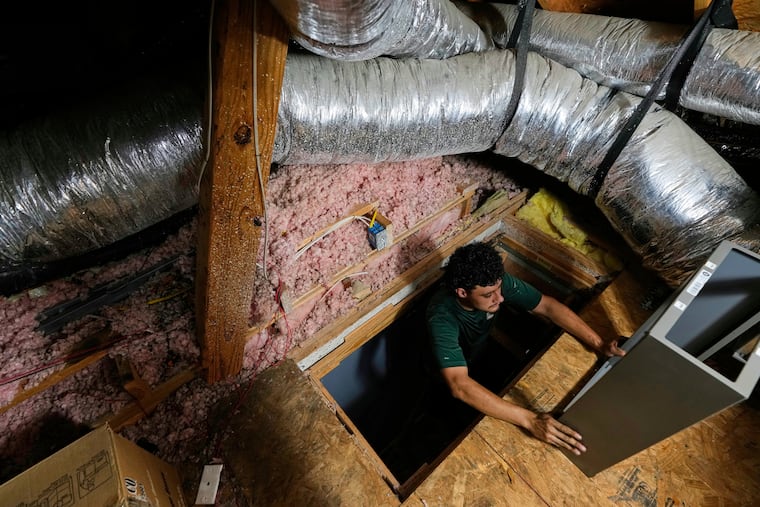
Replacing your home’s heating or cooling equipment can cost thousands of dollars. When you need to upgrade your system, you’ll want to work with a company that offers the best possible advice and prices. How well a new system performs and what it costs largely depends on how well it is designed and installed.
Nonprofit Delaware Valley Consumers’ Checkbook’s surveys of local consumers turned up dozens of excellent HVAC services. But not all contractors are cool characters: Others received poor overall ratings from their surveyed customers.
Through a special arrangement, Inquirer readers can access Checkbook’s ratings of local HVAC services for quality and price free of charge until May 5 via Checkbook.org/Inquirer/HVAC. If you need to replace or add equipment, there’s lots to consider.
Energy efficiency matters
If you need new HVAC equipment, companies will present you with several options offering a range of energy efficiency capabilities. Learning some energy-ratings lingo will help.
Need a new central air conditioner? Consider a heat pump instead. These devices are basically air conditioners that can both heat and cool buildings. New models are extremely energy efficient and quiet and can reduce reliance on furnaces.
For all types of HVAC equipment, energy-efficient models cost more than basic ones. For many homeowners, environmental concerns inspire them to pay extra. But lower power bills and rebates from utility companies often provide additional financial motivation. In this area, you’ll quickly recoup the extra cost of buying a high-efficiency furnace.
Most HVAC contractors won’t provide detailed calculations on exactly how much highly energy-efficient equipment will lower your utility bills. But they can estimate what percentage you’ll save with different types and models of equipment. You can then roughly calculate your annual energy bills to determine how much you’d save with say, Furnace A vs. Furnace B.
If you’re planning an addition or seeking to improve heating or cooling in one room, a basement, or an upper floor, consider a ductless mini-split heat pump. These highly energy-efficient units allow you to control temperatures in a single space.
Don’t spend thousands of dollars on energy-efficient HVAC equipment without taking other steps to reduce waste. Identifying and sealing leaks and improving insulation will give you the biggest bang for your energy-conservation buck. Many improvements cost little or nothing but will have big effects on your utility bills.
Getting the correct size
Make sure that the equipment you buy is the correct size for your home. Undersized units won’t efficiently heat or cool spaces; oversized units cost more and cycle on and off constantly, thus boosting utility bills, making more noise, requiring more frequent maintenance, and dying sooner.
The size of heating and cooling units is called capacity. For furnaces and heat pumps, capacity is the amount of heat a unit can generate as measured in British thermal units (BTU). For air conditioners (and heat pumps operating in cooling modes), capacity is measured in BTU but expressed as the amount of heat the units can remove. The capacity of heat pumps and air conditioner units is usually described in “tons.” One ton equals 12,000 BTU — for example, a 36,000-BTU air conditioner is a “three-ton unit.”
If you have expanded your home, finished a previously unconditioned space, or if your old equipment didn’t sufficiently heat or cool all parts of your home, companies should perform a load calculation to determine the right size of equipment. (If you are replacing old equipment that adequately heated and cooled your home, you can skip this step.)
Getting a fair price
Getting competitive bids from several contractors will save you money. For large installation jobs, it’s common for company-to-company price differences to exceed $1,500 for the same equipment and work. Even for smaller installation jobs, prices vary considerably.
Invite several reputable companies to your home to offer written proposals. Ask each to explain whether you need more than one separate heating or cooling system and more than one thermostat, and whether you’d benefit greatly from features such as variable-speed blowers. If you’re adding a new type of system, ask how ducts will be run, where and how a condenser unit and blower will be mounted, plus how to access equipment for maintenance and filter replacement.
Their advice and your choices impact how noisy the system is, how quickly and uniformly your home is heated or cooled, how easy it is to maintain, energy consumption, and how disruptive the installation process will be. You’ll also want to ask how much closet, attic, or outdoor space the system requires, and how disfiguring the ducts and air-supply registers will be.
Ask each company which makes and models of equipment it will install and their capacity, energy efficiency, and sound ratings. Most companies can offer equipment at several different quality levels; ask about pros and cons.
Pay with plastic
Whether you need repairs or a new unit, settle with a credit card. If you are dissatisfied with the work, you can dispute the charge with your credit card company.
Watch out for shady financing offers
Because many homeowners don’t have the cash on hand to pay for the equipment and installation, installers often offer financing through third parties, usually at high interest rates.
Before signing loan paperwork, review all repayment terms. If an HVAC company offers you a zero-interest loan, you’ll often have an interest-free period but pay a hefty deferred-interest fee when it ends. Some HVAC outfits now push equipment leases; the policies we’ve reviewed might be the most lopsided contracts we’ve encountered in Checkbook’s 50-year history.
Delaware Valley Consumers’ Checkbook magazine and Checkbook.org is a nonprofit organization with a mission to help consumers get the best service and lowest prices. It is supported by consumers and takes no money from the service providers it evaluates.