How to find a local roofer to keep you covered
Replacing a roof is a costly endeavor, but Delaware Valley Consumers’ Checkbook has tips on how to get the job done well at a reasonable price.
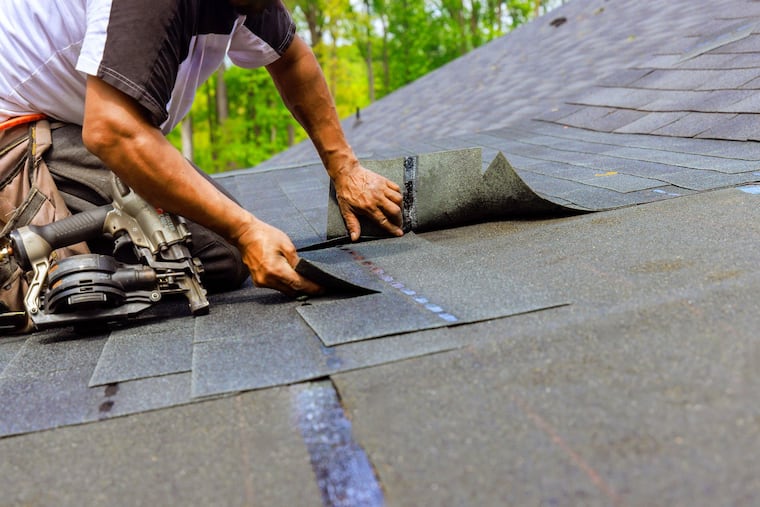
There’s nothing more basic than the shelter a roof provides. But when the time comes to replace a roof, the cost will likely be steep. And unless you choose your contractor carefully, you can spend way too much and get lousy work.
The keys to getting a quality roofing job are to hire a reliable roofing contractor, get in writing exactly what will be done, and keep a close eye on the job as it progresses.
Through surveys of local consumers and undercover price shopping, nonprofit Delaware Valley Consumers’ Checkbook found many excellent local companies that charge fair prices. Until Dec. 5, Inquirer readers can access Checkbook’s roofer ratings via Checkbook.org/Inquirer/roofers.
Consider price and quality.
Checkbook’s researchers found big price differences when they asked companies to bid on several different, carefully specified reroofing jobs in the area. Local roofing companies quoted $10,585 to $27,887 for one job, $11,600 to $27,900 for another, and $6,385 to $12,613 for a third.
Don’t assume a low bid signifies lousy work. Although for each job the highest quote was thousands of dollars higher than the lowest quote, Checkbook found no relationship between price and quality for roofing work, as highly rated companies were just as likely to quote low prices as companies that earned low marks for work quality.
Get several bids for your job.
There is no hard-and-fast rule on how many bids to get, but, in general, the larger the job the more bids you should get. If there are large differences between the first two or three bids, you should seek more.
And get more bids when labor — not materials — constitutes a large part of the cost. All contractors pay roughly the same amount for materials, but hourly labor rates and productivity may vary substantially.
If you can’t be present during the estimate, email your specifications in advance. If your roof is fully visible via Google Maps’ satellite view option, many roofers will use software to supply estimates without needing to inspect in person. Use estimators as your consultants to determine what needs to be done. Then go back to them with the final description of what you want and invite them to bid on the work.
Check for licenses, insurance, and warranty.
Before deciding on any contractor, ask for proof that it is licensed and carries liability and workers’ compensation insurance.
Get a copy of the warranty from the manufacturer of whatever roofing materials are used. Also get a warranty on the roofer’s work, ideally for five years or more. Have the roofer write into your contract: “In addition to all other warranties, if roof leaks within five years [or, better still, 10 years], except as a result of accidental damage, contractor will bear the cost of labor and materials to eliminate all leaks.”
Get a fixed-price contract.
Specify exactly what roof areas are to be covered and other details, such as whether old shingles are to be removed, whether flashings are to be replaced, who is responsible for cleaning up and hauling away debris, and exactly what types and weights of materials are to be used.
While you should be able to obtain a binding contract at the estimate price, most roofers will insist on provisions for extra charges if they find damaged fascia, sheathing, or structural lumber. Most contracts state that required carpentry will be performed on a “per-foot” or “time-and-materials” basis. Make sure your contract states how charges will be computed, typically per-square-foot or per-linear-foot.
Don’t pay in advance.
Avoid roofers that require big upfront payments. A 10% deposit to secure a spot on a company’s schedule is reasonable, but beware the home improvement scammers who demand a large deposit to buy materials. Reputable contractors have credit accounts with their suppliers that grant them at least 30 days to pay.
Arrange to pay for most or all of the job after the work is complete. Most roofers allow this. Try to withhold at least a portion of the price until your roof has been tested by stormy weather.
Report problems immediately.
If problems arise, first, negotiate directly with your roofing contractor.
If that doesn’t work, complain to a local government consumer affairs agency, your state’s contractor licensing board, or the Better Business Bureau.
Delaware Valley Consumers’ Checkbook magazine and Checkbook.org is a nonprofit organization with a mission to help consumers get the best service and lowest prices. It is supported by consumers and takes no money from the service providers it evaluates.