Shopping secondhand for kids’ stuff is getting more popular in Philly
Local store owners say they’ve seen more parents come in without hesitation to find pre-used clothing and supplies.
When Jennifer Kinka was pregnant with her first child, she stood in the aisle of Babies R Us with a registry sheet, looking over the wall of plastic consumables the company deemed required for having a baby. What she saw was waste.
“I was just like, this is crazy that there’s no system for this,” Kinka said. “There’s no problem-solving around how this is happening and how we could do this better.”
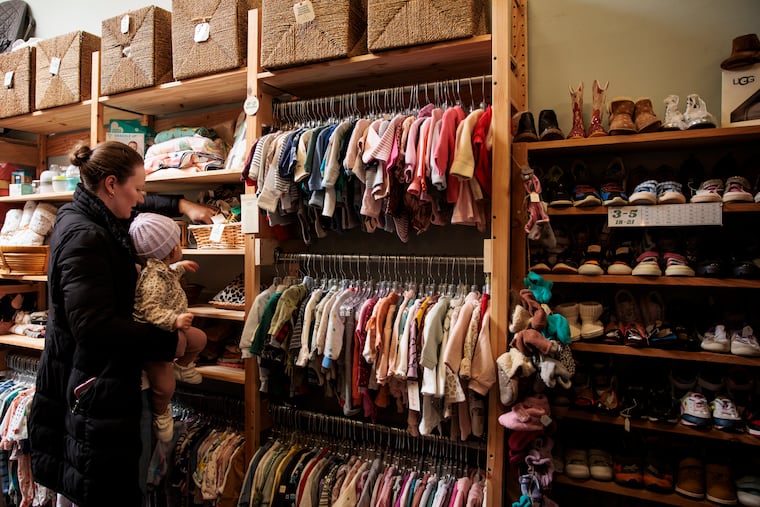
After a few more years, her second pregnancy, and a small inheritance from the loss of her terminally ill parents, Kinka was able to implement her solution: The Nesting House, a kids’ consignment shop based in Mount Airy that she founded 15 years ago.
Shoppers across Philadelphia, including parents buying for their children, are increasingly forgoing new items in favor of secondhand and lightly used in an effort to save money and live more sustainably.
Chris Baeza, associate program director of Fashion Industry & Merchandising at Drexel University, asks her students each semester who shops in the secondhand market. While five years ago she might have had a single student raise a hand, now it’s nearly all of them.
The global secondhand apparel market grew by 15% in 2024, according to online consignment store ThredUp’s annual report, and it’s expected to continue growing each year. ThredUp estimates that the resale apparel market is growing 2.7 times faster than the overall apparel market.
For Abby Sewell, a South Philadelphia mom of two, secondhand clothing and furniture was a mainstay of her childhood, when she spent weekends trash picking and combing through yard sales to find reusable items. Her father is artist Leo Sewell, who built a replica of the Statue of Liberty’s arm and torch at the Please Touch Museum.
“I just know how much there is out in the world,” said Sewell, who also describes herself as an environmentalist. “There’s just so much kids clothes that it kills me to buy something new when I know there’s like 50 pairs of 2T leggings in someone’s basement.”
A dramatic shift toward secondhand not only coincided with the proliferation of social media but followed the 2013 Rana Plaza factory collapse in Dhaka, Bangladesh, that killed more than 1,000 people. People began to wonder how their clothing was being made, and the conditions laborers were under, Baeza said.
Next came the broader revelation of textile waste — pictures and video of clothing from the United States washing up on the shores of African countries — which plays into the interest in the secondhand market, she said.
“This was stuff that we just throw away, or we put in a drop box [thinking] it’s going to a good cause,” Baeza said. “They’re actually packing stuff up, and it’s a commodity they’re selling abroad.”
While Beaza teaches her students to scrutinize the marketing of sustainable fashion and to understand secondhand may not be the be-all-end-all of building circularity into the industry, she gets the sense they want to be part of what she describes as a renaissance period.
“They want to be part of the solution, not the problem,” Baeza said.
Sewell prefers to shop thrift and consignment around her neighborhood and frequents stores like Lilypad and 2A. She also goes to annual church sales in the suburbs and uses eBay for more specific items — a specific kind of sleep sack that works for her 1-year-old or an item in a specific color or fabric for her 4-year-old.
“I’m still shocked to this day when I learn that other parents still are buying mostly new clothes for their children,” Sewell said. “I think I’m on a very different end of the spectrum, and I always have been as a consumer.”
Lilypad, which began as a play space on Broad Street, expanded to include a small thrift shop in its basement after the COVID-19 pandemic sidelined its twice-yearly City Kids consignment events. The nonprofit sells only donated items at its shop, now located in East Passyunk, to support charging an affordable annual membership to its play space.
Lilypad board member Maria Hughes said the number of people actively seeking out secondhand clothing for their kids, particularly babies, has increased exponentially over the last several years. The store sees more pregnant people, who don’t want to go through the process of building a registry. Hughes added that there are also more grandparents and grandparents-to-be shopping at Lilypad now.
“They’re not going to Marshalls and buying the things,” Hughes said. Instead they’re opting for pre-owned items “either at the directive of their children or because they believe now.”
Kinka said the early days of the Nesting House “felt like it was mission work.”
“Nobody understood what we were doing,” Kinka said. “People would come in very confused. They would oftentimes refer to us as a thrift store.”
Eventually people saw the store as a sound economic choice: get high-quality children’s clothing at a great price. But she has seen “a huge shift” over the last five years.
“It’s this current generation,” Kinka said. They’re on board with the concept “before they come. They’re ready for us.”