Critics say Haddonfield ban on sleeping outdoors in public at night would criminalize homelessness
Since the U.S. Supreme Court last year ruled that municipalities could enforce bans on homeless people sleeping outside in public areas, several New Jersey communities have considered such measures.
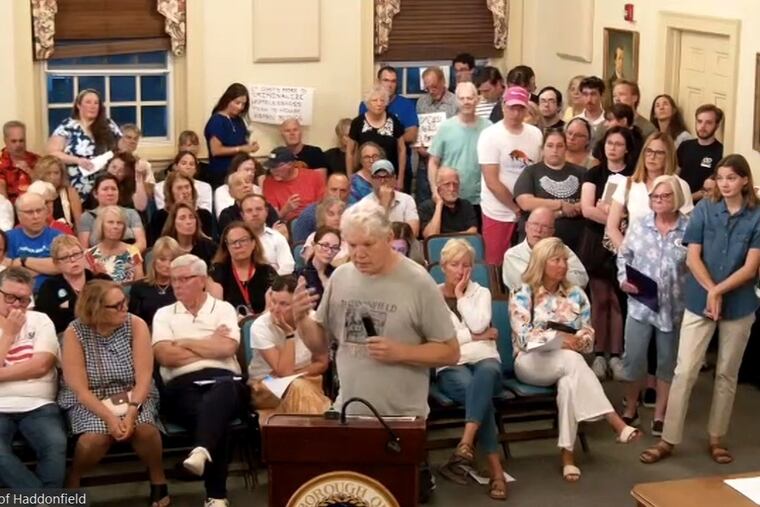
The affluent Camden County borough of Haddonfield is debating whether to impose criminal penalties for sleeping outdoors in public at night, which critics argue would criminalize homelessness.
After more than three hours of sometimes impassioned public comment on Monday night, the Haddonfield Board of Commissioners voted 2-1 to introduce the proposed ordinance. The board has until the end of the year to decide whether to make it a law.
Under the proposal, it would be illegal to sleep outside in a public area from dusk to dawn, as well as to engage in disorderly conduct at night. The law could be enforced only if a person refused to go to an available nearby homeless shelter. The law could not be enforced if no shelter space was available.
“The goal of this [ordinance] — this is my goal — is not to incarcerate anybody. It’s just to move people to get help,” Police Chief Jason Cutler said during the meeting.
The maximum proposed penalties are up to 90 days in jail, a maximum fine of $2,000, or up to 90 days of community service.
The ordinance also deals with urinating or defecating in public areas.
Since the U.S. Supreme Court last year ruled that municipalities could enforce bans on homeless people sleeping outside in public areas, several New Jersey communities have considered such measures.
In June, the wealthy North Jersey community of Summit passed an outdoor public sleeping ban. Other municipalities have floated the idea, then pulled back after facing vocal opposition.
Haddonfield, with a population of roughly 12,500 people, has a median household income of $190,882, compared with the state average of $99,781, according to the U.S. Census Bureau.
On Monday night, Cutler said there had been a sharp increase this year in calls to the police to deal with “somebody that was homeless,” from 88 for all of 2024 to 148 so far this year as of Friday.
“It’s becoming more of a problem,” Cutler said.
The majority of the calls involve the same four to six people, he said. Many of the calls are for trespassing, including businesses reporting someone refusing to leave the premises.
Other calls include reports of people using public restrooms to bathe and defecating in public areas, Cutler said.
He emphasized that the proposed ordinance would be a tool that could, for example, put someone with mental health issues before a judge who could order a psychological evaluation.
Commissioner Itir Cole, who voted against introducing the ordinance, said that the borough should find alternatives to the criminal justice system.
“Jail is not stable housing, so they’re going to end up back right on the street. We haven’t solved anything,” Cole said.
Mayor Dave Siedell, a member of the board who voted in favor of the introduction, said that it was important to have the debate and that he believed the situation in Haddonfield was becoming urgent.
He noted that PATCO will be shutting down overnight weekday service starting Sept. 1, which means people using the train system for shelter will be looking for somewhere to go.
“Haddonfield is a safer place to be homeless than it is in our neighboring communities,” Siedell said.
During the public comment period, many of the speakers opposed the ordinance.
Julie Vick, who said she has lived in Haddonfield for 40 years, remarked: “There’s so much cruelty in our country right now. Does our little town have to add to it?”
Liz Rocco, a Realtor with an office on Kings Highway, was one of the few who spoke in support of the ordinance, pointing to open drug use and public defecation.
Rocco said her business has been burglarized and her car broken into.
“This is not how Haddonfield should be. We should not be left alone either, to deal with this by ourselves,” Rocco said.
“We’re not asking for cruelty, we’re asking for balance, compassion for homeless people in need, and safety for our families, our children, and businesses,” she said.