Judge declines to dismiss charges for man accused of killing hockey’s Gaudreau brothers in drunken driving incident
Sean M. Higgins' attorney said authorities had mishandled a blood-alcohol test that would have shown a level below the legal limit had it been read correctly. He asked the judge to dismiss the case.
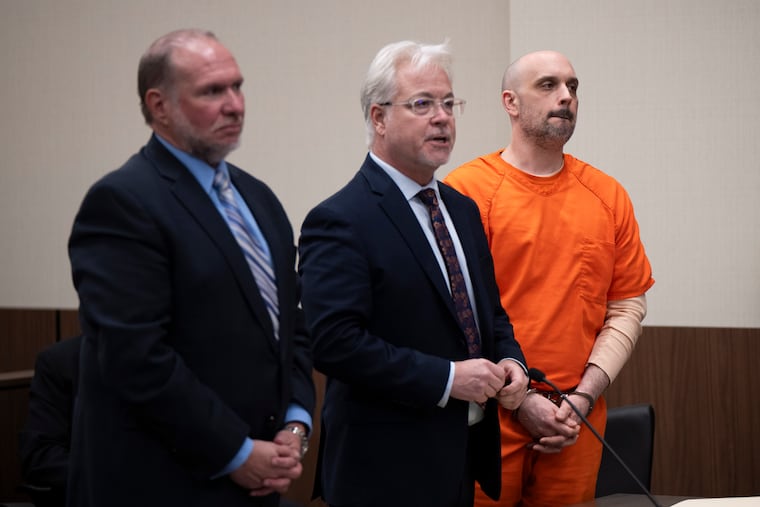
A New Jersey judge on Monday rejected a defense request to dismiss all charges against the man accused of killing NHL star John Gaudreau and his bother in a drunken driving incident in Salem County that shook the nation’s hockey community.
Sean M. Higgins, 45, was arrested after striking Gaudreau and his brother, Mathew, with his car in Oldmans Township as they biked home from their sister’s wedding rehearsal in August 2024.
Police said Higgins’ blood alcohol content was 0.087 that night; the legal threshold for intoxication in New Jersey is 0.08.
A grand jury indicted him on two counts of vehicular homicide and related crimes after prosecutors said he was driving under the influence of alcohol when he struck the brothers.
Higgins’ attorney, Richard F. Klineburger III, had asked the judge to toss out those charges, saying his client’s blood alcohol content was actually below the legal limit and that prosecutors had presented a “half-truth” to the grand jury.
But Salem County Superior Court Judge Michael Silvanio said Monday that the charges would stand and that prosecutors had not acted improperly.
“The trial is the appropriate forum for resolving factual disputes arising from new evidence,” he said to a courtroom where Gaudreau’s parents, Guy and Jane, waited patiently for the ruling among other onlookers.
Klineburger said authorities had mishandled Higgins’ blood sample, failing to do a standard conversion when determining his blood alcohol content. He said the state’s forensic experts tested the serum sample from Higgins’ blood rather than the “whole blood.”
Because alcohol concentrates more heavily in serum samples than whole samples, the alcohol level was possibly 16% higher in that sample, the lawyer said. To account for this, investigators are expected to use a mathematical conversion to get the true reading, he said.
Klineburger said Gary Lage, a toxicologist hired by the defense team, found that in Higgins case, a proper analysis would have shown that he had a blood-alcohol level of .075, which is below the legal limit for intoxication.
Prosecutors told Silvanio they had experts who would refute the defense team’s findings.
Assistant Salem County Prosecutor Michael Mestern said prosecutors had not hidden from the grand jurors that the sample was from Higgins’ serum rather than whole blood.
That process was necessary because Higgins’ initial blood sample had clotted, he said.
“The chemist knew he should treat this as serum to determine the BAC level,” Mestern said.
He suggested the dispute could be resolved through toxicologists’ expert testimony at trial.
And in court documents, Mestern said prosecutors had ample evidence of Higgins’ guilt beyond his intoxication level.
The prosecutor said Higgins acted recklessly and with extreme indifference to human life the night he struck the Gaudreau brothers from behind in his Jeep Grand Cherokee while attempting to pass other cars on County Road 551.
Mestern cited interviews with witnesses who said they saw Higgins driving erratically, and prosecutors said he tried to leave the scene of the crash. They said Higgins also admitted to investigators that he had been drinking before getting in the car as well as during the drive.
Silvanio, the judge, said prosecutors were only obligated to present evidence to a grand jury if it was clearly exculpatory, and that Klineburger’s findings did not meet that threshold.
Klineburger said his team plans to file a motion to suppress the evidence.
A hearing on that matter is scheduled for June 16.