Man who killed five people in the Kingsessing mass shooting pleads guilty, is sentenced to decades in prison
Kimbrady Carriker walked through Kingsessing dressed in body armor and armed with an AR-15-style rifle, then shot and killed five people at random on July 3, 2023.
The man who walked through the streets of Kingsessing and shot people at random in 2023, killing five and wounding five others in one of Philadelphia’s deadliest mass shootings, pleaded guilty Wednesday to multiple counts of murder and was sentenced to decades in prison.
Kimbrady Carriker, 43, admitted that on the evening of July 3, 2023, he calmly walked through a Southwest Philadelphia neighborhood dressed in body armor and wearing a ski mask, and pointed his AR-15-style rifle at seemingly random passersby — then pulled the trigger.
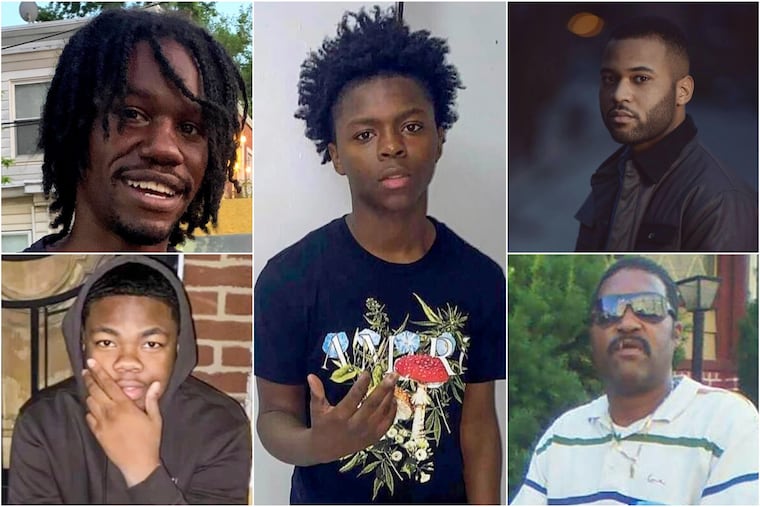
He killed five people: DaJuan Brown, 15; Lashyd Merritt, 21; Dymir Stanton, 29; Ralph Moralis, 59; and Joseph Wamah Jr., 31.
Five others were injured: a 13-year-old boy he shot multiple times in the legs, and a mother who was driving with her 2-year-old twins and 10-year-old niece when he fired more than a dozen bullets into her car.
Wamah was killed first in the early morning of July 2, targeted in his home for reasons that remain unclear. Carriker returned to Wamah’s block nearly two days later, armed with the same gun, and shot the others.
Carriker’s admission to the killings marks the end of the legal saga in a shooting that shocked the city, shattered families’ lives, and traumatized a community.
“This was 14 minutes of terror for the residents of the Kingsessing neighborhood,” Assistant District Attorney Robert Wainwright said of Carriker’s carnage.
Carriker’s attorneys had been expected to argue at trial that he was legally insane when he gunned down his victims, and that he should be housed in a secure psychiatric facility for most of his life, not state prison.
Carriker suffered from “severe delusions and religious preoccupations” and “had a fixed illusion that he was working for the National Security Agency,” said Gregg Blender, assistant defender at the Defender Association of Philadelphia.
Even after he was arrested, taken to Norristown State Hospital, and medicated, he believed that he had done something wrong only because the “National Security Association personnel did not come and rescue me,” Blender said he told doctors.
Prosecutors disagreed that Carriker was legally insane and said his actions were deliberate and he should spend the rest of his life in state prison. But as they prepared for trial, an expert hired by the Philadelphia District Attorney’s Office interviewed Carriker and agreed with defense lawyers that he did not appear to know that what he was doing that night was wrong.
Prosecutors did not want to risk that a jury might find Carriker not guilty by reason of insanity, Wainwright said. So they offered Carriker the opportunity to plead guilty to five counts of third-degree murder, five counts of attempted murder, and gun crimes. They asked a judge to sentence him to 37½ to 75 years in prison.
On Wednesday, Carriker agreed.
Common Pleas Court Judge Glenn B. Bronson sentenced Carriker to the agreed-upon decades behind bars. The judge said that, in his 15 years of handling homicide cases, this was the worst he had seen, but that he would respect the deal reached by prosecutors and Carriker’s defense team.
“It traumatized an entire community,” the judge said of the shooting. “It traumatized an entire city.”
Survivors of the shooting, and loved ones of the people who died, spoke emotionally in court Wednesday of the devastation of that July night, and the lasting impact on their lives.
The father of Joseph Wamah Jr., consumed by the trauma of finding his son’s dead body inside his home, died earlier this year. His daughter said he could not mend his broken heart, and spiraled into a health crisis.
“He faded in front of my eyes,” Jasmine Wamah said of her father.
Other family members spoke of being hospitalized for their mental health, of looking after children without fathers and caring for kids with bullet scars in their legs.
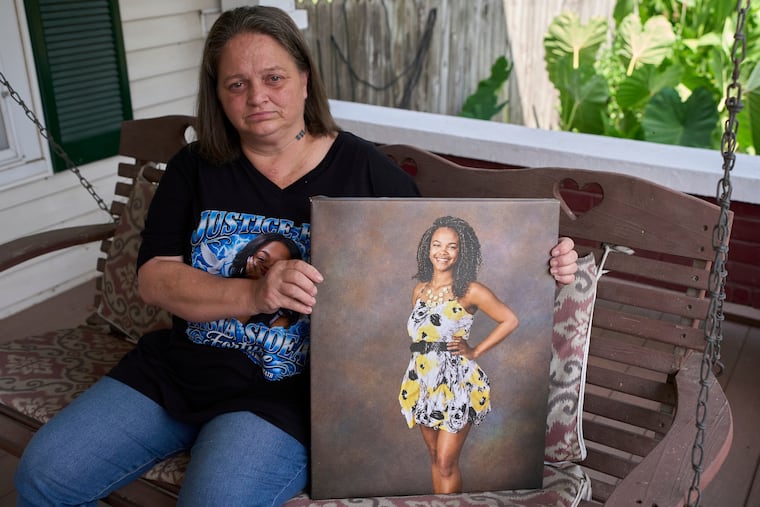
Odessa Brown spoke of holding her 15-year-old grandson as he bled out from his injuries.
“When DaJuan was born, he was given to me and I held him in his arms,” she said. “And that day, I held him when he was on the ground, dying, praying, asking God, please save my child.”
Ralph Moralis’ daughter, Taneisha Moralis, said that, at six months pregnant, she can’t stop thinking about how her child will never know their grandfather.
And Charlotte Clark, the girlfriend of Dymir Stanton, said she struggles to get up each day to care for their daughter, who was only 3 when her father was killed.
“I am still yearning for him from my soul. It makes me crazy,” she said, shaking.
She said she hoped Carriker would rot in prison for what he took from her family.
A killing spree
Carriker’s killing spree began shortly after midnight on July 2, when he showed up at Wamah’s home on the 1600 block of South 56th Street. He shot multiple bullets through the door, then walked in and shot Wamah nine times.
It remains unclear why Carriker targeted Wamah. Police did not know he had been killed until days later.
Nearly two days later, just before 8:30 p.m., Carriker returned to that block with the same rifle and a semiautomatic handgun. First, he fired 18 shots into the Jeep of Octavia Brown, a young woman driving her 2-year-old twins and 10-year-old niece to a family barbecue.
One of the toddlers was shot multiple times in the leg, and the other twin was grazed by a bullet. Glass shards exploded into Brown’s face and eye. The boys survived their injuries, but the family was traumatized. Brown said Wednesday that her son still has pain in his legs from the shooting.
As nearby police rushed to the scene, Carriker walked south down 56th Street, coming across 13-year-old Ryan Moss and shooting him multiple times in the legs. His friend, DaJuan Brown, was on his grandmother’s porch and ran out to help his friend. DaJuan and a responding officer found the boy screaming for help behind a car.
As DaJuan ran home for help, Carriker shot him multiple times, killing him.
Carriker continued on, next shooting Moralis as he got out of his car. Then, as he reached Greenway Avenue, he came to face Lashyd Merritt leaving his home, and shot him. Both men died.
Carriker then turned up South Frazier Street, where he shot and killed Dymir Stanton. Stanton’s brother, Kaadir, shot at Carriker in self-defense as he tried to get to his brother.
Philadelphia police responded to a sprawling scene nearly a mile long. Officer Ryan Howell ran toward the sounds of gunfire, then found Carriker in a dark alleyway. The gunman quickly surrendered.
‘I am sorry’
Prosecutors said Carriker told Howell “good job” as he took him into custody, and said, “I’m out here helping you guys.” Law enforcement sources have said Carriker told police that the shooting spree was an attempt to help authorities address the city’s gun violence crisis, and that God would be sending more people to help.
Carriker’s attorneys said he was profoundly delusional and did not understand the impact of his actions.
Blender, of the defender association, said Wednesday that there was nothing he could say to comfort to the victims’ families — or the relatives of Carriker, who live with their own guilt.
“He was under a mental health disease that prevented him from understanding what was going,” Blender said. “It is not an excuse. It is not to justify this horrific, horrific behavior.”
Later in the sentencing, Carriker, dressed in a red jumpsuit, attempted to apologize.
“All I ever wanted to do was help my community. I never meant to cause this harm,” he said. “I am sorry for the pain I have caused. I would take it back, but I can’t, so I will say that I am sorry and maybe one day you can forgive me.”
After the hearing, the heartbroken families poured into the streets.
A man who said he was like a father to Carriker said: “All families are hurting. If there’s anything that we could ever say, it’s that we are sorry that this happened.”
And the loves ones of the victims left with little comfort. Wamah’s sister did not get the answer to the question that she says haunts her every day: “Why?”
When she asked Carriker in court, he said nothing.