A former supervisor in DA Larry Krasner’s office has been suspended in federal court
The development comes just one day after the Pennsylvania Supreme Court sharply curtailed Krasner's office’s ability to seek to overturn old convictions and accused its lawyers of misleading judges.
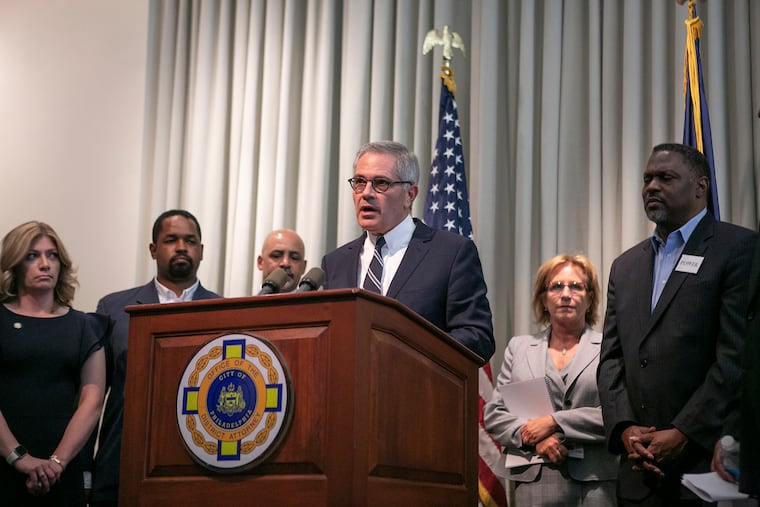
A former supervisor in Philadelphia District Attorney Larry Krasner’s office has been suspended from the region’s federal courts, a development that came just one day after the Pennsylvania Supreme Court sharply curtailed the office’s ability to seek to overturn old convictions and accused its lawyers of misleading judges.
Nancy Winkelman was suspended for three years by a panel of federal judges who found that she was complicit in efforts to mislead a federal judge while seeking to overturn the death sentence of a man convicted of killing an East Mount Airy couple in the 1980s and allow him to serve life in prison instead.
The ruling, made public this week, adds to the mounting judicial scrutiny of post-conviction work in Krasner’s office. On Tuesday, the state Supreme Court imposed remarkable new restrictions on prosecutors’ efforts to reverse potentially problematic convictions.
In a forceful and scolding opinion, the high court said Krasner’s office misled judges, submitted false statements, and “violated its duty of candor” in asking a judge to vacate a 2004 murder conviction.
The court wrote that prosecutors’ actions in the case were part of a troubling pattern of conduct in seeking to overturn murder convictions and ordered that, going forward, the state attorney general’s office must be asked to review and weigh in on all such cases.
The panel of federal judges, in ordering Winkelman’s suspension, echoed some of those concerns.
Winkelman, who had led the office’s law division since 2018 before moving into a part-time role handling legal matters in state court last year, did not respond to a request for comment Wednesday. Her attorney, Andrew Hellman, declined to comment.
Winkelman is appealing the decision. In an earlier request that the findings remain under seal, Hellman described the ruling as having “findings and conclusions infected by serious errors.”
Krasner said in a statement Wednesday night that Winkelman is an exceptional attorney who left a lucrative private law practice to serve the public. He said she always showed “exceptional competence and integrity and contributed mightily to needed reform.”
“On the eve of Juneteenth,” he said, “we should all remember that reform is necessary in every era. And that those who bring needed reform sometimes are made to pay a price.”
The three-judge panel, in a ruling issued in March and unsealed this week, said Winkelman and a subordinate, former assistant district attorney Paul George, misled a federal judge by misrepresenting parts of the case while attempting to reverse the death sentence of Robert Wharton.
Wharton was convicted of first-degree murder and sentenced to death for the 1984 strangulation and drowning deaths of Bradley and Ferne Hart inside their East Mount Airy home.
The jury found that Wharton, angry over a disputed debt, spent months terrorizing the family before he forced his way inside the home at knifepoint and killed the couple. Afterward, he turned off the heat, leaving the couple’s seven-month-old baby, Lisa, to freeze to death — but she survived.
Decades later, prosecutors in Krasner’s office, in seeking to vacate his death sentence, suggested in court that the victims’ family backed their effort. But it was later discovered that they had consulted only one relative and never contacted Lisa Hart-Newman, the couple’s surviving daughter, who strongly opposed the move.
George later acknowledged that was a mistake, and U.S. District Judge Mitchell Goldberg ordered Krasner to write apology letters to the Harts’ relatives.
Goldberg, who denied the request to reduce Wharton’s sentence, later said that George’s and Winkelman’s review of the case was “patently deficient” and that they had violated federal rules of procedure in a manner that was “egregious” and “exceptional.”
The two prosecutors then faced federal disciplinary proceedings to examine whether they had been intentionally deceptive.
Last year, the three-judge panel found that George had lied to Goldberg about key facts, “flouted the interests of the public and the victims’ families,” and acted as the “quarterback” of efforts by the district attorney’s office to undo or undermine all death penalty cases.
George, 75, was disbarred in federal court. He has denied the accusations and filed an appeal. His attorneys said his disbarment was “highly disproportionate and offends basic tenets of justice.” Krasner also defended George’s work and said he believed the appeals court would find that the opinion criticizing George was filled with “factually and legally incorrect” statements.
The panel’s probe into Winkelman’s conduct continued, and the judges said they determined she “was willfully blind to, and complicit in,” George’s misrepresentations to Goldberg.
Winkelman, the judges said, “knowingly made misrepresentations” as part of the district attorney’s office “policy of vacating all death sentences.”
Krasner and his staff have long denied that the office has any such policy.
But the panel appeared to reject that, writing: “We do not credit [Winkelman’s] testimony that there is no such policy.”
According to the order, after Krasner was elected in 2017, he asked Winkelman, who had spent decades in civil appeals work but had no criminal law experience, to lead his office’s law division, a unit that handles hundreds of appeals and post-conviction cases in state and federal court each year.
George, a veteran attorney in the office, was made her assistant supervisor “to fill what she described as the ‘very big gap’ in her resume,” the order said.
The judges wrote that while Winkelman “betrayed the public’s trust,” she “has had a long and distinguished career.” George was the “quarterback of the DAO’s misrepresentations,” they said, and he alone misled Goldberg in the office’s communication with the Hart family.
