Virginia police identify body found in 1972 as 4-year-old Philadelphia boy
Police believe Carl Matthew Bryant and a 6-month-old sibling were killed during trip from Philadelphia to Virginia.
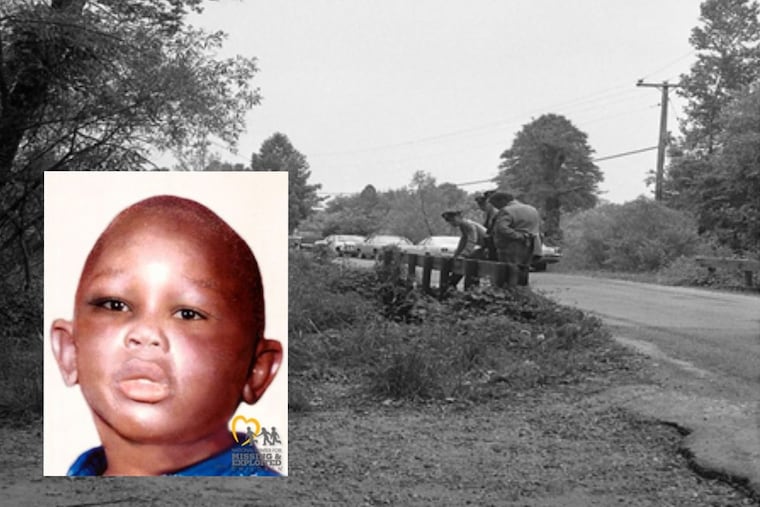
A 4-year-old Philadelphia boy whose unclothed body was discovered in a Virginia creek in 1972 has been identified, and police believe his mother and her then-boyfriend, a previously convicted murderer, were involved in the child’s death.
Carl Matthew Bryant was identified last month based on advanced DNA testing and forensic-grade genome sequencing, the Fairfax County Police Department in Virginia announced at a news conference on Monday.
Before getting their DNA match, detectives suspected that the boy’s mother was Vera Bryant, who died in 1980. Detectives learned from Bryant’s family in Philadelphia that she had a second son, James, who was born in January 1972, and who also disappeared that year. Police believe he was killed.
Vera Bryant and James Hedgepeth, who was convicted of murder in 1962 and spent time in prison, took a trip in 1972 from Philadelphia to Virginia and met Hedgepeth’s family, police said. The couple did not have the two boys with them.
When Vera Bryant visited her relatives for Thanksgiving in 1972, she claimed her boys were with Hedgepeth’s family in Virginia, police said.
“Based on the fact that the couple left with children and arrived without them, they never made a report of any kids being missing, we believe that both boys may have been murdered on June 13, 1972, between Pennsylvania and Virginia,” Assistant Chief Brooke Wright said at the news conference.
Hedgepeth is also dead now, but because of his violent criminal background, “We’d like to talk to people who knew a little bit about him,” Police Chief Kevin Davis said.
Wright provided a timeline of events that led to the identification of Carl Bryant.
“On June 13, 1972, a boy was riding his bike home from school in the Lorton [Va.] area, and he saw a body below the bridge, the Old Colchester Bridge in Lorton, he raced home, told his mother, she called police,” Wright said.
The cause of the boy’s death was blunt-force trauma, and it was ruled a homicide. Police checked other jurisdictions for reports of young missing boys, but nothing matched. With no other promising leads, a local church group buried the unidentified boy at Coleman Cemetery in Alexandria, Va. The church group named the boy “Charles Lee Charlet,” police said.
In the 2000s, the National Center for Missing and Exploited Children created a computer-generated sketch of the boy, but he continued to remain unidentified.
Hair evidence was discovered in the case file and sent to the FBI for DNA analysis and entry into a national database. No matches were found.
Years later, detectives working on the cold case sought to obtain better DNA, but the grave could not be located because of poor cemetery records and because of a severe storm in 2012 that displaced tombstones.
Through genetic genealogy, detectives narrowed in on the Bryant family in Philadelphia and learned that Vera Bryant had a 4-year-old son who disappeared after leaving for a trip to Virginia in 1972.
DNA was collected from relatives and the boy’s suspected father, along with birth certificates and historical records, police said.
Vera Bryant’s body was exhumed from Greenmount Cemetery in the Feltonville section of Philadelphia to confirm her DNA link. The Fairfax County police thanked the Philadelphia Police Department, the Philadelphia Medical Examiner’s Office, and the Philadelphia District Attorney’s Office for assisting with the case.
After several failed attempts, usable DNA was finally extracted from a portion of the mother’s remains and a firm called Astrea Forensics on July 1 matched the DNA to the boy.
During the 1972 autopsy of the boy, a detective in the case collected the hair sample that later became crucial to Carl Bryant’s identification decades later.
Why the detective saved the hair remains a mystery. Police were not collecting evidence for DNA back then.
“Who knows why he did it,” Chief Davis said, “but thank God he did do it.”