A bus program that has taken families for decades to visit incarcerated loved ones could disappear without funding
The nonprofit Pennsylvania Prison Society, which runs the program, needs $600,000 to keep it running next year.
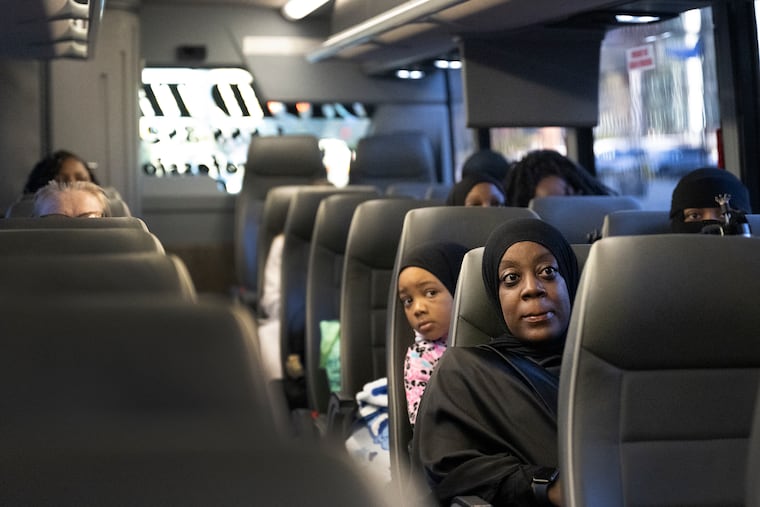
The bus rattled as it climbed north, a constant metallic shake that vibrated through its frame and into the seats beneath passengers. Renee Martin dragged her finger across her phone, trying to complete a digital puzzle of the Mona Lisa.
The vinyl seat squeaked as she shifted to brace her feet against a footrest. It was 9:51 a.m. — two hours and 12 minutes into a four-hour ride — and outside, the shadows of trees along Interstate 83 flickered across the bus on a cloudless April morning, then passed a 25-foot Statue of Liberty rising from the Susquehanna River.
Martin, bright-eyed but barely sitting still with anticipation, didn’t notice. No one did. Most passengers were asleep or staring out the window in silence.
Martin, 68, had awakened before dawn, carefully applying burgundy lipstick and packing her favorite blond bob wig in her tote bag. She wanted to look good for her son.
She hadn’t seen him in person in nearly seven years.
In 2006, Michael Martin was convicted of aggravated assault and related crimes after he shot a man in the back during a robbery in Bella Vista. He’d been incarcerated for 20 years, first at SCI Albion, a state prison more than six hours from Martin’s home in Cobbs Creek, and now, at SCI Benner, just outside of State College. For years, she made the drive with family to visit him. But in 2019, a cancer diagnosis — and then, the pandemic, which shut down in-person visits entirely — kept her from seeing him.
Last fall, her knees, worn with arthritis, gave out as she climbed the steps to her front door. Injections in February had eased the pain, but not enough for a four-hour ride in a cramped car.
Plus, gas was $4.15 a gallon.
When she heard about the bus, she quickly signed up as a way to finally get her back to her son.
For nearly two decades, the nonprofit Pennsylvania Prison Society has run buses across Pennsylvania — taking thousands of people each year from Philadelphia to far-flung state prisons. For many families, the buses — funded by the state — were the only way to see incarcerated loved ones.
During the pandemic, the prison system canceled the program’s funding. And in the years since, the nonprofit has tried to rebuild the service through pilot routes paid for with short-term funding. The bus Martin took is one of a limited number still running. The trip to SCI Benner costs about $2,500. Its 15 riders paid $20.
At that rate, prison society officials say, it needs significantly more funding to keep the program afloat. It would take about $600,000 a year to restore consistent service and expand the program’s reach, running buses from Philadelphia and Pittsburgh to every state prison, every other month.
The society has asked legislators to include that funding in the state budget this year. Without it, they say, the buses could disappear again.
“The vast majority of our riders, without this program, can’t visit their loved ones in person,” said Kirstin Cornnell, the prison society’s family and community support director. Many don’t have their own transportation. For others, the cost is too high. “Programs like this are really their lifeline for in-person visits,” she said.
On the bus to SCI Benner last month, Martin looked up from her phone and caught another woman’s eyes and smiled.
Carlota Gustave, a retired ICU nurse, had awakened at 5 a.m. to make it to the pickup spot near 30th Street Station. She didn’t want to risk missing her second trip on the bus.
Her son, Khadrek Edwards, 28, is serving an eight-year sentence for conspiracy to commit robbery. He went to prison in 2021, the same year Gustave’s husband of 27 years died, and she lost her brother, too.
Edwards is her adopted son. She took him in when he was 3, after his father killed his mother — Gustave’s sister — and raised him as her own.
Gustave dressed in jeans and a gray sweater. The first time she rode the bus, in December, she’d worn a hoodie, and a guard made her take it off. She was cold the entire visit, forced to wear a borrowed T-shirt the nonprofit brings on bus trips for emergencies like dress code violations.
She looked at Martin’s mint-green hoodie. “You can’t wear that in,” Gustave said, leaning slightly across the aisle. “They’ll make you take it off.”
Martin looked surprised. “But there are shirts in the front seat you can wear,” Gustave said.
Within moments, the prison came into view, at the base of a large hill. Martin reached for and pulled on a blue sweatshirt on her way off.
As Gustave walked toward the front, the driver called out: “Don’t forget to watch the step.”
The driver, Steve Campbell, stayed behind. Laminated papers hung from the windows of the bus, noting he had been driving buses since 1982.
For 13 years, he has driven routes like this to prisons scattered across the state. Before the pandemic, when the buses left even earlier and visits lasted an entire day, he made these trips each month. Then COVID-19 reshaped visitation entirely.
The prison system shifted toward digital access, introducing video visits and requiring online accounts to schedule time with incarcerated relatives. Prison visits, according to state data, are higher now than they’ve ever been. But 91% are video calls.
“It’s prohibitive for people who are tech-limited,” Cornnell said, as well as those without internet access or email addresses. The prison system is also in the process of selecting a new communications provider, meaning video calls — currently free — could soon carry a cost.
When in-person visits resumed, the prison system agreed to facilitate these pilot bus runs and has allowed three-hour visits. The next trip to SCI Benner, in July, will leave at 4 a.m. to give riders a full day with their families.
“Nothing can replace holding a loved one,” Cornnell said.
Campbell hadn’t forgotten the rhythms of the rides: the silence on the way there as loved ones slept or sat quietly, rehearsing what they might say; the uncertainty of the return. He has watched children climb back onto the bus in tears. Mothers staring out windows, silent.
The job, as he saw it, was as much psychologist as driver. To lighten the mood, he developed a routine.
“I’m Mr. Campbell, like the soup,” he would say to introduce himself. He always warned about an extra step down when getting off the bus. “There’s a lot of paperwork if someone falls,” he’d say, jokingly. That one usually got a laugh.
Sometimes people returned to the bus early, before the visit’s window was up. A bra’s underwire set off a metal detector, or a misunderstanding with a guard forced someone to wait outside. Once, at another prison, a man tried to bring in pills. State troopers swarmed the prison and the whole place locked down, like in a movie, Campbell recalled.
Campbell said he tries to absorb what he can from each trip, but not carry it home. The night before this drive, he talked at length with his daughter about what he has seen over the years. One thing that struck him most: “Prison doesn’t discriminate,” he told her.
At 3 p.m., Campbell opened the bus doors. Women filed back on slowly, some carrying stacks of photographs.
Gustave held three. They cost $5 each.
The last time she visited, there had been a backdrop, fall trees and a lawn printed on a paper sheet. Her son wore an orange prison shirt, his dreadlocks long, black glasses resting on his nose. They stood side by side. This time, there was no backdrop. Just the two of them, arms tight around each other.
Gustave already has a ticket for the next trip in July — one of the last scheduled rides to SCI Benner.
Martin climbed back into her seat, beaming as if she were still savoring her joy. When she saw her son, she had gasped. He was taller than she remembered, 6-foot-2 to her 5-foot-3.
They played Monopoly. They didn’t finish, but her stack of money was thickest.
She hadn’t cried when they said goodbye. She thought she might, but she was too happy.
Now, as the bus pulled away from the prison and turned back toward Philadelphia, she leaned her head against the seat, and slept.