2026 NFL draft: Rating 14 potential first-round targets for the Eagles
An offensive lineman? A wideout? An edge rusher? The Eagles have a bunch of realistic possibilities for Thursday night's first round.
Welcome to The Inquirer’s annual Draft Meter, where our beat writers rate NFL draft prospects on a scale from 1 to 10, with 10 being most likely that the Eagles will pick that player, and 1 being least likely.
This year, we rated 14 players.
The Eagles have the 23rd pick in Thursday night’s draft, and they have some needs. Here’s who we think is most likely to be on the team by the end of Thursday night:
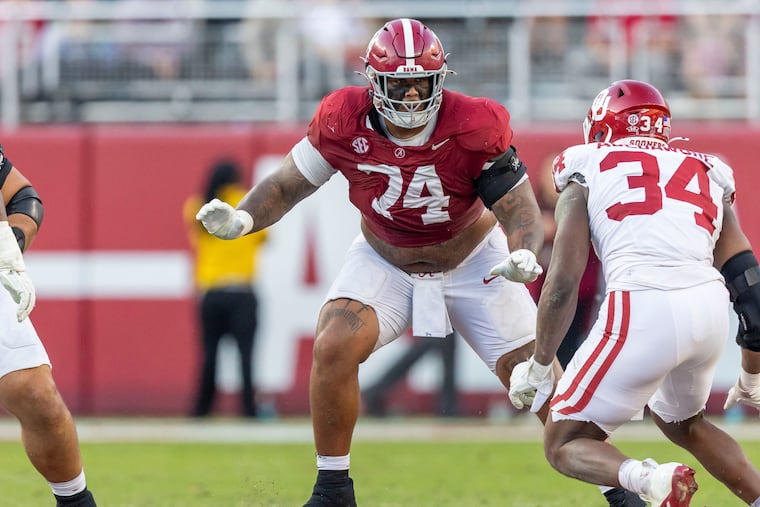
Kadyn Proctor, OT, Alabama
Jeff McLane: Proctor has maybe the best combination of size and athleticism among the tackle class. I could see the Eagles salivating over the Alabama product’s potential. Concerns about weight management could affect their evaluation, though. Georgia’s Monroe Freeling is a cleaner prospect, but he has only one full season as a starter in college. He put up some of the best speed and agility numbers at the NFL Scouting Combine. He’s not Lane Johnson freakish, but he would project as his eventual replacement, even though he played primarily on the left side. I’m flipping a coin between Freeling or Proctor as the Eagles’ most likely first-rounder.
Draft meter: 8.5
Jeff Neiburg: Will he fall to the Eagles? That’s the bigger question for me when it comes to Proctor than which position he ends up playing. Guess what? The Eagles may need a guard to replace Landon Dickerson sooner than they need a tackle to replace Johnson. Proctor is young — he doesn’t turn 21 until June — and athletic. And he’s really big (6-foot-6, 352 pounds). He’s a prospect who fits the Eagles’ mold, regardless of whether Jeff Stoutland still is in Howie Roseman’s ear.
Draft meter: 8
Ryan Novozinsky: Proctor would be a splashy pick at a clear position of need for the Eagles (Jalen Hurts was sacked 70 times the last two seasons!). Too bad he probably won’t be available unless they trade up for him. Howie Roseman reportedly is considering a non-A.J. Brown trade on draft day, but I’m not sure Proctor — who some scouts believe should move to guard — is worth it.
Draft meter: 6.5
Olivia Reiner: Proctor would be a very Eagles-y pick, given his upside at a premium position. He has the physical tools the Eagles typically value, especially his explosiveness and movement skills at his size. His technique remains a work in progress, but the team has the luxury of time to develop Proctor, who would be waiting in the wings behind Lane Johnson. While it is unclear whether Proctor would be best suited for tackle or guard at the next level, the Eagles could use him on the interior, too, as Tyler Steen is entering a contract year and Landon Dickerson has suffered numerous injuries.
Draft meter: 9
Average score: 8
Monroe Freeling, OT, Georgia
McLane: It’s difficult to feel confident about the Eagles selecting anyone in particular so late into the draft, especially when it’s possible they don’t pick at No. 23. But the strong assumption here is that Howie Roseman will take a tackle and need to trade up to get one with first-round talent. Roseman isn’t immune to the concept, of course. He’s moved up in eight of the 15 drafts he’s run since becoming GM. Only once has he jumped more than three spots — in 2010 when the Eagles went from No. 24 to No. 13 for Brandon Graham. I don’t see Roseman needing to be as aggressive to get a tackle — unless he absolutely loves Spencer Fano. But if his desired target drops into the late teens, he might pounce.
Draft meter: 8.5
Neiburg: You could make a strong argument that the Eagles should try to trade up to select Freeling, who is long and athletic and would have the luxury of being tutored by one of the best to ever do it. Will they? Freeling, who can play both sides, may be less likely to fall to No. 23 than Proctor, and if the Eagles have Freeling graded higher than Proctor, perhaps they pull the trigger.
Draft meter: 8
Novozinsky: Here’s a Johnson successor who might be worth trading up for. What Freeling lacks in experience, he makes up for by being a superb athlete who excels in pass protection and run blocking.
Draft meter: 7
Reiner: A big tackle with long arms and great athleticism. He has just one full year of starting experience, so he still has room to develop. Freeling is among the top tackle prospects in this year’s class and might not be available to the Eagles at No. 23, but, like Proctor, he could be a candidate for a trade up.
Draft meter: 8
Average score: 7.88
Max Iheanachor, OT, Arizona State
McLane: With the Eagles able to draft for the future, Iheanachor would qualify as a developmental tackle who could use a year to watch and learn. Born in Nigeria, he didn’t play football in high school. He spent two years at junior college before transferring to Arizona State. He started 31 games at right tackle over three seasons, but is still considered very raw. The Eagles could pull the trigger on his upside, but I think he would qualify as more of a trade-back-into-the-latter-stages-of-the-first-round candidate.
Draft meter: 8
Neiburg: If Iheanachor is on the board at No. 23 and Proctor and Freeling are gone, this seems like the safe pick. Safe isn’t bad. Safe can be good. Iheanachor is a latecomer to football and is still ascending. That’s great, given that the Eagles don’t need him to start this season. Iheanachor’s profile fits the horizontal blocking schemes the Eagles likely will be deploying in the run game.
Draft meter: 8.5
Novozinsky: Scouts are bullish about Iheanachor’s ceiling, but some believe he should do a “redshirt year.” This could be a perfect marriage, given that he could be Lane Johnson’s long-term replacement.
Draft meter: 8.5
Reiner: Iheanachor’s stock has risen rapidly since his strong Senior Bowl showing. He backed up his on-field athleticism with stellar combine testing, including a 4.91-second 40-yard dash. But Iheanachor has just five years of football experience. Is it too risky to use a first-round pick on a player that raw? Maybe the Eagles could get lucky and find a way to land him in the second round, an outcome reminiscent of the trade up for Cooper DeJean.
Draft meter: 6
Average score: 7.75
Keldric Faulk, Edge, Auburn
McLane: When in doubt, look to the trenches for whom the Eagles might draft in the first round, especially after taking a cornerback and off-ball linebacker the previous two years. I’d be surprised if Roseman went defense again in the first round, but if he can’t get an offensive tackle, securing an edge wouldn’t be out of character. Faulk may be bigger and longer than the outside linebackers the Eagles have drafted in recent years (see: Nolan Smith and Jalyx Hunt), but the trade-deadline acquisition of Jaelan Phillips showed that Roseman saw the need for size on the edge. Faulk still is only 20 and has “red star” prospect traits.
Draft meter: 7.5
Neiburg: Faulk’s mock placement is all over the place. Some have him going in the top 12, others have him near the end of the first round. Faulk is big (almost 6-6) and has long arms and won’t turn 21 until September. There’s a lot to like about him as a prospect, even if his sack total dipped from seven to two this past season.
Draft meter: 6.5
Novozinsky: Faulk would be a nice fit on the Birds’ stout defensive front. He has a 276-pound frame and is versatile, playing multiple positions on the defensive line at Auburn. Roseman’s primary goal likely is beefing up his O-line, but if Faulk is available and the Eagles don’t like what’s there, he wouldn’t be a bad consolation prize.
Draft meter: 7
Reiner: Faulk is one of the largest edge rushers in this draft class, and he has the versatility to move inside. His strength at his size shows up on tape, especially against the run (20 run stops, 10% missed tackle rate in 2025, according to PFF). His pass-rush stats aren’t overwhelming (10 sacks in three seasons), but he’s still young. With more development as a pass rusher, he could be a nice complement to Smith and Hunt.
Draft meter: 6
Average score: 6.75
Blake Miller, OT, Clemson
McLane: Miller is a more obvious replacement for Johnson because he played right tackle at Clemson. The Eagles shouldn’t overemphasize the expected switch to more wide-zone run blocking, but he could thrive in the scheme. Some Eagles evaluators love his mental makeup, I’ve been told. But he seems like a tackle for whom the Eagles would trade back — or simply take in the second round — rather than one they’d be aggressive in acquiring.
Draft meter: 6
Neiburg: Of all the tackle prospects, Miller seems the most likely to be on the board if the Eagles are on the clock at No. 23. He’s a four-year starter with a lot of experience under his belt. He started every game in college (54) and while he has some things to work on, he’s NFL-ready.
Draft meter: 6.5
Novozinsky: Not only will Miller likely be there at No. 23, he might be even more NFL ready than Iheanachor. He’s sharp in pass protection, has a high football IQ, and is an impactful run blocker. He’ll certainly be high on Roseman’s board.
Draft meter: 9
Reiner: Miller has the requisite size of an NFL tackle and solid athleticism. His durability is impressive, as he has started 54 games at Clemson, primarily at right tackle. But seeing as the Eagles aren’t in need of an immediate starter at the position, could they take a swing on a prospect with more upside in the first round?
Draft meter: 5.5
Average score: 6.75
Caleb Lomu, OT, Utah
McLane: Lomu might have the best skill set for wide zone blocking, but Roseman has to be careful about drafting for scheme. He should be looking for starting-caliber talents who can thrive in any system in the first round. Lomu may have those capabilities. Like Miller, he has better value in the second round.
Draft meter: 6
Neiburg: Most respected mock drafts have Lomu going after the Eagles pick at No. 23. He’ll likely be on the board when the Eagles are picking. Lomu is big and has a frame that could even stand to add more muscle. He’s a two-year starter who is still a work in progress. What’s needed? Some muscle and coaching. The Eagles can offer him both.
Draft meter: 5.5
Novozinsky: There’s a decent chance Lomu will be there at 23. If that’s the case, Roseman will have to determine whether he prefers his upside over, say, Miller’s or Iheanachor’s. Lomu is a project tackle prospect who needs to improve his strength and technique in order to reach his ceiling.
Draft meter: 7
Reiner: Another viable tackle option for the Eagles with great movement skills, but he has to add some strength at the next level. He is just 21 years old and has eventual starting potential with more development. Still, there should be tackles with higher ceilings and more intrigue to the Eagles available in the first round around No. 23.
Draft meter: 5.5
Average score: 6
Akheem Mesidor, Edge, Miami
McLane: It’s tough to look past Mesidor’s age. He turned 25 on April 5. The Eagles tend to lean younger, especially after the Danny Watkins mistake from 2011. Mesidor also had a laundry list of injuries in college. There’s a lot to like about the edge rusher who starred in some of Miami’s biggest games last season. He’s got speed and power and can jump inside when needed.
Draft meter: 5.5
Neiburg: Edge rusher is the team’s biggest weakness right now, and a position that, similar to the offensive line, has some lingering questions about its future makeup. The Eagles need more talent here, for 2026 and beyond, and Mesidor has plenty of pass rushing moves and is solid against the run. You just wonder if his age and injuries to his feet and shoulder scare off teams in need of edge help early in the draft.
Draft meter: 7
Novozinsky: While I think offensive tackle is the move for the Birds in Round 1, they certainly couldn’t go wrong with this disruptive edge rusher. Standing at 6-3, 259 pounds, Mesidor is explosive, quick and has active hands. He was a major factor in Miami’s success this season.
Draft meter: 8
Reiner: Mesidor had a breakout season as a sixth-year senior in 2025, flaunting his pass-rush ability with his ACC-leading 12½ sacks. But he just turned 25 years old, making him one of the older prospects in this draft. Between his age and his foot injuries, Mesidor seems like an improbable first-round pick for the Eagles.
Draft meter: 3
Average score: 5.88
Kenyon Sadiq, TE, Oregon
McLane: On paper, Sadiq makes sense. For the second straight year, the Eagles’ top three tight ends are on one-year deals. They had hoped to add to the group a year ago, but a tight end didn’t drop their way. This year’s crop is said to be deeper, so Roseman doesn’t have to push for Sadiq. He’s more of a flex than an in-line tight end, but free agent Johnny Mundt will handle a lot of the blocking. Sadiq could contribute right away even with Dallas Goedert returning. I think Eli Stowers in the second round would be a solid pull, too.
Draft meter: 7
Neiburg: If he’s on the board at No. 23, which seems unlikely, I don’t think Sadiq is a bad pick for the Eagles. It’s probably a good pick given where experts have him rated and the team’s positional need beyond 2026. Sadiq is a versatile pass catcher who also has some blocking chops. The Eagles need those traits. But do they need a tight end more than they need offensive line help or pass rushers?
Draft meter: 5
Novozinsky: Sadiq is perhaps the only pass catcher I could see the Eagles being tempted to trade up for. While not the best blocker, he can create space down the middle and is excellent after the catch. Alas, plenty of other teams could use him, so I don’t see Roseman coughing up the big haul needed to strike a deal.
Draft meter: 5
Reiner: Could Sadiq be Goedert’s successor at TE1, even though Roseman has never drafted a tight end in the first round? Sadiq, the top tight end in this draft class, could be worth breaking that trend. He’s a dynamic receiver and a competitive blocker, even though he doesn’t have ideal size at the position at 6-3, 241 pounds. He could lessen the blow to the receiving corps if A.J. Brown is traded. The likelihood that Sadiq is available to the Eagles at No. 23 or in a reasonable trade seems slim, though.
Draft meter: 6
Average score: 5.75
Omar Cooper Jr., WR, Indiana
McLane: I don’t think Roseman will move up for a receiver with depth at the position, but if he was pigeonholed into No. 23 or moved back several spots, Cooper could justify the selection. The Indiana product has inside-outside versatility. He also has length the Eagles currently lack at the spot. No matter what happens with A.J. Brown, I’ll be surprised if Roseman doesn’t draft a receiver by the end of Day 2.
Draft meter: 6.5
Neiburg: There are flashier receiving prospects in this draft, but Cooper is big, physical, and really good with the ball in his hands. He had 20 touchdowns over the last two seasons, and while his route-running could use some work, Cooper can play inside and out. The Eagles may covet that type of versatility in the passing game when they’re on the clock. Keep in mind, too, that there are Day 2 targets in play at receiver.
Draft meter: 6.5
Novozinsky: Yes, I know Brown is likely a goner, but the Eagles have far too many needs to address before they take a receiver. Barring a massive slide from a stud like Jordyn Tyson, they’re better off taking one on Day 2.
Draft meter: 3
Reiner: Cooper uses his explosiveness and physicality to create extra yardage after the catch. Last season, he posted 414 yards after the catch and forced 24 missed tackles (ranked fifth among FBS receivers), according to PFF. He has impressive long speed, too, running a 4.42 40 at the combine, which suggests he can be more than just a slot receiver. Cooper also has championship pedigree, a trait the Eagles value.
Draft meter: 6
Average score: 5.5
Malachi Lawrence, Edge, UCF
McLane: You could probably toss a blanket over a half- dozen edge rushers who could go in the late first to early second rounds. Scheme, fit, team preference and more will factor into the order in which they’re drafted. Lawrence is on the smaller side, but he killed at the combine. I don’t like him for the Eagles at 23, but maybe if he falls? T.J. Parker, Cashius Howell, Zion Young, and R Mason Thomas are other possible edge rushers who would represent good value in round 2.
Draft meter: 4.5
Neiburg: Lawrence is pretty explosive off the ball and at 6-4, 253 pounds, with 4.52 40 speed, has the size and athleticism NFL teams covet. Lawrence seems likely to be on the board at No. 23. Some mock drafts even have him in the second round. Depending on how the board falls, the Eagles could even trade down a few spots, stockpile extra picks, and get a player like Lawrence near the end of the round.
Draft meter: 6
Novozinsky: This is a top-heavy and deep edge rusher class. Lawrence will surely make some team happy in the late first round or early second round, but I’m just not sure Roseman should reach on him at 23.
Draft meter: 5
Reiner: Lawrence may be average in size for an edge rusher, but he has the speed and athleticism that the Eagles typically covet at the position. He had a decently productive 2025 season, leading the team with seven sacks. Still, Lawrence is in the tier of edge rushers below top prospects David Bailey and Rueben Bain Jr. He could be a potential trade-back candidate or a second-round trade-up possibility.
Draft meter: 4
Average score: 4.88
Denzel Boston, WR, Washington
McLane: I’ve seen Boston projected to the Eagles in mock drafts, but I’m just not buying it. He’s a gifted receiver with an impressive catch radius, but he doesn’t scream first-round talent. Or at least the kind of receiver the Eagles would make their No. 1 pick. Perhaps he falls into the second round and Roseman grabs him after taking a tackle. KC Concepcion, Chris Bell, and Germie Bernard could also be receiver options on Day 2.
Draft meter: 4
Neiburg: There are concerns about Boston’s speed and separation skills, but he’s 6-3 and 212 pounds and has really sharp ball skills. Like Cooper, Boston also has 20 touchdowns over the last two seasons and is a strong red-zone target. He may be less NFL-ready than some of the other first-round prospects, but the Eagles, even without Brown, might not need a whole lot out of Boston in 2026.
Draft meter: 5.5
Novozinsky: Unless Boston somehow slips to No. 54 (and he probably won’t), the Eagles aren’t likely to take him. The reason Roseman acquired Dontayvion Wicks is so that he could worry about wide receiver later in the draft. Stick with the plan and take a tackle or edge rusher early.
Draft meter: 3
Reiner: Boston was a contested catch machine at Washington, hauling in 75% of such targets in 2025, according to Pro Football Focus (ranked fourth in the FBS among receivers with at least 78 targets). His size and physicality at 6-4, 212 pounds are enticing. But he isn’t the speediest athlete among the top tier of receivers and his decision not to run the 40 ought to raise questions.
Draft meter: 5
Average score: 4.38
Jordyn Tyson, WR, Arizona State
McLane: Tyson is unlikely to be around at No. 23. He’s explosive and can make acrobatic catches. That’s quite the combination. But injuries made durability an issue in college. Could he fall within striking distance and give the Eagles a plug-and-play receiver with Brown likely to be traded? I don’t see it, but stranger things have happened on Day 1 of the draft.
Draft meter: 5
Neiburg: Maybe it’s time to start operating as if Brown is no longer on the Eagles. The team’s actions have certainly tipped its hand there. Are the Eagles fine with DeVonta Smith, Dontayvion Wicks, Hollywood Brown and Co. leading the depth chart in 2026? Probably. Do they need to start rebuilding the corps with young talent? Definitely. Will Tyson be there at No. 23? Almost no chance. Trading up to get him would be a splashy move, but I’m having a hard time seeing it happen.
Draft meter: 4
Novozinsky: I’ve seen Tyson projected as high as the No. 5 pick and as low as the second round in mock drafts. The Arizona State wide receiver is talented, but I don’t see him falling to No. 23 — and given his injury history, that’s probably a good thing.
Draft meter: 4.5
Reiner: Tyson is a playmaker with inside-outside versatility. He produced consistently at Arizona State over two seasons, eclipsing a combined 1,800 yards and posting 18 touchdowns in 21 starts. His lengthy injury history ought to give teams pause. If the Eagles are preparing for an A.J. Brown trade, though, Tyson’s potential might be too great to ignore. But would he fall to No. 23? Doubtful.
Draft meter: 4
Average score: 4.38
Emmanuel McNeil-Warren, S, Toledo
McLane: The Eagles’ most obvious hole is unlikely to be addressed in the first round, even if McNeil-Warren and Dillon Thieneman have long-term starter ceilings. Roseman uncharacteristically drafted a safety in the second round (Drew Mukuba) in 2025, which makes it unlikely he takes one a round earlier a year later.
Draft meter: 3.5
Neiburg: Do the Eagles go back to a Toledo defensive back in the first round? It worked with Quinyon Mitchell. Nick Sirianni won’t have any trouble learning everything he can about McNeil-Warren given that his close friend Jason Candle coached him at Toledo. There’s a positional need for the Eagles, who aren’t very deep at safety and are likely to have a healthy competition for a job in camp. I just don’t see them drafting a safety in the first round with the other players likely to be available at this slot.
Draft meter: 4.5
Novozinsky: Safety is obviously a huge need — and McNeil-Warren would fill it well — but I just don’t see Roseman taking one in the first round. Thankfully, the 2026 safety crop is deep, so Roseman should be able to find a solid one on Day 2 or 3.
Draft meter: 4
Reiner: Could McNeil-Warren be the Jihaad Campbell of this year’s draft in the first round? The rangy safety had stellar production at Toledo, with 15 pass breakups, nine forced fumbles, 11 tackles for losses, and five interceptions over four seasons (26 starts). Even though the Eagles need a starting safety, the team doesn’t typically prioritize the position in the first round.
Draft meter: 5
Average score: 4.25
Vega Ioane, G, Penn State
McLane: Ioane could probably start on Day 1, but assuming Landon Dickerson is healthy and Tyler Steen returns, he would conceivably have to wait his turn at guard. Maybe he could beat out Steen immediately, but this could be a pick in case Dickerson can’t get through the season or he decides to hang them up next year. Ioane may have top-10 talent, but guards tend to drop. Would Roseman be willing if he’s still there at No. 23?
Draft meter: 6.5
Neiburg: All the talk about the Eagles needing a succession plan for Lane Johnson ignores the reality that they need a plan for Dickerson, too. The left guard has been beaten up by the game of football over the years. And what about Steen’s future? The offensive line needs rebuilding, and Ioane can step in right away if needed. But he’s unlikely to be there at No. 23, and if you’re trading up for a player, it’s probably not him.
Draft meter: 3
Novozinsky: Ioane is another prospect with a wide mock draft range. Some outlets have him in the top 10, others all the way in the late first. Either way, I don’t see him ending up in Philadelphia. It’s a shame too, as he projects to be an NFL starter.
Draft meter: 4
Reiner: Ioane is in the Sadiq category of “best player at his position in the draft, but unlikely to be available to the Eagles at No. 23.” He could immediately compete for a starting job given his well-rounded game and ample experience. Would the Eagles trade up for a guard, a position they rarely target in the first round? That seems far-fetched.
Draft meter: 3
Average score: 4.13

The Eagles seem reluctant to address the handling of the Jalen Hurts blood clots saga, but the key questions involved in the story aren’t going anywhere. Throughout the week, in the absence of remarks from general manager Howie Roseman or team medical personnel, head coach Nick Sirianni was peppered by reporters. He’s offered few details in return. After speaking with high-ranking medical officials currently or previously employed by NFL teams, The Inquirer’s Jeff McLane frames four central issues that remain unanswered, while also looking at what this situation means for Hurts’ future in Philadelphia. Listen here.
Listen to all episodes here or wherever you get your podcasts.