2026 NFL draft, position by position: Could the Eagles add a Day 3 quarterback?
It's not a major area of need for a team that has Jalen Hurts, Tanner McKee, and Andy Dalton, but there are scenarios that have the Eagles continuing to add to the QB corps.
From April 6-17, The Inquirer’s Eagles reporting team will be breaking down each position on the roster ahead of the NFL draft, looking at the depth chart and long-term personnel picture, as well as some names that could emerge as Eagles targets in the April 23-25 event.
QB personnel picture
Here’s the state of the quarterback depth chart ahead of the draft:
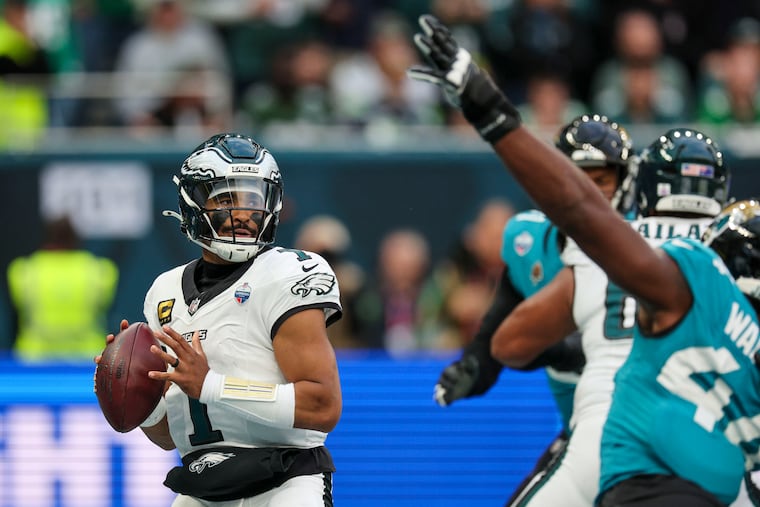
Another offseason, another refresh to the depth behind Jalen Hurts. The Eagles acquired 38-year-old Andy Dalton from the Carolina Panthers for a 2027 seventh-round pick on March 24, tentatively slotting him into the third quarterback spot vacated by Sam Howell in free agency.
That’s right, third quarterback. Howie Roseman said at the annual league meeting in Phoenix that the trade for Dalton was made “independent of Tanner [McKee].” Dalton, he said, can add a lot “on and off the field.” He started seven games in the last three years in relief of the Panthers’ Bryce Young and has shown he can “still throw it, he still really makes quick decisions,” according to Roseman.
» READ MORE: A lot of people are missing the point on Jalen Hurts and the Eagles
The addition of Dalton doesn’t necessarily mean that a trade of McKee is imminent. Roseman emphasized that McKee, the 2023 sixth-round pick out of Stanford, still provides “incredible security for us‚” given that the team prefers to carry three quarterbacks on the active roster. Competing in 2026 is the goal, Roseman said, not maximizing McKee’s value in a trade going into the final year of his rookie deal.
Reading between the lines a bit, these are the kinds of things that a general manager might say to gain leverage in a potential trade. If the Eagles get an outstanding offer for McKee, they might feel more comfortable moving him given Dalton’s experience. If they don’t, they simply have more insurance in the QB corps behind Hurts. Plus, given that the Eagles are paying just $1.5 million of Dalton’s 2026 salary, he is relatively affordable for a third quarterback.
The quarterbacks room likely isn’t set heading into the draft, though. The Eagles tend to keep four quarterbacks on the 90-man roster in training camp and on the 70-man roster (including the practice squad) during the season. Last year, that fourth spot went to Kyle McCord, the Eagles’ 2025 sixth-round pick out of Syracuse.
But after McCord finished the season on the practice squad, his contract expired, and he signed with the Green Bay Packers. The Eagles could fill the fourth quarterback spot with a veteran (in 2024, Will Grier and Ian Book split the job) or they could turn to the draft for a developmental rookie. This quarterbacks class after Fernando Mendoza, the anticipated No. 1 overall selection, isn’t particularly deep, so most options likely available to the Eagles will be classified as projects. — Olivia Reiner
» READ MORE: 2026 NFL draft, position by position: Why the Eagles must future-proof the D-line
Who are the potential QB targets for the Eagles in the draft?
Beyond Mendoza, there are two quarterbacks who will likely come off the board by the end of the third round: Alabama’s Ty Simpson, who is getting late-first-round buzz, and LSU’s Garrett Nussmeier, who is a firm Day 2 candidate.
It’s unlikely the Eagles are drafting a quarterback when there are needs elsewhere in the short and long term, and adding Dalton to a corps with Hurts and McKee already signals a Day 3 quarterback is a more realistic option for the team.
With that in mind, here are four players to keep an eye on as developmental quarterback options:
Sawyer Robertson, Baylor
Robertson had far more early-round buzz before the 2025 season than at the end, when he finished with 3,681 yards, 31 touchdowns, and completed 60.4% of his passes. There is still plenty to like about Robertson, who measured in at 6-foot-4, 216 pounds at the combine.
He showcases NFL-level touch on vertical passes, has a compact throwing motion that allows him to attack all areas of the field, and has some mobility, though just functional, to make plays happen outside of the pocket.
He’s inconsistent in his accuracy on throws outside of the numbers, needs to improve his anticipation on timing throws, and does not always handle pressure well, whether it’s identifying it presnap or in his natural pocket feel.
Still, Robertson has a profile worth betting on and could eventually develop into a backup-level quarterback for the Eagles. If McKee is either traded or leaves at the end of next season, the Baylor quarterback could become the long-term backup.
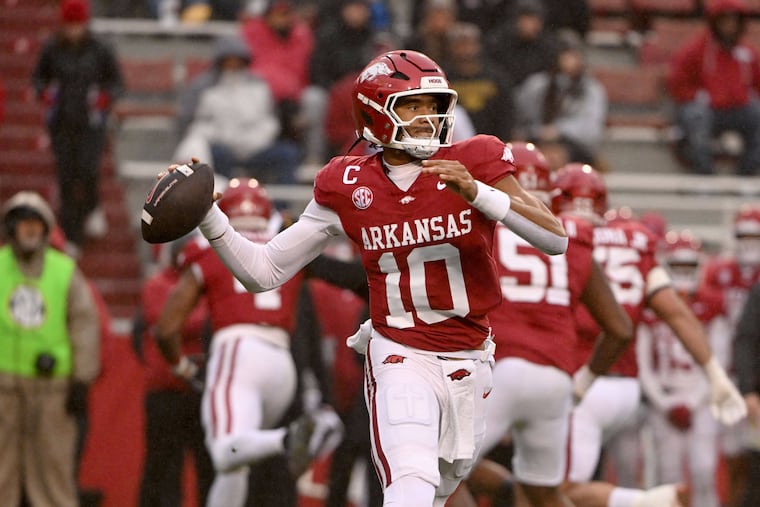
Taylen Green, Arkansas
Green, who has an outstanding athletic profile after running a 4.36-second 40-yard dash, jumping a 43.5-inch vertical, and leaping 11 feet, 2 inches in the broad jump, is one of the more intriguing players in the draft class. He’s 6-6, 227 pounds, and a four-year starter across stops at Boise State and Arkansas, and is no doubt talented as a dual-threat quarterback.
As a passer, Green is at his best making throws between the numbers on intermediate routes such as curl, in-breaking, and seam routes. Because he’s an elite athlete, he can extend plays with his legs and make throws on the run and create scrambling opportunities.
However, the ball placement, accuracy, and mechanics all need work and he’s a developmental player. Because of his running ability, he does not yet strike a consistent balance of making something happen outside the pocket and living to fight for another play.
A likely Day 3 player, Green would need a couple of years to develop into a backup-level player, but the elite athleticism makes him a strong candidate the Eagles should consider.
Cole Payton, North Dakota State
Yes, Payton played for North Dakota State, which may still be a sore spot for some Eagles fans who have a negative association with Carson Wentz’s alma mater. Payton, a one-year starter for the Bison, has a nice deep-ball touch on vertical throws, has a strong arm to make throws at all three levels of a defense, and is an extremely athletic player who excelled so much as a runner that the staff used him in run-only packages early in his career.
The lack of experience at the position and facing FCS-level competition are big reasons he is projected to be a Day 3 pick. Like Green, Payton tries to create plays outside the pocket, which can then turn into negative plays like turnovers and sacks. His pocket feel, while it has improved, still needs work, and that will only happen with more reps.
The lefty quarterback looked like he belonged at the Senior Bowl and would be a long-term backup option with mobility and running ability.
Haynes King, Georgia Tech
King is an experienced signal-caller who started his final three seasons at Georgia Tech after beginning his career at Texas A&M. Of the quarterbacks mentioned on this list, King has probably already reached his perceived ceiling as a backup-level quarterback, but he shows NFL-level pocket poise and can deliver accurate throws on crossing routes and in-breaking routes.
He has decent arm strength but doesn’t throw receivers open often, he struggles throwing under pressure, and doesn’t consistently hit throws outside the numbers. His running ability, though, stands out as a strength and he can keep the defense honest.
King projects to be a late draft pick, in Round 6 or 7, and can develop into a low-end backup or third-string quarterback.

For over two decades, one of the guiding personnel principles of the Philadelphia Eagles organization has been to prioritize the offensive line. Through four games, and this past week in particular, the group has undergone dramatic turnover. Hall of Fame-caliber tackle Lane Johnson retired. Cam Jurgens was shipped to Baltimore in a trade. Their respective replacements have potential, but, compared to how general manager Howie Roseman has stockpiled talent on the line in the past, the options now seem less optimal. Did Roseman and the Eagles stray from a long-held philosophy? The Inquirer’s Jeff McLane retraces key decisions that brought the team to this point. Listen here.
Listen to all episodes here or wherever you get your podcasts.