2026 NFL draft, position by position: Will the Eagles find a tight end they like?
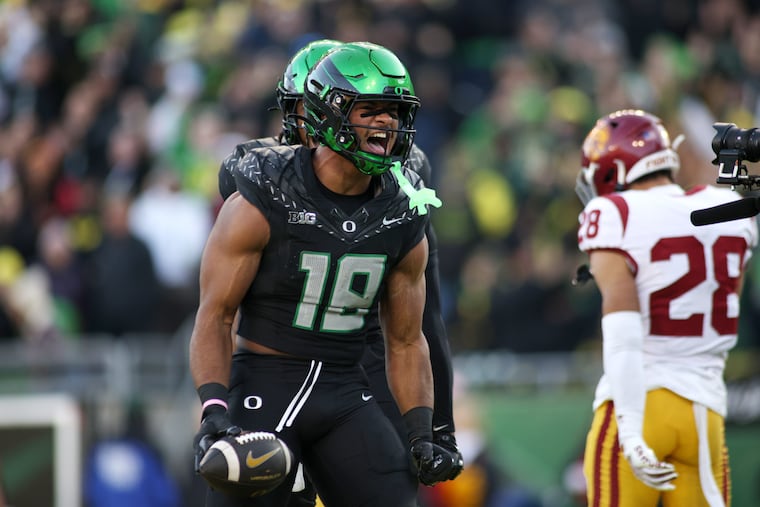
Oregon's Kenyon Sadiq is the tight end prize of this draft. Will he still be available when the Eagles are on the clock?
From April 6 to 17, The Inquirer’s Eagles reporting team will be breaking down each position on the roster ahead of the NFL draft, looking at the depth chart and long-term personnel picture as well as some names that could emerge as Eagles targets in the April 23-25 event.
TE personnel picture
Let’s take a look at the tight end depth chart ahead of the draft:
Don’t get used to this precise order. With Dallas Goedert signing a one-year deal to return to the Eagles for his ninth season, Howie Roseman is likely going into the draft on the hunt for the team’s TE1 of the future.
Goedert, 31, is a fine stopgap option in 2026. He started a career-best 15 games in 2025, a reflection of his improved health after he missed seven games due to injury the year prior, and tied for second in the league with 11 touchdowns.
He scored 10 of those touchdowns in the red zone, in part because of the inefficiency of the Tush Push as the season progressed. His scoring success was also indicative of his chemistry with Jalen Hurts, which they have cultivated over the last six seasons.
But Goedert’s blocking struggles in 2025 served as a reminder that the Eagles eventually need a do-it-all tight end in that top role. To some extent, Roseman temporarily addressed that blocking deficiency on the roster this offseason when he signed veteran Johnny Mundt to a one-year deal.
Mundt, 31, ought to be well-acquainted with the Shanahan/McVay-style wide-zone blocking scheme that Sean Mannion will install, as he played with the quarterback-turned-Eagles offensive coordinator with the St. Louis/Los Angeles Rams and played for offensive line coach Chris Kuper with the Minnesota Vikings.
Roseman also brought back Grant Calcaterra, the depth receiving tight end who was too frequently miscast as a blocker in 2025. Ultimately, each of these signings gives the Eagles some insurance at the position in 2026 if they don’t draft a tight end, or if that prospective rookie tight end isn’t ready for a prominent role in the offense at the start of the season.
The former seems unlikely. This is a relatively deep draft class of tight ends, led by Oregon’s Kenyon Sadiq. The 2025 Big Ten tight end of the year could be an option for the Eagles with their first-round pick, or the team could wait until Day 2 or 3 to take advantage of the value in the mid-to-late rounds.
Roseman hasn’t drafted a tight end in the first round in his tenure as Eagles general manager. His earliest picks at the position include Goedert (2018, Round 2, No. 49 overall) and Zach Ertz (2013, Round 2, No. 35 overall). However, the same could be said for the inside linebacker position last year and the cornerbacks position the year before. The Eagles went on to draft Jihaad Campbell with the No. 31 overall selection in 2025 and Quinyon Mitchell at No. 22 in 2024.
— Olivia Reiner
Potential targets in the draft
Kenyon Sadiq, Oregon
Sadiq, the top overall tight end in this class, is an elite athlete at 6-foot-3 and 241 pounds, is willing to do the dirty work as a blocker, and is a dynamic receiver when the ball is in his hands. His production is not on par with other first-round tight ends before him (51 catches, 560 yards, eight touchdowns), but he excels as a pass catcher working the seam and finding soft spots in zone coverage.
Though he won’t be a full-time, in-line tight end — he lacks length (31.5-inch arms) — Sadiq has tenacious effort in the run game, particularly thriving on the move, with his best reps coming against linebackers and secondary players in space.
Sadiq was one of the combine’s top performers (4.39-second 40-yard dash; 43.5-inch vertical jump; 11-foot, 2-inch broad jump), but must continue to grow as a route runner and clean up his drops at the NFL level (10.5% drop rate in 2025).
Though Sadiq should be near the top of the Eagles’ draft board, there is uncertainty that he will be available by the 23rd pick of the first round. But if he’s within range for a trade-up, the Eagles should strongly consider selecting the dynamic and explosive tight end.
Oscar Delp, Georgia
Delp, the standout Georgia tight end, had underwhelming college production (20 catches, 261 yards, one touchdown in 2025) but has an explosive, yards-after-catch skill set with eye-popping blocking skills that give him a strong baseline to carve out an NFL role.
He was held out of testing at the combine because of a hairline fracture in his foot, but Delp more than made up for it at his pro day, running a 4.48-second 40-yard dash, jumping a 38.5-inch vertical, and leaping a 10-foot broad jump. At Georgia, Delp showcased linear speed to threaten the seams and the route pacing to separate from linebackers and safeties.
He has the blocking technique and effort to be an effective blocker, but he needs to continue to add weight to his frame (6-5, 245) and to get stronger to thrive more in an in-line tight end role. He projects as a Day 2 pick and could make sense as one of the Eagles’ two third-round picks, with the potential to become a long-term answer at the position.
Sam Roush, Stanford
Roush, one of the heavier tight ends in this class at 6-6, 267, runs his routes with urgency and excels at finding soft spots against zone coverage over the middle of the field. He is an aggressive, physical, in-line blocker who showcases high effort and intent to move defenders off the ball, though he is not always consistent because of his lack of arm length (30⅝-inch arms).
Roush, like Delp, did not have overwhelming college production (49 catches. 545 yards, two touchdowns in 2025), with most of his targets coming less than five yards beyond the line of scrimmage.
Roush likely won’t be a high volume target at the NFL level, but his combination of blocking ability and route-running nuance can set him up to be a more productive pro than he was in college. He projects as a late Day 2 or early Day 3 player.
Justin Joly, N.C. State
Joly, who was a third-round pick in our Eagles seven-round mock draft last month, is a polished route runner who can stretch a defense vertically with his speed and find soft spots over the middle of the field against zone coverage. As opposed to some other tight ends on this list, Joly was far more productive in college (92 catches, 1,150 yards, and 11 touchdowns over last two seasons) and has rarely dropped passes (one drop in 2025).
Joly as a blocker is at his best on the move or out in space. His relatively small frame (6-3, 241) and lack of upper-body strength to move defenders in the run game projects him as a move tight end rather than in-line.
The N.C. State standout projects as a late Day 2/early Day 3 player that can be the future receiving tight end for the Eagles, but would likely need to be paired with a more traditional in-line tight end to offset his limited blocking ability.
Nate Boerkircher, Texas A&M
Boerkircher, who is reportedly taking a “30″ visit with the Eagles, plays a more traditional in-line tight end role and is a physical blocker who revels in doing the dirty work that doesn’t always equate to targets and catches. He has nice size (6-5, 245) and decent short-area quickness (7.03-second three-cone, 4.33 short shuttle at his pro day)
The sixth-year tight end did not produce much in the box score as a receiver (19 catches, 198 yards, 3 touchdowns) and does not have the speed to consistently generate downfield targets, but he does have reliable hands and can make tough catches over the middle of the field.
Boerkircher projects as a Day 3 player who can fill a blocking role and likely won’t receive a high volume of targets in the passing game early in his career.
— Devin Jackson