To the Eagles, Vic Fangio is a savvy defensive mind. To Dunmore, he’s a former umpire, bartender, and much more
Fangio's journey to becoming one of the game's most revered defensive minds began as a high school coach in a small town 120 miles from Philadelphia.
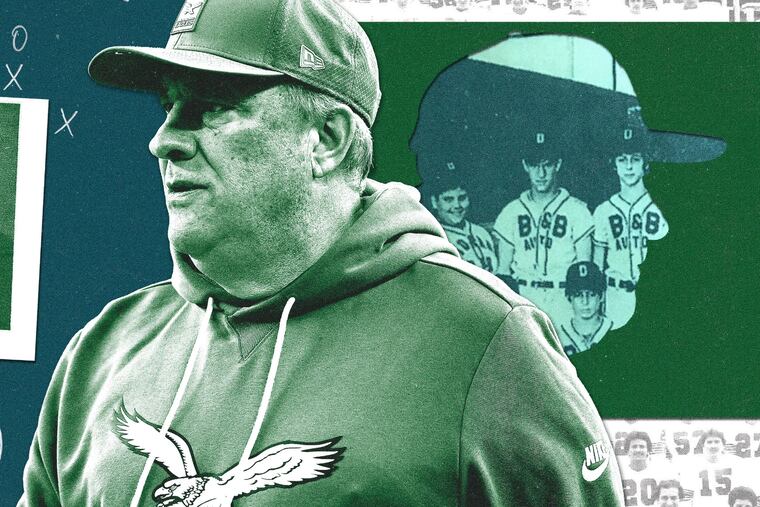
DUNMORE, Pa. — Roseann Henzes is 89 years old and watching the Eagles is the highlight of her week. This is not because of the players, the head coach, the general manager, or the famous security officer.
It is because of Vic Fangio, whom she has known since he was 14, when he played high school football for her late husband, Jack Henzes.
A day before the game, the octogenarian will text the defensive coordinator “good luck.” From her wheelchair in Dunmore, she’ll take in every snap, paying close attention to moments when the camera pans to the coaching booth.
Fangio wears the same expression he did in the 1970s: stern, focused, and endearingly gruff. Win or lose, Henzes sends him a message afterward. He usually replies, with his typical brevity.
“I get one-word answers,” she said with a laugh. “‘Thanks,’ or ‘appreciate it,’ maybe. No time to chitchat.”
Some coordinators are toughened by long hours and stressful seasons, but the people of Dunmore say this is how Fangio has always been. Even as a young safety, he was hard-nosed and meticulous, a player who devoured film and grasped concepts on the first try.
Fangio showed an ability to be in the right spot at the right time, or, better yet, anticipate what the opposing offense would do next. These instincts only sharpened in 1979, when he was hired by Jack Henzes as linebackers coach at Dunmore High School, his alma mater, about 120 miles north of Philadelphia.
It was an opportunity that laid the foundation for the rest of his career. Henzes became a mentor to Fangio, whom he saw as a kindred spirit. He taught his pupil how to work, how to coach, and how to get the most out of his team.
They took pride in the minutiae, drilling players on everything from proper footwork to hand placement. This translated into success: After losing seasons in 1976 and 1977, and a bounce-back 10-win season in 1978, Fangio and Henzes went 21-13 over their three years coaching together.
The Eagles defensive coordinator has accomplished a lot since then — including a Super Bowl championship in which he had a crucial role — but locals still see the same understated guy.
To Roseann Henzes and the Dunmore community, he will always be the kid who umpired Little League games for fun. Or the high school coach who tended bar at Ragnacci’s for extra money — despite his reticent nature.
“I just laugh when they show him in the [coaches’] box,” said Tony Donato, Fangio’s former neighbor. “The same expression on his face. Doesn’t crack a smile. I think he’s saying, ‘I don’t want this camera on me at all.’”
A player known as ‘Hector’
Fangio spent his formative years in Dunmore, a borough of about 14,000 people just outside of Scranton. His mother, Alice, was a housewife and, later, a secretary at the local high school. His father, Vic Sr., owned a tailor shop.
From a young age, Fangio was immersed in sports. He played baseball in the spring, football in the fall, and basketball in the winter. As if that wasn’t enough, Fangio began umpiring in Dunmore’s Little League, where Vic Sr. served as a coach, in the early 1970s.
He was only a teenager, but he displayed a breadth of knowledge that commanded respect.
Bob Holmes, who played for Fangio from 1979 to 1981, experienced this firsthand. He met his future football coach in the batter’s box. The umpire showed no mercy.
“He called balls and strikes,” Holmes said. “And if you were just this kid sitting up there, and you’d watch one go by, he’d punch you out like it was a major league game. Off to the side, fist out, you’re done. Out you go.”
Locals assumed Fangio would work in sports. Some wondered if he’d become an umpire, following in the footsteps of Dunmore resident and Baseball Hall of Famer Nestor Chylak.
But after Fangio was introduced to Henzes, his love for football became clear. He played for the freshman team in eighth grade, with a voracious appetite to learn. Bill Stracka, Fangio’s coach in 1971, said the middle schooler would bring him NFL concepts to implement.
“Every once in a while he’d say, ‘Could I talk to you before we leave?’ And I’d say, ‘Sure,’” Stracka said. “He’d say, ‘Well, last night, I was watching part of the game, and I saw something that I’d really like to explore here. I think I could do it.’
“Whenever we talked about things, it was like that. He was very, very aware.”
Fangio joined the varsity team in 1973, and was taken by Henzes’ understanding of the sport. Henzes was taken by Fangio, too. Roseann said her husband would talk about the safety “all the time,” and eventually introduced her to Fangio when he was a sophomore.
She was struck by how similar they were, down to their demeanor. Both Fangio and Henzes were quiet. Both had a borderline obsession with the game, spending long days and late nights studying film.
Because of all this work, they could predict an opposing offense’s next move. Joe Carra, a former linebacker at Dunmore, remembered one game in 1973 against Valley View, which Dunmore hadn’t beaten in years.
With Fangio on the field, they achieved the improbable. He intercepted a pass late in the fourth quarter and returned it 40 yards for a backbreaking touchdown en route to a 33-27 win.
“He would play right behind me, and he was always in the right position,” Carra said. “That’s why he had a bunch of interceptions.”
Together, Henzes and Fangio elevated the program to new heights. After a lackluster freshman season in which it went 5-4-2, Dunmore posted a 28-6-1 record over its next three years with three Big 11 Conference championships.
At some point during this span, Fangio was given an unusual nickname among a select group in his hometown: “Hector.” Carra recalled that it was assistant coach Paul Marranca who first coined it (although Marranca’s memory of this is hazy).
In Carra’s telling, one day in practice, Marranca was trying to get his players in position and mistakenly yelled “Hector” instead of “Victor.” The moniker stuck.
“We all laughed under our breath,” Carra said. “Coach Henzes would have made us run if he thought we were laughing at him.”
Fangio graduated in 1976 and attended nearby East Stroudsburg, where he attended coaching clinics. By 1979, he’d gotten his first coaching job, overseeing linebackers under Henzes at Dunmore, while finishing his senior year of college.
He stayed for three seasons, working as defensive coordinator in 1980 and 1981. The first stop of his career shaped his philosophy for decades.
“Everything he got came from Coach Henzes,” Carra said. “He went further with the detail. He learned toughness. He learned hard work.”
Coach by day, bartender by night
It didn’t take long for players to realize their new coach was advanced for his age. Dunmore had previously been running base defenses. After Fangio was hired, it started incorporating stunts and blitzes.
“We had no idea what we were doing,” former safety Paul Sheehan said via email.
The coach would challenge them schematically, but also would harp on fundamentals. Fangio had rules for every position group. The players first had to line up correctly. Then, they needed to know their coverages. They’d have to use their hands, stay square, and tackle properly.
Any mistakes would be pointed out in film review on Monday — even with players outside of his purview.
“He would stop the film and run it back 18 times to make a point,” Holmes said. “If [he] were critiquing our offensive line, he would critique their stance. ‘Your foot’s too far.’ ‘You just got beat off the corner because your foot wasn’t far enough.’ Or balance. The littlest of things.
“You’re sitting there, and you’re like, ‘Oh my gosh.’ You can’t wait to get out of there. But everything was important.”
It was here that Fangio’s attention to detail really shone. Former linebacker Jack Miles remembered one day in 1980 when they were reviewing footage of an upcoming opponent. The coach paused the film, then rewound it.
He pointed to the hash marks.
“He [noticed] that if both receivers were outside the hashes, they’d run the ball,” Miles said. “If one receiver was inside the hash mark and the other one was outside, that was their throwing formation. Sure enough, he was correct.”
Fangio was just as thorough on the field, equipping his players for every situation. Defensive backs would practice “high-pointing” the football, catching tipped passes, and taking efficient angles while pursuing ballcarriers.
Before long, Dunmore was running sound, but unpredictable, defense — one that proved difficult to dissect. Fangio’s unit would use four-man, five-man, and six-man fronts, all with four or five different plays apiece.
He occasionally reminded the players of his impact. On a Monday after a big win against Valley View, Fangio ran back a clip of Miles making a tackle untouched. Then, he ran it again. And again.
Fangio looked at the linebacker.
“He says, ‘Did anybody touch you?’” he said. “And I said, ‘No, Coach.’ And he says, ‘Aren’t you going to say thank you?’”
For Miles, getting a laugh out of Fangio was a point of pride. He was famously reserved, and not only at practice. Bobby Ragnacci, who coached Dunmore’s offensive line, hired Fangio to work at his family’s restaurant in the early 1980s.
He needed a bartender, and Fangio needed some extra money. So one night a week, the future Eagles defensive coordinator served 25-cent drafts and two signature cocktails: the Blue Moon and the Blue Hawaiian.
Pouring beer into a glass wasn’t an issue. Making small talk was.
“Well, he was no Tom Cruise, flipping bottles and stuff,” Ragnacci said. “But he was very efficient. And very honest. Certainly didn’t give away any free drinks.
“He was a good listener. Not much feedback.”
Added Holmes: “Not particularly good. He was probably drawing plays or something.”
Despite his taciturn demeanor, Fangio showed how much he cared. Holmes struggled in high school. He didn’t play a full season in his sophomore year because he became academically ineligible.
He was in a car accident in his junior year, which prolonged his time off the field, and finally returned to the team in 1981, his senior year.
Holmes remembered Fangio giving a speech to set the tone for offseason workouts. He made a reference to “the players who weren’t here” in years past.
The tailback took notice.
“I think what he was saying to me, without saying it, was that we value you,” Holmes said. “‘We missed you last year. But I don’t want you to just sit there on the bench and hear me talk. I want to draw [your] attention. Because we feel you’re going to be an important part of our team.’”
To those around them, the parallels between Fangio and Henzes were obvious. They were defense-minded coaches who led with high expectations and tough love.
They possessed a savant-like ability to draw up plays, not because of clairvoyance, but hard work.
“Coach [Henzes] never felt like he was too smart for the game,” Holmes said. “He was always trying to learn new things. And I think he probably instilled that in Victor.”
Faxing defense to Dunmore
In the early 1980s, Fangio told Henzes he wanted to coach at the next level. Henzes urged his pupil to leave as soon as possible. He did, taking a job as defensive coordinator at Milford Academy in Connecticut in 1982.
After working as a graduate assistant at the University of North Carolina in 1983, Fangio was hired by Jim Mora as a defensive assistant for the USFL’s Philadelphia/Baltimore Stars from 1984-85.
He entered the NFL in 1986, joining Mora’s New Orleans Saints as a linebackers coach. He stayed there for the next eight years, leading one of the greatest linebacker units in history, the “Dome Patrol.”
Despite his busy schedule, Fangio always made time for his hometown. He often would provide tickets to family and friends from Dunmore. If they came to visit, he’d make sure to see them.
In the 1990s, Stracka and his wife traveled to New Orleans for a conference. They decided to let Fangio know, and he invited them to tour the Saints facility.
The couple walked the grounds, and afterward, Fangio offered to show them his office.
Stracka and his wife were aghast by what they saw.
“What’s the matter?” Fangio asked.
“Well, you must have 1,000 sheets of paper in here,” Stracka replied.
The linebackers coach was unfazed. He looked at the papers, stacked up around his desk, and went through each pile one-by-one.
“Well, that’s for linebackers,” he explained matter-of-factly, “and this one’s for this, and …”
Despite the fact that Henzes and Fangio were about 1,200 miles apart, they still talked on a regular basis. This continued at all of Fangio’s NFL stops: Carolina, Indianapolis, Houston, Baltimore, San Francisco, Chicago, Denver — where he was the Broncos’ head coach — and Miami.
Henzes would ask his pupil for advice on schemes and how to attack upcoming opponents.
Fangio would draw up plays and fax them to the guidance office at Dunmore High School. Sometimes, he’d call Henzes back at the field house, where the coach’s office was located, to talk to him directly.
“You’d hear the phone ring, and somebody would pop out, and they’d say, ‘It’s Coach Fangio,’” said former fullback Kevin McHale, who played for Henzes in the 1990s. “And he would say, ‘Excuse me for a second, I’ve got to talk to Victor.’ It was like the president was calling him.”
McHale said Fangio often would respond to his former coach that day. If he wasn’t able to reach him at his office, he’d try calling Henzes at home.
Roseann usually would pick up the phone. A self-described “talker,” she would try to engage the coach in conversation.
“All I do is ask questions,” she said. “How are you? What did you do? Where are you going? Where have you been? How’s the kids?
“And I would get one-word answers, right? And I always joke that I could talk to a wrong number — and I could — but that was tough. It was really tough.”
She’d pass the phone to her husband, who would jot down Fangio’s X’s and O’s with a paper and pen in hand. Every once in a while, she’d hear his end of the conversation.
“He’d say, ‘Well, I can’t do that, because I don’t have the personnel that you have,’” Roseann said. “But he’d get the ideas from him anyway.”
Fangio continued to help his former coach until he retired from Dunmore in 2019. Aside from his role as Henzes’ unofficial defensive consultant, he also visited him in person, taking the coach to lunch at Ragnacci’s or talking to his high schoolers over the summer.
In turn, Henzes would use Fangio as a model for his players. If he saw someone acting out of line, he’d muse that they wouldn’t see “Victor’s guys” doing the same thing. The coach bought NFL Sunday Ticket so he could watch all of Fangio’s games. Any lessons he learned, he relayed back to his team.
In 2022, Dunmore High School built a statue dedicated to Henzes, the third-winningest high school football coach in state history. Fangio, who was working as a consultant for the Eagles at the time, showed up to surprise his mentor.
About a year later, in the summer of 2023, he made an impromptu stop at the Henzes household.
It was the last time Fangio would see his former coach. The mentor and the mentee sat together in the back room, talking about football and family. Henzes died two weeks later, at 87.
“V-I-C”
In the lead-up to Super Bowl LIX, Dunmore’s football team watched every Eagles playoff game and Fangio news conference from its weight room.
McHale, who was named the Bucks’ head coach in 2019, would break down Fangio’s defense after each matchup, pointing out how his players performed on the biggest stage.
The teenagers looked on in awe as a man who’d once walked the same halls they did put on a defensive master class. The Eagles’ Super Bowl victory filled Dunmore with pride. In a way, it felt like his hometown had won, too.
Fangio’s former players could see traces of their high school coach in Philadelphia’s defense. The personnel was more advanced, of course, but the foundation was the same: sound fundamentals, attention to detail, and unpredictable pressures.
Holmes observed how Zack Baun tackled and thought back to Fangio’s rules: head across the body, driving through the ballcarrier, proper angle of pursuit. It all seemed familiar.
“When we watch the Eagles now, we’re like, ‘Hey, we recognize that,’” he said.
A few weeks after the Super Bowl, Fangio returned to Dunmore. McHale had heard he’d be around, and reached out to the defensive coordinator to see if he would talk to his team.
Fangio agreed. On Feb. 28, he met the players in their locker room and stayed for an hour and a half, answering every question they had. Some were technical — asking Fangio how he developed the defense’s approach to Patrick Mahomes — and some were more trivial in nature.
At one point, McHale paused the Q&A. He asked Fangio if he’d ever met anyone who had shaved his name into the back of his head.
Fangio said no.
“Well,” McHale said, “we’ve got a kid right here.”
He motioned to right tackle Drew Haun, who turned around to reveal a big “V-I-C” etched into his buzz cut.
This got a smile out of Fangio.
“I think he liked it,” the freshman said.
McHale is not in contact with Fangio as much as Henzes was, but he consults him from time to time. And if the defensive coordinator doesn’t reply right away, his concepts are never far.
All McHale has to do is go to his home office in Dunmore. There, on a bookshelf, is a manila folder full of faxes; a trove of wisdom from a coach who will always be known as “Victor” or “Hector.”