It looks — and sounds — like the Eagles knew what they were doing with Sean Mannion, Jeff Stoutland, and A.J. Brown
The Eagles decided that they’d arrived at one of those inflection points that plenty of teams would ignore in the interest of convenience or ego protection. Will it work?
One of the Eagles’ great strengths as an organization is they understand the implications of the NFL’s competitive Darwinism. You evolve, or you die. It is a league full of maniacs who will not sleep until they figure out what your team is doing and how to stop it. The margins are slim, so fortune can flip fast. The Eagles saw it with Chip Kelly in Year 1 vs. Years 2 and 3. Anybody who can’t adapt to what comes next will quickly be out of the league.
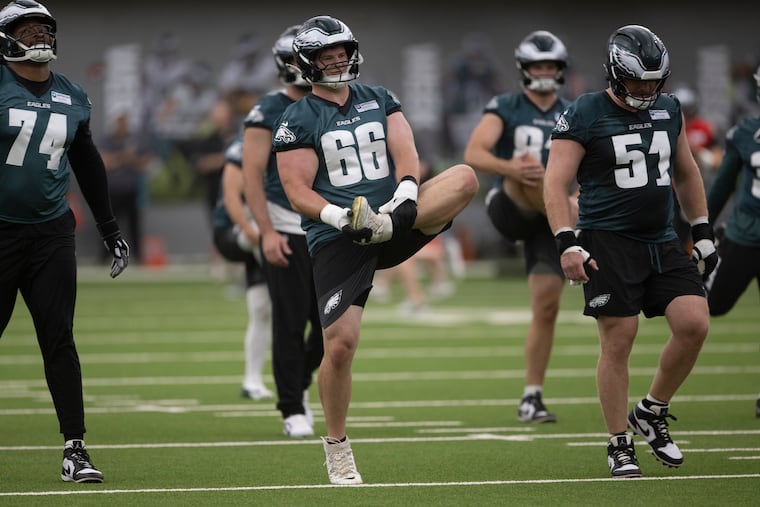
The Eagles were on the field for only a few days this week, but their mandatory minicamp was long enough to give you a real sense of why the offseason went the way it did. It was a startling thing to behold, both on the practice field and inside the building. Over five seasons, almost nothing had changed with regard to the fundamentals of the Eagles offense. Sure, coordinators came and went, but the identity remained the same. It served them well, with two Super Bowl appearances in three years, one of them a title from which they were less than a year removed when the offseason began. Yet they clearly sensed that an inflection point was coming, if it hadn’t already arrived.
That sense was most evident in the words and tone of one Lane Johnson, the eldest statesman of the offense and the keystone around which the Eagles have built everything over the last decade and a half. Earlier this week, the veteran tackle spoke publicly for the first time since before a foot injury sidelined him for the last eight games of the season. A lot had changed in the interim. Gone was Jeff Stoutland, the legendary offensive line coach who inspired a fierce loyalty in his former players. In his place was a new blocking scheme, with new terminology, and a new philosophy, all under the command of a 34-year-old first-time playcaller whose playing career ended less than three years ago.
» READ MORE: Eagles practice observations: Jalen Hurts and offense strike back; rookie setbacks; Riq Woolen excels again
Yet here was Johnson, barely a year removed from anchoring one of the greatest single-season offensive line performances of all time, and having done so under the tutelage of one of the greatest offensive line coaches of all time, en route to one of the most dominant Super Bowl victories of all time, and dadgummit if he didn’t sound positively refreshed.
“I think with this offense, we’ll be able to stretch the field and really work our zone game and get the defense running and work things off of that,” Johnson said. “I’m really excited for what it can do, not just for tackles. I think it will open up a lot in our game.”
The two keywords there are “this offense.” As opposed to that offense. You know, the one the Eagles used to run. It may sound like a small thing, but only if you didn’t listen closely during the four previous changes at playcaller. I don’t think that phrase was ever used. At least, not like Johnson and the rest of the Eagles who spoke publicly have been using it. As a signifier of real, legitimate change. It didn’t sound like this when Nick Sirianni gave way to Shane Steichen, nor when Steichen gave way to Brian Johnson, nor Johnson to Kellen Moore or Moore to Kevin Patullo. The operative question always centered on who would have final say over the plays rather than what those plays would look like from a broad schematic standpoint.

David Murphy alerts
Not so this time around.
The change is real. That was the biggest takeaway from this week’s preamble to training camp. The hiring of Mannion, the jettisoning of Stoutland, the trading of A.J. Brown, the subtle challenges to Jalen Hurts … this was not the same window-dressing offseason of years past. These were purpose-driven moves rooted in the realization that 2025 would not be a one-year blip if the Eagles fooled themselves into thinking that the things that worked in previous seasons would one day work again.
It remains to be seen what the scheme will actually look like. You’d have to work just to get an NFL coach to admit he will have precisely 11 players on the field. But Johnson referred to Mannion’s scheme as a Kubiak/Shanahan system, the archetype being the 1990s Broncos teams that utilized heavy amounts of outside zone/stretch runs from under center and the resulting play action looks that offered quarterbacks ample passing lanes and plenty of distance between them and the line.
“I’ve always envied wanting to be a part of it,” Johnson said. “So here I am, after all these years, getting that chance. Not to say we’re going to be better because there’s a lot to learn. I think we have the ability to be a lot more than what we were last year.”
The Eagles did the right thing in treating last year as a sign of the times rather than awarding themselves a mulligan. Their strength as an organization has long been their willingness and ability to execute a hard pivot. Dating back to Joe Banner’s reign as club president, the Eagles front office has built its decision-making processes on a cold philosophical calculus. A team is better off being a year early than a year late on its consequential decisions.
It is true at all levels of football management, from awarding contract extensions to the evaluation of veteran players to the identification of leaguewide trends. There is considerable risk in being early, which is why a lot of teams end up being late. It isn’t easy to let a franchise icon leave town, or to spend a second-round pick on a quarterback when one already has a starter. Vindication occurs in a separate time horizon from a fan base’s patience. It is good to be proved right. It is better to be employed.
» READ MORE: Jalen Hurts pushes back on ESPN report suggesting his resistance to change: ‘I’m always open to growth’
What Jeffrey Lurie and Howie Roseman both realize is that the last teams to arrive for dinner often become the dinner. Barely a year after winning their second ever Super Bowl title, the Eagles decided that they’d arrived at one of those inflection points that plenty of teams would ignore in the interest of convenience or ego protection.
Will the offense actually look different? Like, materially? The players sure seem to think it will. In which case, the big question is this:
Will it work?

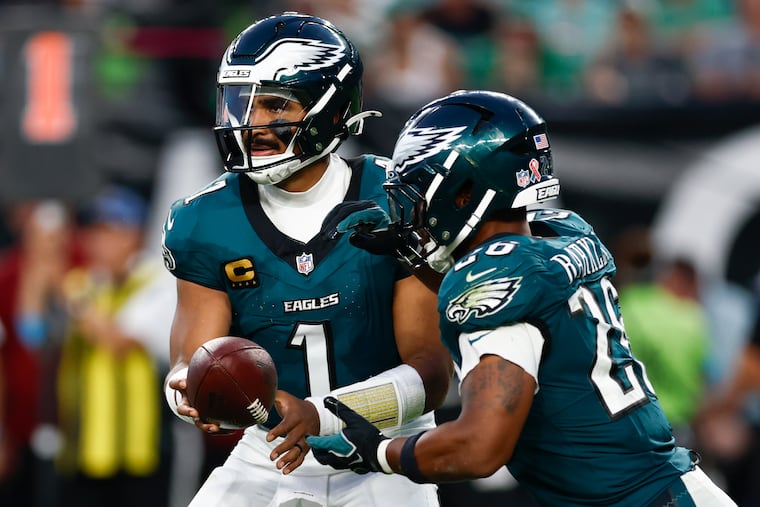
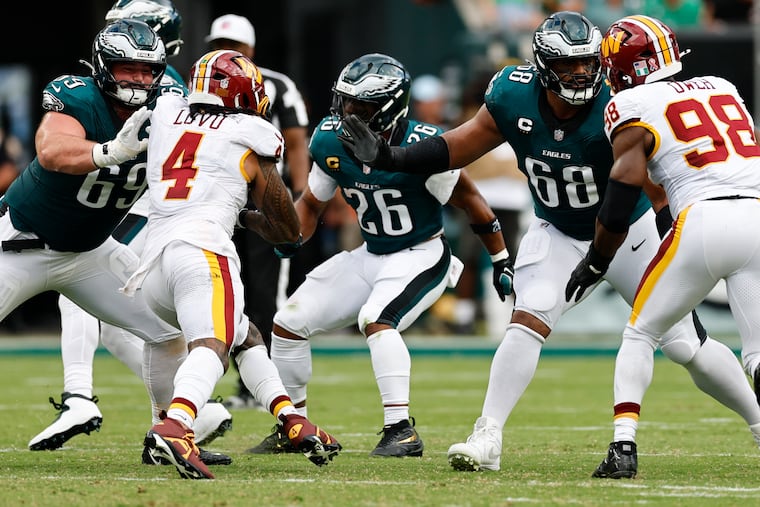
The Eagles eked out a season-opening win over the Washington Commanders thanks, in large part, to Jalen Hurts channeling the elements of his game that make him so dangerous. But when it comes to other areas of the offense, concerns from last year still linger. The Philadelphia Inquirer’s Jeff McLane and David Murphy assess Hurts’ performance, Sean Mannion’s debut as offensive coordinator, and warning signs on the offensive line Listen here.
Listen to all episodes here or wherever you get your podcasts.