Five reasons the Eagles beat the Packers | Paul Domowitch
The Eagles' dominant ground game and some terrific bend-but-don't-break work in the red zone were just two of the reasons for Thursday night's win over the Packers.
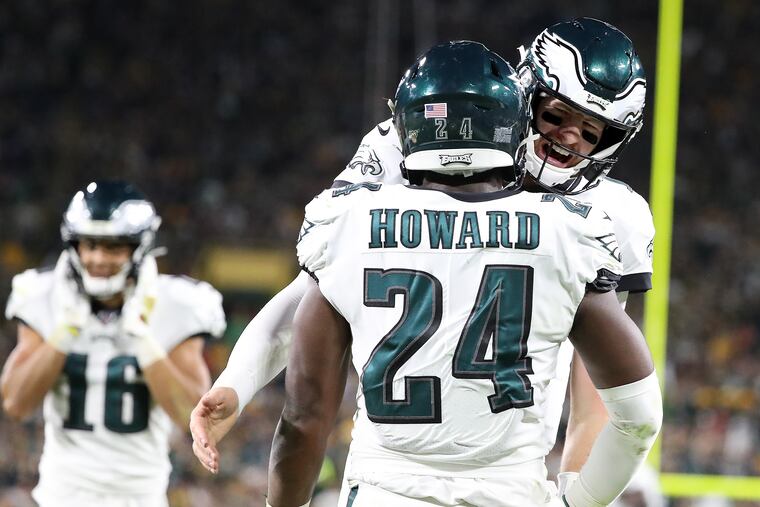
GREEN BAY, Wis. — Behind a strong running game and a bend-but-don’t-break defense, the Eagles earned an improbable 34-27 victory over the Packers on Thursday night.
More on that plus three other reasons for the win:
Da doo run run
The Eagles went into Thursday night’s game with the clear intention of running the ball a whole lot. The Packers’ defense led the league in takeaways, had the league’s second-most sacks and had allowed just one touchdown pass in its first three games.
But the Packers hadn’t been very good against the run. In their two previous games, against the Vikings and Broncos, the Packers had allowed 5.4 yards per carry.
After spending the short practice week getting on the same page with their offensive line, Jordan Howard and Miles Sanders combined for 159 of the Eagles’ season-high 176 rushing yards.
As Pro Bowl right guard Brandon Brooks aptly put it, the offensive line “imposed our will’’ on the Packers’ defense. They dominated them from start to finish, opening hole after interstate-wide hole for Howard and Sanders.
With tight end Dallas Goedert healthy again and playing 43 snaps, the Eagles used a heavy dose of “12’’ personnel. They also dusted off their RPO game.
Howard, who missed a few holes in last week’s loss to the Lions, didn’t miss any Thursday as he notched two rushing touchdowns and six of the Eagles’ season-high 10 rushing first downs. He also had four double-digit-yard runs, which was two more than he had in the first three games.
Howard and Sanders averaged 6.5 yards per carry on first down, which was three yards more per carry than they averaged in the first three games. Their first- and second-down (6.1 yards per carry) success kept the Eagles out of many third-and-long situations.
Bend but don’t break
Defensively, this game had a Super Bowl LII flavor to it. Much like Tom Brady that night, Packers quarterback Aaron Rodgers piled up the passing yards, throwing for 422.
Rodgers continually frustrated the Eagles’ pass rush by escaping the pocket and extending plays. But most of his passing success came outside the red zone.
Once he got inside the 20, the Eagles’ depleted secondary used the back of the end zone to its advantage.
Rodgers threw just two touchdown passes, and the Packers converted only three of a whopping seven red-zone opportunities into TDs. Rodgers completed 29 of 37 passes outside the red zone, but just 5 of 16 inside it.
Just one of wide receiver Davante Adams’ 10 catches came in the red zone. The Eagles turned the Packers away at the goal line twice in the fourth quarter.
The first time, safety Rodney McLeod made a pair of huge plays: one in coverage against tight end Jimmy Graham, and the other on a Rodgers bootleg, which he read perfectly and forced a throwaway.
Then, late in the game, cornerback Craig James, just two days removed from the practice squad and subbing for injured Avonte Maddox, who had been subbing for injured Sidney Jones, deflected a pass intended for Marquez Valdes-Scantling into the air. Linebacker Nigel Bradham intercepted it to preserve the victory.
Protecting the rock
The Eagles had little margin for error Thursday night, and they knew it. They couldn’t make the same sloppy mistakes they made against the Lions a week earlier when they lost two fumbles in a three-point loss. Aaron Rodgers, who had won 66 of 84 career starts at Lambeau, was going to be tough enough to stop without giving him help.
The Packers entered the game with a league-high eight takeaways. But they weren’t able to add to that total against the Eagles.
Miles Sanders, who fumbled twice against the Lions, didn’t put it on the ground at all against the Packers. Neither did Jordan Howard.
Quarterback Carson Wentz, who threw three touchdown passes, had his second straight interception-less game. He’s thrown just two picks in 145 pass attempts this season and none in his last 98 attempts.
The absence of turnovers helped the Eagles force the Packers to play on a long field most of the night. Green Bay’s average starting field position was its 21-yard line.
The game plan
Doug Pederson pushed all the right offensive buttons against Mike Pettine’s defense. Ran the ball early and often, dusted off the Eagles’ RPO game, which they haven’t used much since their Super Bowl run, and used a healthy dose of two-tight-end sets to keep Pettine from going to the defensive-back-heavy personnel packages that he favors.
Granted, it didn’t take a genius to know the Eagles needed to run the ball against the Packers. If their opponent rush average (4.9 yards per carry) didn’t tell you they weren’t nearly as good against the run as they were against the pass, the film certainly did.
The decision to use RPOs was smart. It helped both the run and pass games. The Eagles likely will continue to use them going forward this season.
Tight end Dallas Goedert’s calf injury had prevented Pederson from using much “12’’ personnel the last two weeks. They used it just 18 times in 141 snaps in losses to the Falcons and Lions.
But with Goedert healthy again Thursday, Pederson turned to it nearly 50 percent of the time in the first half and quite a bit in the second half.
Special-teams redemption
A week after giving up a 100-yard kickoff return for a touchdown in their loss to the Lions, Dave Fipp’s special teams redeemed themselves.
Miles Sanders had a 67-yard, second-quarter kickoff return after the Packers went up, 10-0. It kick-started a short touchdown drive that helped the Eagles gain momentum and climb back into the game.
Punter Cam Johnston put three of his four punts inside the 20, forcing the Packers to start at their 11 twice and the 10 once. Johnston had just one punt returned, for zero yards.
Jump in on our great one-day sale. You get 2 months for $2 for all the Inquirer offers at www.inquirer.com/pdomowitch Offer expires at midnight.
