Eagles-Vikings film: Beating disguised zone coverage looks, slowing down Justin Jefferson, and more
The Vikings defense is known to disguise its zone coverages, often forcing offenses to take shorter passes. On the other side of the ball, Jefferson is a concern, as always.
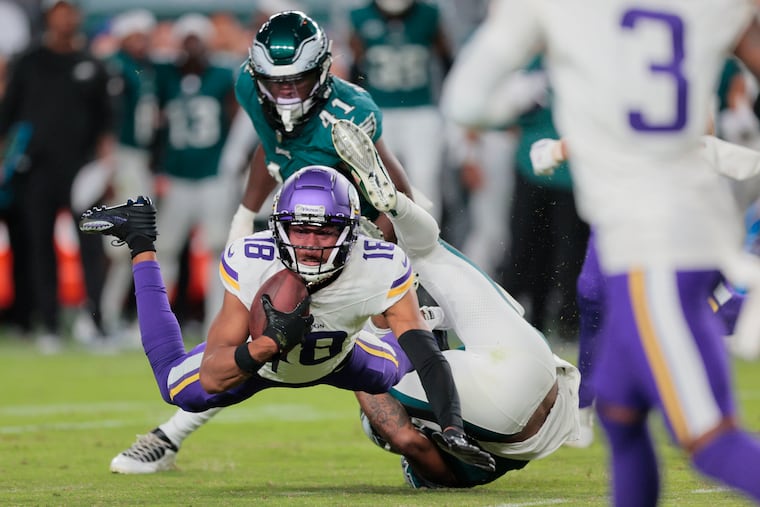
After an embarrassing showing last week, the Eagles are looking to turn the page as they head to Minnesota on Sunday, although the Vikings’ starting quarterback for the matchup remains unclear. Former Eagle Carson Wentz has started the last three games after J.J. McCarthy suffered a high ankle sprain in a Week 2 loss to Atlanta.
No matter who starts Sunday, slowing down Minnesota’s offense begins and ends with wide receiver Justin Jefferson, who had more than 100 receiving yards in each of the last two games.
With Quinyon Mitchell’s status for Sunday in question, containing Jefferson and dealing with Minnesota’s zone coverage disguises are among the keys for the Eagles to snap their two-game losing streak. Here are some other film takeaways:
Minnesota’s coverage disguises
According to Fantasy Points Data, the Vikings play zone coverage on 73% of their snaps, using Cover 2 (two-high safety zone coverage) at a 29% rate and Cover 1 (one-high safety coverage) at a 21% rate. Minnesota has the No. 1-ranked pass defense in the NFL in expected points added (which measures team performance on a play-by-play basis) at -0.42, according to Next Gen Stats.
Part of the success against the passing game for Brian Flores’ group comes from disguising coverages, especially on third downs, and forcing offenses to take shorter passes, allowing Minnesota’s defense to rally and tackle.
Minnesota asks its linebackers and safeties to handle a lot of the post-snap rotations, from lining up at the line of scrimmage to dropping back over the middle of the field, particularly in Cover 2. The late rotations take away immediate middle-of-the-field options, and force the quarterback to hold on the ball longer instead of expecting overload blitz pressures.
These exotic looks give time for Minnesota’s pass rushers to get after the quarterback, particularly edge rusher Jonathan Greenard, who leads the team in pressures (18) although he has only one sack this season. He lines up almost exclusively over the left tackle and can turn the corner quickly, which should present another challenge for the Eagles’ Jordan Mailata.
The Vikings also have used him on pass-rushing stunts, allowing other defensive linemen to roam free. They are also blitzing at a 35.8% rate, ranking second in the NFL, according to Next Gen Stats, but rank in the bottom 10 in the league in total pressures (58).
Although their blitz rate is among the league leaders, because they play zone coverage at such a high rate, the Vikings can be caught in their post-snap rotations and out of position.
In Week 4, the Pittsburgh Steelers hit a couple of big plays in the passing game by catching Minnesota rotating when the ball was snapped. The same happened in Week 2 against the Falcons, when Michael Penix found Drake London and Kyle Pitts on slant routes just before the linebackers could drop back from the line of scrimmage into the passing lane. It is worth noting that Vikings linebacker Blake Cashman missed four games with a hamstring injury but is expected to return this week, and he is a much better coverage player than Eric Wilson or Ivan Pace.
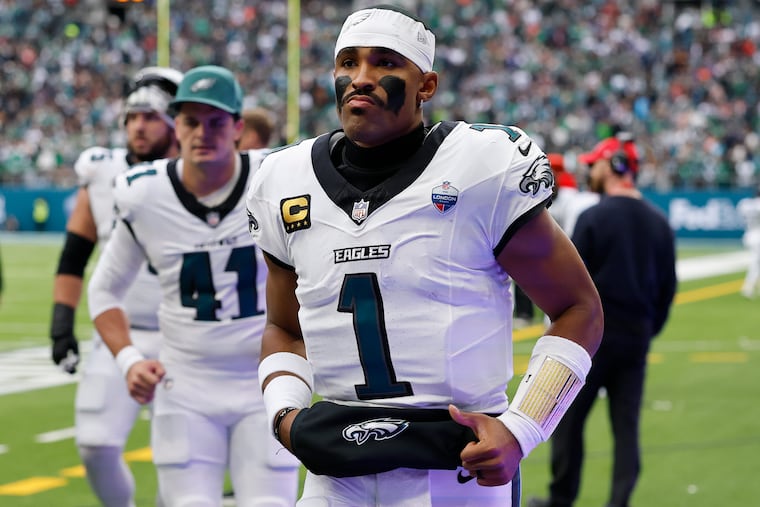
Against the Giants, Jalen Hurts completed 18 of 21 passes for 217 yards against zone coverage, but he has struggled this season against zone blitzes. He has a -0.32 EPA per drop back and averages 6.5 yards per completion against zone blitzes, compared to 10.4 yards per completion against zone coverage without blitzes, according to Next Gen Stats.
Finding A.J. Brown and DeVonta Smith in those vacated areas will be critical for the Eagles’ passing game against a stingy pass defense that does not allow explosive plays.
Jefferson finding his groove
In his first matchup against the Eagles in 2022, Jefferson was mostly held in check, catching just six passes for 48 yards on 12 targets. But in 2023, he lit up the Birds’ secondary with 11 catches for 159 yards, most of which came in the second half.
With Mitchell’s health in question for Sunday and Adoree’ Jackson and Kelee Ringo’s inconsistencies this season, Jefferson will command a lot of attention from the Eagles’ secondary.
Through the first three weeks, Jefferson had five or fewer catches in each game, but he has 17 over the last two games with Wentz at quarterback. Because Minnesota moves him all over the formation, Jefferson has been able to exploit both man and zone coverages. Pro Football Focus has Jefferson at 249 snaps out wide and 49 snaps in the slot.
Jefferson is especially effective on deeper crossing routes and attacking the seams of defenses. On targets that travel 10-19 air yards, Jefferson has caught 11 of 15 passes for 205 yards, accounting for nearly half of his 499 receiving yards this season.
On early downs, the Vikings attack off coverage with play-action passes, specifically to hold safeties from rotating toward Jefferson. Both McCarthy and Wentz have found Jefferson on deep out or comeback routes against zone coverage.
The main difference for Minnesota’s offense with McCarthy starting as opposed to Wentz is the average time to throw. Wentz is getting the ball out at an average of 2.55 seconds, compared to McCarthy’s 3.15 seconds, according to Next Gen Stats, which has opened up Jefferson’s opportunities to create after the catch.
Running game for both teams is X factor
Both defenses have struggled stopping the run this season. Minnesota ranks 24th in EPA per rush (0.09) and allows the ninth-highest average of rushing yards per game (132.2). The Eagles rank 22nd in EPA per rush (0.01) and are 27th in rushing yards allowed (134.3), according to Next Gen Stats.
The Vikings have struggled stopping the run because their front four isn’t shedding blocks and the linebackers are overrunning their fits, allowing for outside cutback lanes. Minnesota has allowed 21 runs of 10 yards or more, tied for 25th in the NFL, despite having the ninth-highest stacked box percentage (26.5%),
There will be opportunities for Saquon Barkley, for the second straight week, to find running lanes. He ran the ball only 12 times against the Giants, despite breaking off runs of 31 and 18 yards to begin the game.
As for the Vikings, the team primarily runs a zone-based scheme. Teams have opted for runs outside the tackles against the Eagles at the third-highest rate in the NFL (57.8%) and the defense plays with a light box (six or fewer defenders) at the highest rate in the NFL (58.4%).
Jordan Mason has taken the majority of the snaps at running back for Minnesota since Aaron Jones’ injury and has been held under 60 yards in three of his five games this season. But if the Vikings can find some success running the ball against the Eagles, it will open up the play-action passing to get Jefferson and Jordan Addison involved downfield for Wentz or McCarthy.