How Jalyx Hunt went from an Ivy League safety to a pass rusher on the league’s best defense
Hunt's collegiate career started with the Ivy League's least relevant program. His NFL career could produce the pass rusher's second Super Bowl ring in as many seasons.
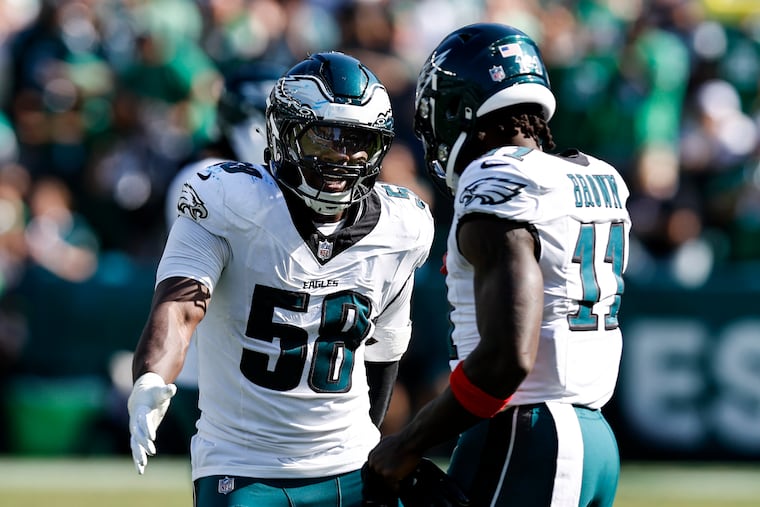
Two years into his Eagles career, Jalyx Hunt counts his blessings in pairs of cleats and gloves.
He doesn’t lack either. About a dozen brand-new white gloves wrapped in cellophane are stacked on a low shelf on the left side of his stall in the NovaCare Complex. Hunt has four pairs of cleats sitting on the racks below that shelf, but he knows that if he busts them, he can ask assistant equipment manager Craig Blake for another pair.
» READ MORE: Eagles vs. Cowboys predictions: Our writers pick a winner for Week 12
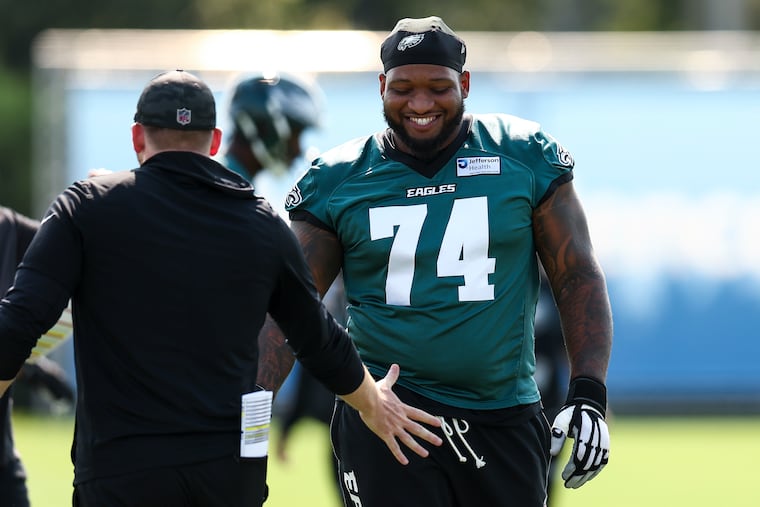
The 6-foot-3, 252-pound outside linebacker still isn’t used to the extravagance. He didn’t take his first charter flight with a football team until two years ago, his senior season at FCS-level Houston Christian. If he wore through a pair of cleats, the cost for new ones came out of his pocket.
Hunt, 24, picked up odd jobs to pay for those expenses integral to attaining his NFL dream, especially his training. He delivered takeout for DoorDash. He and his friends signed up to work as overnight security guards at the 24-hour library on campus, even when they had to lift in the morning.
In high school in Orlando, the zero-star recruit worked nights as a janitor at the urgent care where his father, James, served as a physician’s assistant.
The experiences that shaped Jalyx didn’t magically evaporate after the Eagles selected him in the third round of the 2024 draft.
“I got a chip on my shoulder to a certain degree,” Hunt said on Wednesday. “But I also just appreciate things a lot more, because a lot of these people were able to be blessed coming out of high school. … I was like, ‘Should I be paying for training? If I have to do this, is it really that feasible?’”
A cursory glimpse at his early football path suggests that Hunt’s NFL dream was a long shot. He began his collegiate career at Cornell, a struggling program not known for producing pro players. One of the rising edge rushers on the NFL’s most feared defense just four years ago could be found working as an Ivy League safety.
When Hunt entered the transfer portal in 2022, all he said he needed was an opportunity to make an impact. That, and a program that thought he had a chance to reach the NFL.
Houston Christian gave him both in earnest. A shift closer to the line of scrimmage altered the trajectory of his football journey. His perseverance in realizing a once-unlikely dream doesn’t surprise those close to him, however.
“People think I say stuff like this because he’s my son,” said James Hunt. “But I don’t. My wife will tell you I am very, very real and upfront with my son, my daughter, anybody I know, any kid trying to do something. She calls me a dream killer, because I’m going to tell you.
“But I didn’t think it would be an issue, because I truly feel you can put Jalyx anywhere and he will get it done.”
Jaaqua Hunt discovered her son’s unrelenting motor long before he charged after quarterbacks on Sundays.
Jalyx was always busy, always moving. James recalled how long it took to get him dressed in the mornings before school because he couldn’t stand still. A teacher herself, Jaaqua emphasized to his educators that he needed an activity to do after he finished his work, otherwise he would talk the ears off his classmates and no one would get anything done.
“I told his doctor when he was 15 months [old] that he had ADD,” Jaaqua said. “And they said, ‘You couldn’t possibly know that now. He’s 15 months.’ And I said, ‘Yeah, I do.’ I was at home at the time. I said, ‘He doesn’t have an off switch. He hits the floor in the morning, and he is nonstop until he drops at night.’”
Behavioral therapy as a child helped Hunt learn how to channel his energy in a productive way. His therapist recommended origami, so he folded up what felt like millions of ninja stars, paper cranes, and waterbombs. Origami gave way to thousand-piece puzzles, LEGOs, the saxophone, and most recently the guitar.
Sports became an outlet for Hunt’s energy, too. He started playing basketball around age 6 at the YMCA. James served as an assistant coach for his team.
“He was really dominating these kids,” James said. “They were the same age, but he just had that ‘it.’ And he was bigger. So you kind of felt bad for that, but then you started realizing everything he did, it’s like the environment would change.”
The Hunt family moved around, spending Hunt’s adolescence in the Orlando area where James completed a physician-assistant program, then came Tennessee, Maryland, and eventually South Carolina to be closer to their daughter, Jessica, who was a track athlete at Winthrop University.
Jalyx longed to play football, just like his father had at Alcorn State and Ole Miss. His parents encouraged it, too, believing his chances of earning a scholarship in football were greater than in basketball by sheer numbers alone. Plus, Hunt was cut out better for football, Jaaqua said.
“His dad told him he didn’t have the mentality to play D-I basketball,” Jaaqua said. “And it’s true. Jalyx is a sharer. He’s not selfish enough to play basketball. Even in high school, and all the way back to when he was 6 or 7 years old, he would get a rebound and then give it to someone who didn’t have any points so that they could try and score.”
The Hunt family moved back to Florida before his sophomore year, as James figured that every college football program in the country would recruit in the state. Still growing into his body, Hunt primarily played cornerback and eventually added receiver to his resumé in his senior year.
But he had a hard time getting on the field, finishing his senior season with 20 catches for nearly 500 yards. His recruitment was limited, James said, because he didn’t play much. James put together a highlight video and sent it out to more than 100 schools, which garnered offers from smaller programs and walk-on offers from bigger ones, such as Florida, Marshall, Boston College, and Georgia State.
Cornell was among the smaller programs. Hunt appreciated the opportunity to get an Ivy League education in addition to his football pursuits. He aspired to earn an engineering degree, which he thought would blend his hands-on personality and his affinity for math.
Ultimately, it felt good to feel wanted, and that’s how Cornell made Hunt feel.
“You loved the girl who loves you the most,” Jaaqua said. “They loved him. Simple as that.”
Hunt transitioned to serving as a big free safety in Cornell’s defense. Hunt was responsible for rolling down into the box to play outside linebacker, but would also play in the post and cover receivers downfield.
Hunt was still growing, though, and James always thought he played better when he was closer to the line of scrimmage. The position issue was indicative of the struggles that Hunt had faced throughout his football career.
“Part of the problem he had, his coaches didn’t know how to use his ability,” James said. “Because he was very athletic, and then when you start to grow, he was a bigger guy who had small-guy skills. What do you do with this guy? So let’s put him here. Let’s try him there. They just didn’t know where to put him.”
COVID-19 didn’t make things easier, especially from a mental health perspective. His parents could tell that the isolation — Cornell’s entire 2020 season was canceled — was taking a toll on Hunt’s wellbeing. It showed in his slipping grades, too. Hunt wanted to stick it out at Cornell, according to James, but his parents encouraged him to make a change.
Hunt entered the transfer portal after his junior year in 2021. He garnered interest from some Power 5 programs, including Texas Christian and Boston College, but Hunt was behind on class credits. Houston Christian was the only program that had a plan, on and off the field, for Hunt.
Houston Christian, a 4,700-student member of the Southland Conference, was clear during its recruitment that it viewed Hunt as a defensive lineman/linebacker rather than as a safety.
“We didn’t feel like he could dominate the game covering 20 yards down the field man-to-man,” said Roger Hinshaw, Houston Christian’s linebackers coach. “But you just could see … we [could] make him faster by just moving him closer to the ball.”
Houston Christian was prepared to bring Hunt into its summer school at the local community college so he could get back on track from an academic standpoint, too.
It didn’t matter to Jaaqua or James that they had never heard of Houston Christian (formerly known as Houston Baptist) or its nine-year-old football program. Hunt said defensive coordinator Shane Eachus displayed a sense of belief in him that no one else had.
“He said, ‘We think you can make it to the League,’” Hunt said. “That’s all I need to hear. Like, if you believed in me, bet, let’s go. Even if you’re lying to me, you could be lying to me, but I just needed somebody to even fake it. So, shoot, that’s why I went. That’s the only reason.”
Hunt had all of the physical traits — from his athletic ability to his size to his length — that former Houston Christian defensive line coach Isaac Mooring was looking for in an edge rusher. Hunt had a natural talent at some aspects of the position, Hinshaw said, that his coaches couldn’t teach.
“When he was lined up and the ball was snapped, he was dynamic, which is really the key to any good pass rush,” Hinshaw said. “Quite frankly, that was a DNA thing. God gave him that. Everybody doesn’t get that.”
But beyond his inherent traits, Hunt had a strong desire to learn the position and to be great. Mooring detected that desire through the residency Hunt took up in his office. He was constantly watching film, asking questions in meetings, and taking notes.
Mooring would pull NFL clips and study them with Hunt, and once the young pass rusher began to learn the requisite technique of the position, he began to point out technical nuances on film.
That diligence translated to the football field. If Hunt didn’t get a drill down pat in practice, he would stay after and work on it some more. It didn’t matter if the team had just completed a 24-period session. Hunt could be found striking the sled because he wanted to make sure his hand placement was correct.
Mooring discovered that Hunt had that same attitude after games. After Hunt’s third or fourth contest with Houston Christian, Mooring went around the locker room as he typically would to hug his players and offer words of encouragement. He couldn’t find Hunt.
Eventually, Mooring was told that Hunt was still out on the field. Sure enough, there he was, running 100-yard sprints after playing anywhere from 50 to 70 snaps. He ran sprints at home and on the road, win, lose, or draw.
“I learned to be the type of player that I feel like if we lose, it’s because of me,” Hunt said. “I feel like it’s because of me, like I could have made more plays. I could have done this, I could have done that. So it was one way for me to just think, get some lactic acid out of my legs, but also condition a little bit more.
“Sometimes, I’d get home, off the bus, and go work out, like on the field or bags, whatever the case may be, just so I could do something more. I just felt I needed to get better right now.”
Hunt gradually improved. He began to put on the weight needed to go up against 300-pound offensive tackles. He leaned on the football IQ that he had developed as a safety to understand run fits and drops in coverage when he wasn’t rushing the passer.
Development turned into sacks, and sacks turned into recognition from NFL teams that traveled to Houston Christian to scout him ahead of the draft. In 2022, his first season with the Huskies, Hunt led the Southland in forced fumbles (three) and tackles for a loss (11.5), and his team in sacks (seven).
The following year, he earned the conference’s defensive player of the year honors, leading the team in tackles for a loss (nine), sacks (6.5), and forced fumbles (two). He also had a 16-yard interception returnfor a touchdown.
“That just shows the guys that don’t let somebody tell you just because you’re here at Houston Christian, nobody’s going to find you,” Hinshaw said. “That’s not the case at all.”
Patrick Johnson, the Eagles’ 2021 seventh-round defensive end out of Tulane, first met Hunt through one of his high school teammates who played for Cornell. That fall, Cornell visited Philadelphia to play against Penn.
Immediately, Johnson was struck by Hunt’s size.
“When I first met him, I was like, ‘Dang, you sure you’re a safety, not an outside linebacker?’” Johnson recalled.
Johnson and Hunt didn’t keep in touch. It wasn’t until Johnson dug into the newest Eagles outside linebacker’s film after the 2024 draft that he realized who Hunt was — and that he had made a position change.
Hunt had independently caught the eyes of both Vic Fangio and Jeremiah Washburn, the Eagles’ defensive ends/outside linebackers coach, in the lead-up to the 2024 draft. Washburn saw him at the combine — where he had a 128-inch broad jump (95th percentile among edge defenders) and a 4.64 40-yard dash (81st percentile) — and his pro day.
Hunt possessed great size and athleticism at the position, but he also had an intangible that convinced Washburn that he would be a fit for the team.
“He had intense focus,” Washburn said. “He just had a good demeanor to him, a competitive demeanor, and it just felt like he was an Eagle.”
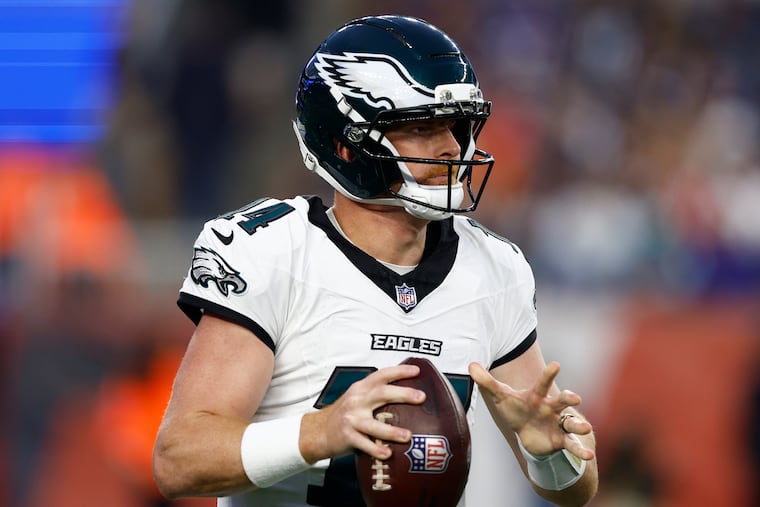
An Eagle who helped the team win a Super Bowl in his rookie season, notching a sack in that game to boot. In hindsight, though, Hunt wasn’t satisfied with his overall performance in his rookie season, as he finished the year with 1.5 sacks.
He still isn’t this year, but Hunt is beginning to show progress. He has two sacks (five quarterback hits total) in his last three games. He said he is stronger, too, sitting at roughly 260 pounds after listed at 252 this year and last year.
In Hunt, Jaelan Phillips said he sees a “stud” with a deep toolbox of pass-rush moves, an ability to blend speed, power, and agility, with a high motor. Brandon Graham said he sees a sense of confidence in Hunt that he didn’t this time last year. Washburn said he sees a more decisive player now compared to his Week 1 performance against the Dallas Cowboys.
Hunt sees room for improvement, but said he’s learned to become patient with himself.
“It takes a lot of patience not to get [ticked] off,” Hunt said. “Like, ‘Oh, I want to get a sack right now,’ especially at the beginning of the year. I didn’t start out how I wanted to start out. But my goal, and I’ve stuck through to it, is I just want to improve on something each week. And I think if you watch my film, you can definitely see that.”
While Hunt has evolved as a player, the small-school chip on his shoulder hasn’t gone away. The stack of fresh gloves in his stall serves as a daily reminder of where he came from. He doesn’t just internalize his journey. He is vocal about it, too, even on the league’s biggest platforms.
In the aftermath of the Super Bowl and his sack on Patrick Mahomes, Hunt appeared on the NFL Network’s Good Morning Football. Mooring’s ears perked up when he gave his coach a shout-out for seeing a skill set in him as a pass rusher that he didn’t recognize in himself.
“That just kind of shows you even though he’s reaching all these types of heights that people only dream of, he’s still humble Jalyx where he understands his beginnings and still [gives] his flowers to people that poured into him,” Mooring said.