Eagles owner Jeffrey Lurie remains a step ahead of Dallas’ Jerry Jones
There is plenty of charm in the old school ways of guys like Jones. But the bottom line is this: whatever Lurie lacks in personality, he has lapped Jones in winning.
When people mourn the loss of personality in modern-day professional sports, they can be talking about a lot of things.
Sometimes, they are coming from a place of class consciousness, or of aversion to the intangible nature of modernity, their cries a yearning for the days when the working man could stop by the ballpark on his way home from work and purchase an actual ticket on actual paperboard from an actual human being and still have enough money that was actually in his pocket to purchase a couple of beers.
Other times, they are raging against the technocracy, the stuffy elites who act as if once-simple games now have layers of complexity that can only be understood by people who speak as if they learned English from a legal liability waiver.
In all cases, the people who bemoan the staid, corporate personality of professional sports are mourning the loss of personalities themselves: the renegades and the scofflaws and the other rough-edged sorts who brokered power back in the Road House days, men who concerned themselves with neither niceties nor nice ties and who made boardrooms feel more like Tatooine cantinas. Al Davis, Mike Ditka, Buddy Ryan, Chuck Bednarik — they didn’t just manage or coach or play. They channeled the ID of a fan base.

- Predicting the Eagles’ 2025 schedule game by game
- Marcus Hayes: The Eagles are still the NFL’s best team. Here’s how they win another Super Bowl.
- Eagles’ Jalen Carter has much at stake this season: ‘God put him on this earth to be a mean football player’
- Mike Sielski: Kevin Patullo will bear a heavy burden as the Eagles’ latest offensive coordinator
- What makes Jalen Hurts special? His teammates say it’s his obsession with improving.
- Saquon Barkley joined the exclusive 2,000-yard club in his first Eagles season. Can he be the first to repeat?
- Meet the 2025 Eagles: What to know about every player
- NFL kickoff: 40 things to know about the season, including Philly’s own Abdul Carter debuting with the Giants
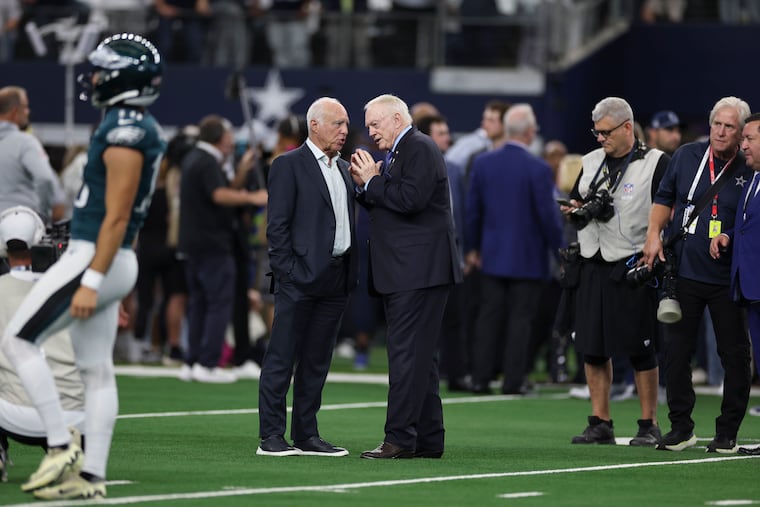
With the NFL in particular, there are several theories about why a league that was once the domain of so many prestige television character types now conducts its business with all the flair of a carton of plain yogurt. Yet there shouldn’t be any mystery. The answer will be right there in front of us on Thursday night, the nationally televised broadcast of an ongoing revolution, as the NFL’s sleekest, most forward-thinking, most purpose-driven organization plays host to Jerral Wayne Jones’ Traveling Carnival and Curiosity Show.
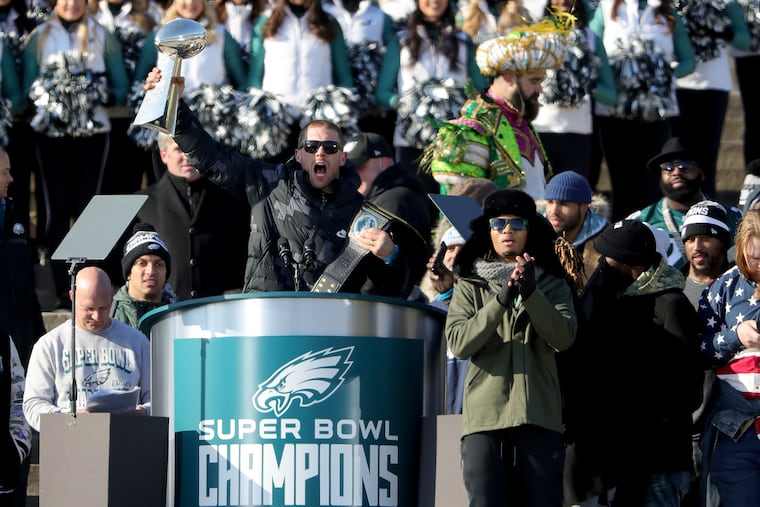
We don’t talk a lot about Jeffrey Lurie when we talk about the behemoth the Eagles have become over the last several seasons. Some of that is due to the nature of the position. Nobody grows up dreaming of the day he leads a team to a championship as chairman/CEO. The list of people more often credited as the driving forces behind the reigning Super Bowl champs include Howie Roseman, Jalen Hurts, Jeff Stoutland, Jason Kelce, Lane Johnson, Saquon Barkley, and many others. None has any reason to apologize for the level of importance he has been assigned. All are quick to offer a share of their credit to their boss. Even still, the role assigned Lurie in the retelling of the Eagles’ second Super Bowl title in eight years is notably understated when compared to the guy who will be in the visiting owner’s suite on Thursday.
Jerry Jones is a man who needs no introduction to football fans, locally or nationally. No executive in NFL history has better exemplified or more eagerly embraced the wildcatter/salesman archetype of the league’s formative years. He is a man who has always subscribed the classical school of sports publicity, where a bad headline is better than no headline and where every microphone is an opportunity. Men of his ilk considered themselves showmen who needed more than wins and losses to make a sale. They were big personalities with big charisma who inspired equal amounts of love and hate and saw equal value in both. They were also relatable in a Brewster’s Millions sort of way. A guy like Jones ran his team with the same impulsiveness and zeal that average fans imagined they might if they stumbled into money.
Well, here we are now. On Thursday night, the Eagles will take the field with a team that is even better than the one that entered the fourth quarter of last year’s Super Bowl leading 34-6. The Cowboys will enter with a projected win total of 7½ after trading away their young superstar edge rusher. They are fitting circumstances, both for an Eagles team that could soon become the NFL’s new standard-bearer, and for a Cowboys team that will be celebrating the 30th anniversary of its most recent NFC championship game appearance.
They are also circumstances that are entirely reflective of their ownership. Jones’ personality and imprint on the NFL is so outsized that it is easy to forget that he bought the Cowboys only five years before Lurie bought the Eagles. Whether or not Dallas’ three Super Bowl victories between 1992-95 were a direct result of Jones’ bombastic, hands-on management style, Jones certainly interpreted them that way. But a much different story is told by the three decades that have passed since the Cowboys were last competitively relevant. While Jones spent them chasing the same headlines and superstars and head coaches with egos as big as their names, Lurie recognized the value of running an organization with the same level of professionalism as a publicly traded corporation. There were plenty of public relations bumps under the stewardship of team president Joe Banner, from the construction of Lincoln Financial Field to Hoagiegate to the departure of Brian Dawkins. However poorly these things were handled, they always had at their foundation a desire for calculated, methodical decision-making processes.
» READ MORE: Mike Sielski: The Eagles are better positioned to repeat than they were in 2018. And it’s not even close.
The best credit you can give Lurie, and Banner, and their acolyte Roseman, is that the Eagles’ current heights are a culmination of a desire to do things better than the way they have always been done. Such thinking led to the hirings of Andy Reid, Doug Pederson, and Nick Sirianni. It also led to the hiring of Chip Kelly and the drafting of Carson Wentz. But Eagles’ greatest strength has been the speed with which they have recognized and recovered from their mistakes. Down in Dallas, the opposite is true.
The difference is ego. That’s often the case in life. All of us have them. All of us feel them. The problem arises when they own us. I don’t know Jeffrey Lurie well enough to judge him, but I do know that he has built a football team that consistently makes decisions that are in the best interest of the name on the front of the jersey rather than then one on the owner’s box. I probably have not appreciated that as much as Lurie has deserved. But I need only look toward the Cowboys for a striking counterfactual.
The thing about personalities is that they are often a reflection of egos. They are as much weapons wielded for social domination and personal gratification as they are genuine reflections of the human spirit. Even when they are the latter, the bigger they are, the more likely they are to impede optimal decisions.
There is plenty of charm in the old school ways of guys like Jones. There is also plenty of bore in the hyper-efficient, hyper-focused pursuit of a singular goal. But the bottom line is this: Whatever Lurie lacks in personality, he has lapped Jones in winning.
Feel the roar of last season all over again with WHAT A RUN! — The Inquirer’s championship book packed with epic stories and jaw-dropping photos from our Sports team. A must-have for every Philly fan. Grab your copy now from The Inquirer Store.