Eagles owner Jeffrey Lurie calls the Linc ‘wonderful,’ but won’t rule out leaving South Philly amid stadium research
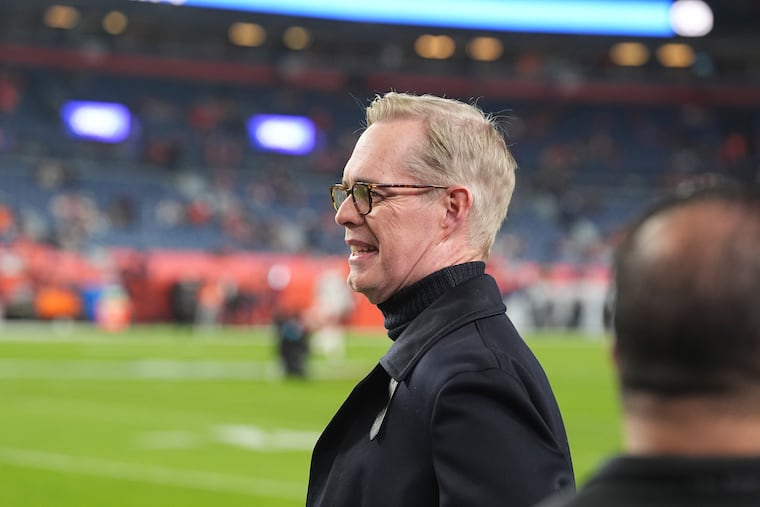
During his news conference at the NFL's annual league meeting, Lurie said the team was being deliberate in its exploratory research around a new or renovated stadium.
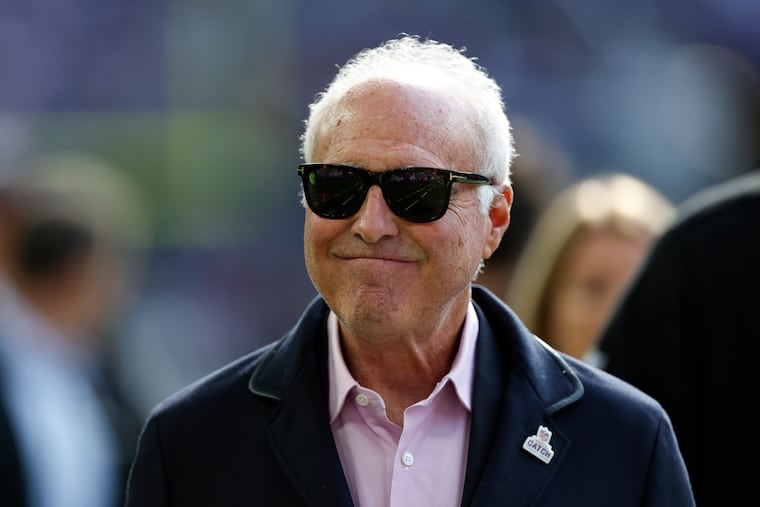
PHOENIX — With the expiration of Lincoln Financial Field’s lease looming in 2032, team owner Jeffrey Lurie made it clear that all options are on the table for the Eagles’ home.
One of those variables is its prospective location.
At his annual news conference Tuesday at the league meeting, Lurie explained that the team is conducting “exploratory research” on the prospect of a new or renovated stadium. That research dates back to at least last year, when the organization sent out surveys to season-ticket holders to solicit their opinions on a stadium renovation or a new building.
Before the Eagles’ move from Veterans Stadium to Lincoln Financial Field in 2003, Lurie said the organization conducted two to three years of exploratory research. Similarly, in the next year or two, he said he aims to have a more “definitive approach” to their stadium plans.
For now, the Eagles are taking it slow with the exploratory process, using the latest NFL stadiums of the Tennessee Titans and Buffalo Bills as well as renovated international stadiums such as Bernabéu in Madrid and Camp Nou in Barcelona as case studies.
“Is there anything we can learn from Nashville and Buffalo?” Lurie said. “Is there anything we can learn from the renovations in Madrid and Barcelona? It’s really important. I think we want to maximize fan amenities and attract the best possible environment for Philadelphia. And to do that, you’ve really got to do the exploratory research. Don’t rush into it. This is a big decision.”
Part of the big decision includes the site of the stadium if the Eagles decide to build anew. Since 1971, the Eagles have called the South Philadelphia sports complex their home. The World War II-era Steagles aside, each of the team’s six permanent home stadiums throughout its 92-year history have been located within city limits.
But in recent years, some NFL teams with new stadium plans have explored moves outside city centers, or even to different states entirely. Chicago Bears president Kevin Warren told Pro Football Talk on Tuesday that the team’s next stadium likely will be in northwest Indiana or suburban Arlington Heights, Ill., after its lease at Soldier Field expires in 2033.
Public funding often plays a role in prospective stadium destinations. Indiana Gov. Mike Braun signed a bill in February that permitted funding for a potential new Bears stadium in Hammond, Ind., which is approximately 25 miles south of Chicago.
Lurie wouldn’t rule out any potential locations if the team builds a new stadium, even if that means leaving South Philadelphia.
“Whatever’s best for the fans,” Lurie said. “I mean, we don’t really go on a geographical basis. It’s whatever’s best for the fans. And I can’t tell you where [the planned stadium in] Cleveland is, Barcelona is, I don’t know. Honestly, the bottom line is whatever is best for the fans.”
Lurie repeatedly emphasized that the fan experience is his top priority in the stadium plans. He said he doesn’t have any “nonnegotiables,” even as it pertains to the decision to include a dome on the team’s home. New stadiums and renovations to existing facilities around the league often have included roofs, increasing the eligibility of those cities to host events such as the Super Bowl.
“We’re so focused on fan amenities,” Lurie said. “To me, that’s the No. 1 thing. Just as a boy growing up, you want to have as best a fan experience. The rest is architecture, design, and where it ends up.”
Lincoln Financial Field will turn 23 in August. The Jefferson Health Training Complex, the team’s practice facility formerly called the NovaCare Complex, is 25 years old. By the time the Washington Commanders’ new stadium is scheduled to open at the historic RFK Stadium site in 2030, Lurie acknowledged that the Eagles’ facilities will be the oldest in the division.
But Lurie said he loves Lincoln Financial Field and called it “wonderful.” The practice facility went from “worst to best” when NovaCare was built in 2001, he said. The team continues to make upgrades to and renovate its facilities, and also invests beyond the physical buildings into player health and safety endeavors.
Just because the Eagles’ facilities are aging doesn’t necessarily mean that they can’t be improved or that a new stadium is a foregone conclusion, according to Lurie.
“There’s Fenway [Park], there’s Lambeau [Field], whatever, but there’s no question our practice facility, and particularly our stadium, will be the oldest in the division,” Lurie said. “We have put so much money into the stadium, so it doesn’t appear that way, and it’s still great, and people still love it, but it’s a fact of that exploration I was talking to you about.
“Do we want to be in 2045, 15 years older than every other stadium in our division or whatever? We’d have to see. Maybe. But it’s all part of it. I know part of our culture is to … maximize the athletic ability that we have of our players, our coaches, and everybody. That will always be the top priority. So whatever we’re doing with [the] stadium, with [the] practice facility, if it’s not near top-notch, it’s not our goal.”
The Eagles are still at least a year away from cementing their stadium plans. The only certainty is that Lurie is considering every alternative.
“I think if you’re just humble about it and open that you don’t have all the answers, and do the exploratory work, you’ll end up with a better long-term situation,” Lurie said.