Jim Murray, general manager of the Eagles’ first Super Bowl team, dies at 87: ‘He was uplifting in every way’
A proud Philadelphia native, Murray also helped found the Ronald McDonald House. “His passion for the city and passion for the Eagles just bubbled over,” Dick Vermeil said.
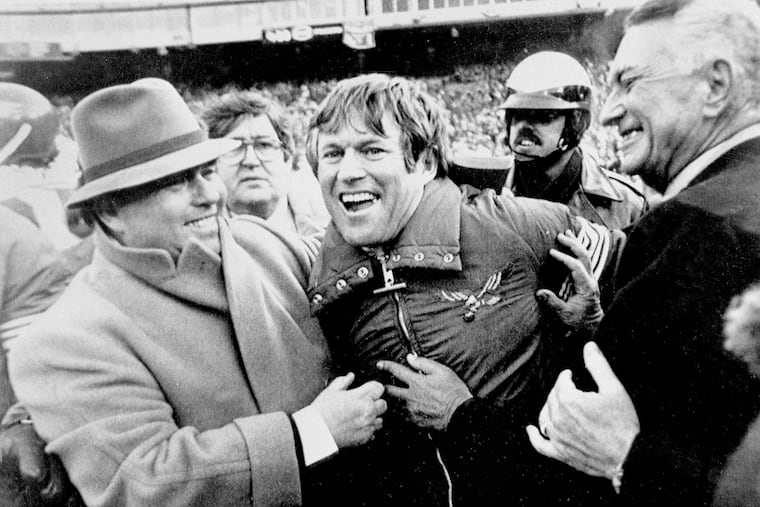
Jim Murray, the former Eagles general manager who hired Dick Vermeil and helped the franchise return to prominence while also opening the first Ronald McDonald House, died Monday morning at home in Bryn Mawr surrounded by his family. He was 87.
Mr. Murray grew up in a rowhouse on Brooklyn Street in West Philadelphia and watched the Eagles at Franklin Field. He attended West Catholic High after being dismissed from a seminary on Staten Island and graduated from Villanova University.
Mr. Murray worked in minor league baseball and managed a restaurant in Malibu, Calif., before returning home in 1965 to work at Villanova. The Eagles hired Mr. Murray in 1969 as a publicist and Leonard Tose, then the Eagles’ owner, named him the general manager in 1974. Mr. Murray was just 36 years old and the decision was ridiculed.
But Mr. Murray — who was known for his wit and generosity — made a series of moves to bring the Eagles back to relevance.
He persuaded Tose to fly to California in January 1976 to meet with Vermeil, who just coached UCLA to a Rose Bowl victory. Vermeil wasn’t interested. The Eagles were terrible and Vermeil did not want to move his family to Philly as he knew the fans were tough. Mr. Murray, who grew up watching the Birds in Franklin Field’s East stands, made his pitch.
“He told Vermeil, ‘You’re never going to leave here,” said Mr. Murray’s son Jim. “And he still has a home here.”
Vermeil was finally swayed and agreed to come to Philadelphia. The Eagles acquired players like Bill Bergey and Ron Jaworski, made the playoffs in 1978, and reached their first Super Bowl in January 1981. The Eagles, with Murray as the GM, were finally back.
“His passion for the city and passion for the Eagles just bubbled over,” Vermeil said. “Talking with Jimmy, you would have thought they won six Super Bowls in a row. He convinced me and said I would never regret coming to Philadelphia. If I did, I would live there the rest of my life.”
Mr. Murray’s father, Jim, worked in food services at the University of Pennsylvania and his mother, Mary Kelly, was a homemaker who also worked the counter at a milkshake shop. Mr. Murray said he would steal his mother’s tips to buy his own shakes.
» READ MORE: Dick Allen’s daughter was killed in 1991. His ‘biggest fan’ would have loved his Hall of Fame induction.
He went to church every morning and decided to become a priest after grade school. But his stay at the Augustinian seminary didn’t last.
“Him and his buddies were going to sneak out to Radio City Music Hall,” his son Jim said. “They threw their coats out the window but never did it. They still kicked them out. He said it was a bad rap. I always said, ‘Thank God or else his kids wouldn’t be here.’”
Mr. Murray finished high school at West Catholic and enrolled at Villanova, where he was the student manager of the baseball team before graduating in 1960. He served in the Marine Corps Reserve and then worked for the Atlanta Crackers, an affiliate of the St. Louis Cardinals where Mr. Murray met his wife, Dianne. Mr. Murray died on the couple’s 58th wedding anniversary.
“My dad accomplished so many things, but my mom was really the strength behind that,” Mr. Murray’s son Jim said. “She took care of everything. When my dad was in minor league baseball, the first thing he said to her was, ‘I’m going to marry you.’ It’s hard to put into words of how great a couple they were. My mom was an unbelievable caregiver for my dad.”
Mr. Murray left minor league baseball to manage The Raft, a Malibu restaurant owned by a friend where Hollywood stars regularly filtered in. Mr. Murray returned home in 1966 to be Villanova’s sports information director but was back in California 10 years later to find a new coach for the Eagles.
“He was one of the most compassionate people I’ve ever met,” Vermeil said. “He loved everyone, even the people who did him wrong. He found a way to forgive them and move on and care about them. He was that kind of guy.”
Mr. Murray met Audrey Evans, an oncologist, in 1974 after the 3-year-old daughter of Eagles tight end Fred Hill was diagnosed with leukemia. Tose wanted to donate money to the Children’s Hospital of Philadelphia and Evans told Mr. Murray that they needed a place where children and their families could stay while they were in town for treatment.
Mr. Murray partnered with local McDonald’s restaurants to have Eagles quarterback Roman Gabriel promote Shamrock Shakes. A share of the profits went toward what became the first Ronald McDonald House, which opened in 1974 near 40th and Spruce Streets. There are now more than 385 Ronald McDonald Houses in 62 countries that provide care for families with children who are ill or injured.
» READ MORE: ‘We’re not ready’: Not even 1976 compares to how special next summer will be in Philly sports, Dan Hilferty says
“He used to say, ‘The power of sport for good,’” Mr. Murray’s son Jim said. “The vehicle in his position was the Eagles and he used that to spread the mission of the Ronald McDonald House.”
Mr. Murray had offers to work for other NFL teams after being fired by the Eagles in 1982. But that would force him to leave Philadelphia. He could not do that.
“He loved his family but he loved the city of Philadelphia so much,” said his daughter Amy. “He had such a deep love for this city.”
Mr. Murray named his son John Paul after Pope John Paul II and then handed the 7-month old baby to a priest, who raised the baby from the crowd and toward the pope when he visited Philadelphia in 1979. The photo of Pope John Paul blessing baby John Paul was on Monday Night Football a few days later. Mr. Murray always found a way.
“This was a guy who grew up on Brooklyn Street in West Philadelphia and was rubbing elbows with popes,” said sports-talk host Rob Ellis, who is Mr. Murray’s godson. “It’s incredible. He was the most genuine human being you’d ever meet.”
Mr. Murray proudly wore his Super Bowl ring, which he often allowed people to place on their fingers. He read the newspaper every morning and called the obituaries “The Irish Sports Section.” Mr. Murray ran his own communications firm and was on the board of the Ronald McDonald House. And he always answered his phone the same way.
“Every conversation you had with him started with ‘How can I help you? What can I do for you? What do you need?” Ellis said. “You know sometimes how you say ‘How are you doing?’ to people as a throwaway? This wasn’t a throwaway. If you needed something, it would be followed up. If you needed sunlight to your day, that’s who he was. He was never down. He was uplifting in every way. His entire life was about giving back to everyone he ever encountered. It was never about him.”
Mr. Murray is survived by his wife Dianne; daughter Karin Davidson (Scott), daughter Amy, son Jim (Nancy), son Brian (Michelle), and son John Paul (Megan), six grandchildren, and two great grandchildren. A viewing will be held Friday from 6 to 9 p.m. at St. Thomas of Villanova Church, 800 East Lancaster Ave. A viewing will be held on Saturday from 9 to 10:45 a.m. with a Funeral Mass at 11 a.m.
