The Eagles’ early 2026 draft haul was promising. But it was the Jonathan Greenard deal that outshined the picks.
Also, the Eagles grabbed an intriguing tight end of the future in Eli Stowers.
The Eagles, to no surprise, went offense with their first three selections in this year’s NFL draft. The injection of youth on that side of the ball was necessary after they expended 10 of 12 picks in the first three rounds of the previous four drafts on defense.
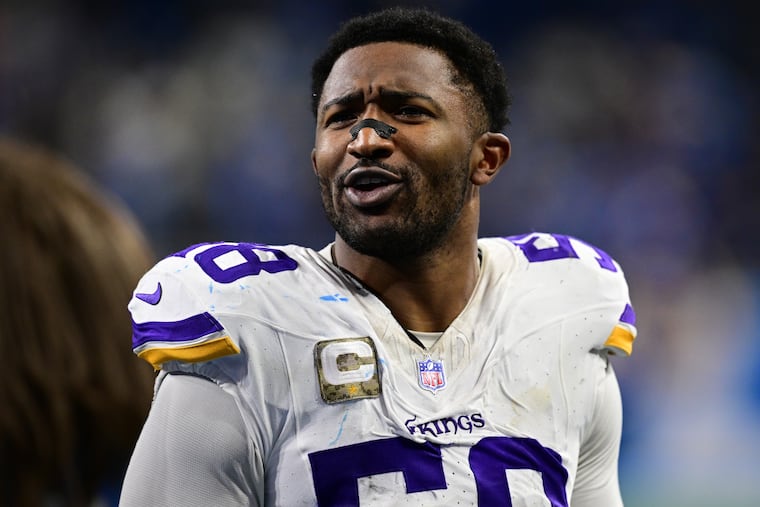
But the selections of wide receiver Makai Lemon, and especially tight end Eli Stowers and tackle Markel Bell on Day 2, were overshadowed by a trade for a defensive player who should have more of an immediate impact on next season than the rookie trio: edge rusher Jonathan Greenard.
While the acquisition of Greenard didn’t produce the shock or awe of Howie Roseman’s stunning Day 1 trade for A.J. Brown four drafts ago — the deal with the Minnesota Vikings had been in the works for weeks — it did similarly address a glaring need with a known commodity.
“Obviously, [we’re] always looking to improve our pass rush, to improve our lines,” Roseman said on Friday night. “He’s one of six guys that’s had 12 or more sacks two of the last three years. Just a really fun guy to watch, a guy that we’ve been studying for a long time.”
» READ MORE: Eagles obtain Vikings edge rusher Jonathan Greenard in draft-day trade
Two years ago, the Eagles had interest in signing Greenard as a free agent. But they signed Bryce Huff instead, and Greenard went to Minnesota. The Eagles managed to win a Super Bowl despite the lack of contributions from Huff, who was shipped off to the San Francisco 49ers last offseason.
But getting Greenard in exchange for two third-round picks — the No. 98 overall pick this year and a future one next year — can be viewed as a correction of sorts. It came with a cost beyond the draft capital. The Eagles signed the outside linebacker to a four-year, $100 million contract extension with $50 million guaranteed.
That’s a chunk of change for a soon-to-be 29-year-old. But it’s $5 million less per year than the amount Jaelan Phillips received last month after the Carolina Panthers outbid the Eagles following what proved to be a half-season rental. (The Eagles should get the third-rounder they sent to the Miami Dolphins ahead of the trade deadline as compensation in the 2027 draft.)
Phillips is two years younger than Greenard, but he doesn’t have his production. In 2023 and 2024, Greenard had 12½ and 12 sacks for the Houston Texans and Vikings, respectively, although he had just three sacks in 12 games last season.
Sacks are hardly the lone metric for measuring edge rusher success. Greenard’s pressure rate in 2025 (15.4%) was actually better than it was in 2024 (13.4%). But the Vikings still felt he was expendable, even if his contract demands and their salary cap situation helped lead to his departure.
“What you see is a relentless player with physical tools,” Roseman said. “He can win in multiple ways. He’s hard to block. I know when we play Minnesota, we are worried about where he is at all times.”
Greenard got his raise in Philly, going from $19 million to $25 million per year, but he’s currently only the 15th highest-paid edge rusher in the NFL, and he’s making half the amount in yearly salary that the Texans’ Will Anderson recently signed for to set the market at the position.
The more pertinent question when it comes to Greenard’s deal — and pending details should provide a clearer picture — is how it affects Nolan Smith and Jalyx Hunt. If either had developed into a No. 1 edge rusher, there never would have been a need to trade for Phillips or Greenard.
That isn’t a criticism. Both have shown promise. But they may not project as top-line defenders. Smith’s first-round draft stock, meanwhile, makes his future more uncertain than that of Hunt, who was drafted a year later in the third round.
Hunt also had more production last season and has been more durable. Both are on the smaller side, but Smith has had shoulder and triceps injuries that have plagued him through his first three seasons. He is eligible for an extension this offseason, but the Eagles are likely more inclined to just pick up his fifth-year option at around $14 million next week.
Roseman, for the record, said that Greenard’s contract doesn’t preclude the Eagles from extending Smith, or Hunt when he’s eligible next offseason. But can they eventually do both?
“That was a lot of the conversations and a lot of the things that we were talking about here in the last couple weeks,” Roseman said. “Ensuring that we’re still going to have the flexibility to sign our young players on defense.”
Defensive tackle Jalen Carter is also slated to have his fifth-year option at around $27 million exercised next week, but that may merely be a placeholder until the Eagles extend their 2023 top pick ahead of the season.
Stowers powers
While the Lemon selection came as a minor shock, partly because many had expected the Eagles to draft a tackle in the first round, and also because he had dropped within striking range, Stowers was slotted to Philly in many mock drafts.
As were many other tight end prospects, including Kenyon Sadiq, in the first round. But the second round had more depth at the position and that’s where Roseman plucked Stowers — with the No. 54 overall pick.
The Vanderbilt product was the second tight end to go off the board after Sadiq went to the Jets at No. 16. But Stowers went just ahead of Texas A&M’s Nate Boerkircher (No. 56), Michigan’s Marlin Klein (No. 59), and Ohio State’s Max Klare (No. 61).
Only time will tell if the Eagles chose the right guy, but Stowers may have the greatest upside of any in the group, having played the position for only two full seasons after switching from quarterback early in his collegiate career.
“I think it’s exciting that he has only played the position for a short time,” Eagles coach Nick Sirianni said. “We’ve done a ton of homework on the guy, obviously. Great character guy. High football IQ having played quarterback. Those guys continue to develop, and excited to work with him because he’s got a lot of room to improve.”
Stowers tested off the charts at the combine. Only Sadiq ran a faster 40-yard dash among tight ends — 4.39 seconds vs. 4.51. But Stowers had the best vertical jump (45½ inches) and broad jump (135 inches) — athletic traits that showed up consistently on film.
Despite his relative inexperience, he caught 111 passes for 1,407 yards and nine touchdowns in two full seasons at tight end.
“Moving to a new position, pretty much everything is new to me,” Stowers said during a video interview. “There are some things that came a little more natural to me like just being an athlete. … Whether it was natural, whether it wasn’t, I want to continue to get better at my game and continue to grow.”
» READ MORE: Beyond the grade: 360-degree analysis of Eagles Day 2 picks Eli Stowers and Markel Bell
He should be given time to develop with Dallas Goedert returning for a ninth season. The Eagles also signed blocking tight end Johnny Mundt and brought back reserve Grant Calcaterra. All three are on one-year contracts, which is why it seemed unlikely the Eagles would exit the draft without getting a tight end.
Some draft analysts expected the Eagles to draft a hybrid tight end after the change to the Shanahan scheme. Roseman had issued a mea culpa in February about leaning too heavily on receiving tight ends.
But the addition of Mundt addressed the need and Goedert has shown — if not as much last season — that he can block when invested. Stowers did his share of run blocking in college — about one-third of his snaps. Did he thrive at it? Not quite, but he was more than willing and should improve with coaching.
“Anything that a tight end does at the NFL level,” Stowers said, “that’s something I want to continue to get better at.”
He’s on the smaller side at 6-foot-4, 239 pounds. But he’ll have a significant size advantage matched up against safeties and cornerbacks, and considering his speed, that’s mostly who he’ll face in man coverage.
The Eagles had previous success with second-round tight ends: Zach Ertz in 2013 and Goedert in 2018. In each case, neither was forced into a prominent role, with existing starters Brent Celek and Ertz in place.
Stowers doesn’t have as much experience at the position as those predecessors. But he could be utilized almost immediately. Either way, Stowers, along with Lemon, project as faces of the future.