How former Eagle Malcolm Jenkins saw himself in the art of a Baltimore artist
A Jerrell Gibbs painting from former NFL star's art collection has now travelled from Jenkins' Louisiana home to Brandywine.
During a visit to Manhattan’s James Cohan Gallery back in 2024, former Philadelphia Eagles safety Malcolm Jenkins was entranced by a painting.
He was about to leave the gallery when the artwork, still unhung, leaning discreetly against the venue’s walls, stopped him in his tracks.
The painting was of a Black man in a blue jacket, sitting with his head bowed in front of a record player, listening to a record from the collection lining the wall behind him. There was also an image of a small child in the painting, mirroring the pose and musical interests of the older man, who is also the artist.
The painting, titled Like Father, Like Son, reminded Jenkins of how quickly influence moves from one generation to the next. He recognized himself both in the father and the son.
“It’s cool how stories are transferable, especially Black stories,” Jenkins said. “And they can help us articulate our experiences, even without them being ours.”
Jenkins thought about the habits, morals, thoughts, and anxieties he has inherited from his father, and the ones he’s passed down to his children.
“Within the work is a universal language, like love, memory, and being present,” said Jenkins, a father of two daughters.
Jenkins bought the painting and added it to his ever-expanding art collection. “I knew as soon as I saw it where I wanted to put it [in my collection],” he said.
For the past year, that painting by Baltimore-based artist Jerrell Gibbs has hung on a wall of Jenkins’ Louisiana home, opposite portraits of his grandfathers and his own vinyl collection.
But now Like Father, Like Son has traveled to the Brandywine Museum of Art, to be at the center of Gibbs’ first solo exhibition.
Childhood memories and family archives
The “Jerrell Gibbs: No Solace in the Shade” exhibit is a survey of Gibbs’ first 10 years as an artist. The large-scale paintings explore the varying layers of Black life in America, with Gibbs often integrating elements from everyday conversations and shared memories of his friends, family, and community.
Gibbs’ paintings are composites of his childhood memories growing up in Baltimore. He often uses photos from his family archive as creative frameworks, to find links between his past and present.
“That’s the only way I can be most authentic and honest,” Gibbs said. “When you see and experience my work, up close, and in real life, there’s an emotional connection that you get. I can’t access that and put it into a painting if I haven’t lived the experience. It has to be real to me ... so I can infuse the painting with the emotion of the moment. That way, viewers can experience it as well.”
These artistic choices, Gibbs said, are chosen to highlight the similarities humanity shares, despite people’s varying experiences and social environments.
“His work is one that didn’t take much explanation for me to understand because it’s so recognizable from an experience standpoint,” Jenkins said. “Once you understand who [Gibbs] is, and what his practice is, it’s extremely personal and so universal. To me, it’s the power of storytelling.”
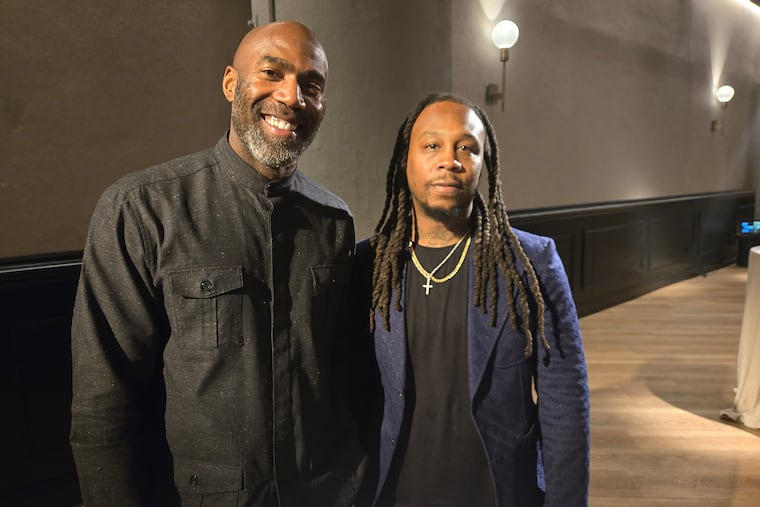
Jenkins, who has added art collecting to his assortment of interests postretirement, typically meets with artists before collecting their work. But it wasn’t until weeks after Gibbs’ exhibition opened at the Brandywine that the two men met in person at an event at the Fitler Club last month. Jenkins and Gibbs shared how Like Father, Like Son managed to connect two men of very different worlds.
But, as the event uncovered, they learned their experiences weren’t too dissimilar, either.
Coming back to art
Like Jenkins, Gibbs was a lifelong athlete with artistic interests. He started drawing at age 7 after his father was murdered. It helped him cope with the devastating loss. Believing there wasn’t a realistic path for him to become a successful artist, he veered away from his artistic pursuits as a teen.
“I naturally gravitated to drawing because it was something I was good at,” Gibbs said. “But at a point, I left it alone because I didn’t really have support from my family, community, or friends at the time. That’s not to say anything bad about them. It’s just the fact that your perception is your reality. During that time, being a successful Black artist wasn’t really a thing [for me].”
His NFL dreams ended at the collegiate level, and the pressures of providing for his wife and daughter soon took over. It would be another decade before Gibbs would revisit his passion for art.
One night, he grabbed a picture of his wife and daughter and sketched it. He took a photograph of it and sent it to his wife.
“She said, ‘I didn’t even know you could draw.’ And to be completely honest, I forgot I could draw too,” Gibbs said.
The following Father’s Day, Gibbs’ wife, Sheila Odom-Gibbs, gave him an easel and a painting kit. He went on to attend Maryland Institute College of Art and has poured all his time into his art ever since.
His works are now part of collections at the Baltimore Museum of Art, the Los Angeles Museum of Art, and the X Museum in Beijing, China, among other arts spaces throughout the world.
Collecting for the community
Jenkins, a two-time Super Bowl winner and Piscataway, N.J., native, grew up with his aunt Cynthia Vaughn’s paintings adorning the walls of his family home. He has also explored artistic mediums of his own, including poetry, essays, and photography.
Since retiring in 2022, he has been intentional about attending more exhibitions, connecting with artists, and championing their works as a form of community engagement.
“Collecting is both a personal mission, but it’s also one that is for the community,” Jenkins said. “When we look at the things that are being erased, and what things get archived, it’s usually not stories of our own, especially not the ones [Gibbs] is bringing. I think getting more people exposed to those stories, getting more Black people collecting and into museums, is a part of my activism.”
“To hear Gibbs talk about pulling material from family photos, how it comes from losing his father, and how he wants to make people appreciate the mundane aspects of family life and community, is an important message to me,” Jenkins said.
“Jerrell Gibbs: No Solace in the Shade” runs through March 1, 2026, at the Brandywine Museum of Art.
For more information on the show and other exhibition-related programs, visit brandywine.org.